
A surface plate is more than just a flat piece of granite; it’s the foundation for precision measurement in many industries. Its accuracy directly impacts the quality of manufactured goods, making proper surface plate care staff training absolutely essential.
These precision instruments require consistent, knowledgeable attention to maintain their critical flatness and extend their working lifespan. Without proper granite plate handling education, even minor misuse can compromise the plate’s integrity. Ensuring every team member understands their role in preserving this standard is a direct investment in measurement reliability.
Think of it this way: a surface plate is only as good as the people using it. Even the best calibration standards will degrade if staff don’t follow established protocols for cleaning, inspection, and usage. Effective surface plate care staff training builds a culture of precision that permeates every aspect of your operations.
Why Comprehensive Staff Training is Essential for Surface Plates
Surface plates are expensive, specialized tools, and their accuracy is essential for quality control. Without proper surface plate care staff training, you risk not only damaging the plate but also generating inaccurate measurement data. This can lead to product defects, costly reworks, and even customer dissatisfaction.
A poorly maintained surface plate can introduce significant errors into your measurement process. These errors accumulate, making it impossible to trust the readings from your instruments or the parts being inspected. Effective granite plate handling education is a frontline defense against these kinds of hidden costs.
Investing in thorough precision measurement training for your team protects your capital investment in metrology equipment. It prevents premature wear, chipping, and contamination that can necessitate expensive repairs or replacements. You simply cannot afford to leave the care of such critical assets to chance.
Consistent training reduces variability in how different operators use and maintain the plates. This standardization is key to achieving repeatable and reproducible measurement results across shifts and personnel. Everyone needs to be on the same page regarding best practices.
It also fosters a sense of ownership among employees, as they recognize their direct impact on overall product quality. This personal investment often leads to greater vigilance and adherence to established protocols. A sense of pride in maintaining precision equipment is invaluable.
Finally, a well-trained team instills confidence in your measurement capabilities. It demonstrates a commitment to quality that extends from the shop floor all the way to your final product. This level of dedication makes a real difference in competitive markets.
Key Areas to Cover in Surface Plate Care Training
Effective surface plate care staff training must cover a broad range of topics to ensure full competency. It needs to go beyond just the basics, embedding a deep understanding of the equipment’s sensitivities. This approach ensures staff can anticipate potential problems before they arise.
One primary area is the physical handling of the granite plate itself. Moving these heavy, delicate calibration standards improperly can cause cracks or damage to the precision surface. Staff must learn appropriate lifting techniques and the use of specialized moving equipment.
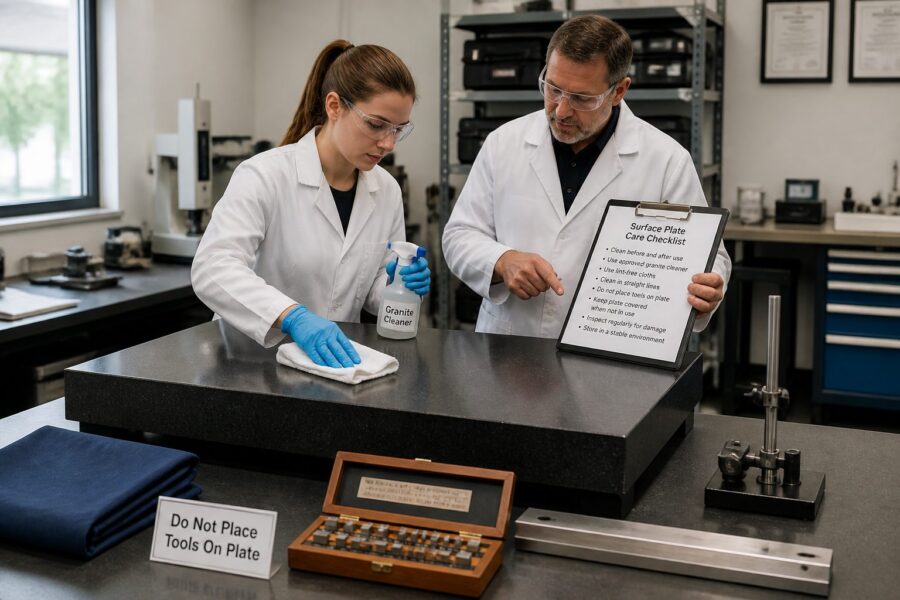
Another important component is the correct cleaning procedure for the plate. Using the wrong cleaning agents or abrasive materials can permanently etch or scratch the surface, compromising its flatness. Only approved cleaning solutions and methods should ever be employed.
Understanding the proper placement and use of measuring instruments on the plate is also essential. Dropping tools, dragging heavy parts, or concentrating loads in one area can cause localized wear or even temporary deflection. Training should emphasize gentle handling and even distribution of weight.
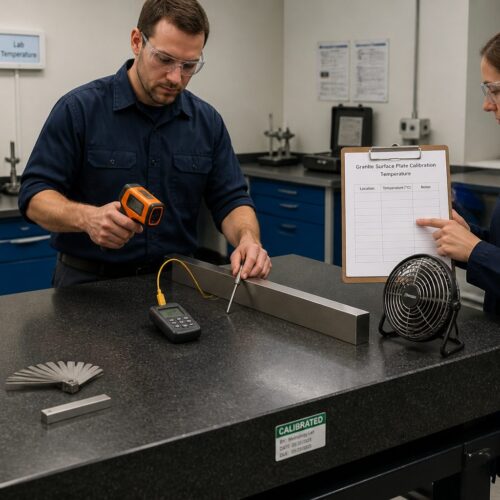
Environmental factors also play a large role in a surface plate’s longevity and accuracy. Staff need to understand how temperature fluctuations, humidity, and airborne contaminants affect the plate. They must learn about proper storage covers and climate control considerations.
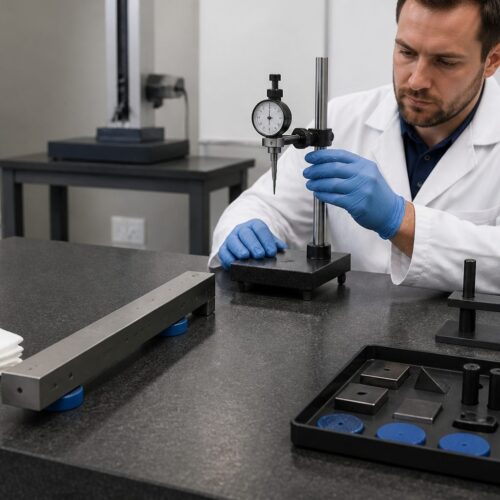
Training should also detail the safe use of accessories like gauge blocks, height gauges, and bore gauges on the surface plate. Improper use or storage of these tools can inadvertently scratch or damage the precision surface. Every tool that touches the plate needs careful consideration.
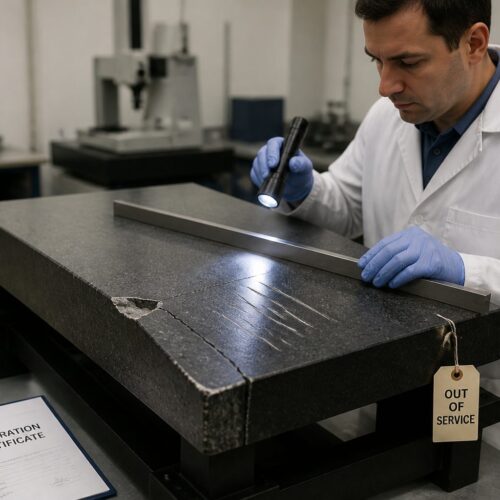
Finally, routine inspection and reporting of any damage or wear are important. Staff should know how to identify chips, scratches, or signs of uneven wear. Prompt reporting allows for timely professional inspection and recalibration when needed.
Developing a Standard Operating Procedure (SOP) for Use and Care
A well-defined Standard Operating Procedure (SOP) provides a clear roadmap for all surface plate care staff training. This document removes ambiguity and ensures consistency across all operators and shifts. Everyone should know exactly what steps to follow for routine maintenance and proper usage.
Your SOP for metrology equipment should cover everything from daily cleaning to annual calibration scheduling. It acts as a comprehensive metrology equipment user guide, leaving no room for guesswork. This document becomes the backbone of your precision measurement training program.
| Procedure Category | Key Actions | Frequency |
|---|---|---|
| Daily Cleaning | Wipe down with approved cleaner, cover after use | End of each shift/use |
| Instrument Placement | Avoid dropping tools, distribute load evenly | Every use |
| Environmental Control | Monitor temperature/humidity, keep area dust-free | Continuously |
| Damage Inspection | Visually check for chips, scratches, wear spots | Weekly/Before critical use |
| Movement & Handling | Use proper lifting equipment, avoid dragging | As needed |
| Reporting Issues | Document any damage, contact supervisor | Immediately upon discovery |
Practical Hands-On Training: What to Teach and How
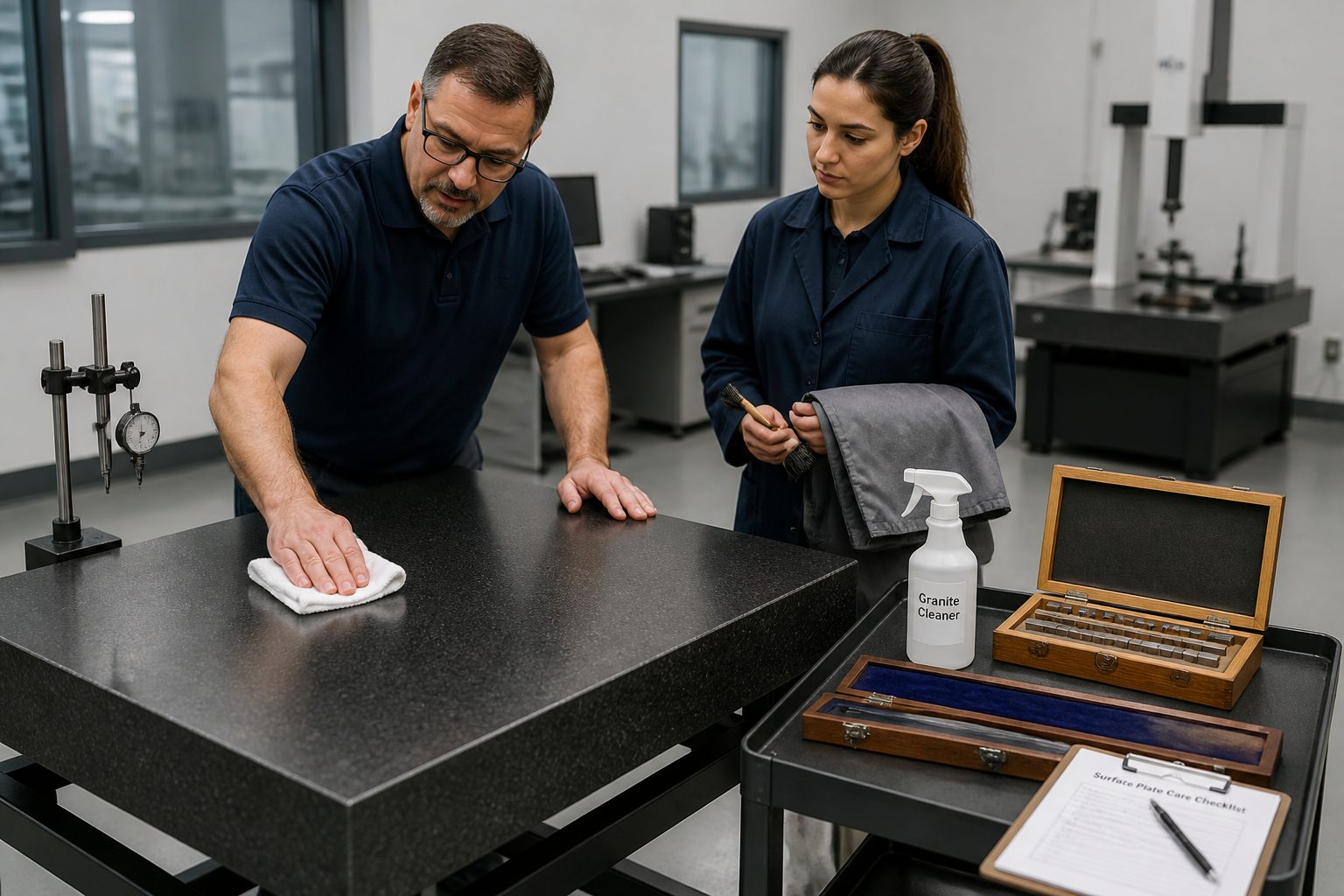
Theoretical knowledge is a good start, but practical hands-on training truly cements proper surface plate care. Staff learn best by doing, especially when it comes to delicate equipment like granite calibration standards. This approach builds muscle memory and confidence.
Start with demonstrating the correct cleaning process, then have each trainee perform it under supervision. Show them which cleaning solutions are appropriate and how to apply them without damaging the surface. This direct practice is far more effective than just reading instructions.
Next, focus on instrument handling and placement. Teach them how to gently place micrometers, height gauges, and other tools without impact. Emphasize the importance of not dragging parts or tools across the precision surface, which can cause wear.
Demonstrate how to properly cover the surface plate when not in use, protecting it from dust and environmental changes. Explain the different types of covers and their specific benefits. This simple step can significantly extend the plate’s lifespan.
Allow trainees to practice moving smaller, less critical plates using approved techniques and equipment. This builds their comfort level before they handle your primary, larger calibration standards. Supervised repetition helps solidify correct procedures.
Include exercises where trainees correctly position workpieces and measurement devices to minimize measurement uncertainty. This involves understanding contact points and avoiding excessive pressure. Precision measurement training requires a delicate touch.
Finally, incorporate exercises where trainees identify potential damage or improper usage scenarios. This helps them develop an eye for detail and reinforces the importance of vigilance. Active problem-solving improves their understanding and retention.
Emphasizing the “Why” Behind Each Care Practice
Simply telling staff what to do is not enough; they need to understand the “why” behind each surface plate care practice. Explaining the consequences of improper handling fosters a deeper appreciation for these delicate instruments. This understanding turns compliance into genuine commitment.
When staff grasp that a small scratch can compromise a measurement by microns, they approach the plate with greater respect. They realize that their actions directly impact the accuracy of every product passing through quality control. This connection makes precision measurement training far more impactful.
For instance, explain how even slight temperature fluctuations can cause the granite to expand or contract. This change directly affects the plate’s flatness, leading to inaccurate readings. Understanding this scientific principle motivates staff to maintain stable environmental conditions.
Similarly, illustrate how abrasive cleaning agents can slowly erode the lapped surface over time. This erosion degrades the plate’s important flatness, necessitating expensive regrinding or replacement. Knowing the long-term effects encourages adherence to approved cleaning methods.
Discuss how concentrated loads or dragging heavy components can cause localized wear spots. These worn areas create inconsistencies across the plate, making it unreliable for precise measurements. Connecting actions to consequences is powerful for learning.
Explain that proper granite plate handling education extends the life of the asset, delaying costly replacement or recalibration. This financial perspective often resonates strongly with employees. They see their efforts contributing to the company’s bottom line.
When staff understand the rationale, they are more likely to internalize the procedures and act as advocates for proper care. This deeper comprehension promotes a sense of ownership over the metrology equipment. It moves beyond rote memorization to genuine understanding.
Documenting Training and Ensuring Compliance
Documenting all surface plate care staff training is non-negotiable for accountability and compliance. This record provides proof that your team has received the necessary metrology equipment user guide information. It also helps track individual progress and identify areas for improvement.
Maintain detailed logs of who attended which training sessions, along with the topics covered and successful completion dates. These records are essential for internal audits and external certifications. Proper documentation is a cornerstone of any robust quality system.
- Record attendance for all training sessions
- Document successful completion of practical assessments
- Note any refreshers or advanced training modules
- Track individual certification expiry dates
- Maintain copies of signed training acknowledgments
- File all training materials and SOP versions
- Log any incidents related to improper surface plate handling
Regular Refreshers and Advanced Training Modules
Initial surface plate care staff training is just the beginning; regular refreshers are a must. Knowledge fades over time, and bad habits can creep in without periodic reinforcement. Keep your team sharp and committed to precision measurement training.
Schedule annual or bi-annual refresher courses to review core concepts and update staff on any new procedures or equipment. These sessions offer a chance to address common mistakes that might have emerged. They also provide a forum for questions and discussions.
Consider introducing advanced training modules for experienced personnel or those taking on supervisory roles. These modules could cover topics like basic troubleshooting, environmental monitoring, or advanced calibration standards maintenance. This deepens expertise within your team.
New employees especially benefit from a structured onboarding process that includes immediate granite plate handling education. Don’t assume prior experience; ensure everyone starts with the same foundational knowledge. This prevents the spread of incorrect practices from the outset.
These ongoing training efforts demonstrate a long-term commitment to quality and continuous improvement. They help maintain a high standard of care for your metrology equipment. Consistent education is an investment that pays dividends in accuracy and longevity.
Regular refreshers also offer an opportunity to discuss real-world scenarios or incidents that occurred on the shop floor. Analyzing these situations helps reinforce best practices and prevent future recurrences. Learning from experience is a powerful teaching tool.
Implement a system for annual recertification to ensure that all operators remain proficient in surface plate care. This formal process underscores the importance of continuous learning and adherence to standards. It keeps everyone accountable.
Creating a Culture of Responsibility and Precision
Effective surface plate care staff training does more than just impart skills; it builds a culture. It fosters an environment where responsibility for precision measurement is shared by everyone. This collective ownership transforms individual tasks into a team commitment.
Encourage open communication where staff feel comfortable reporting concerns or asking questions about surface plate care. A blame-free environment promotes learning and proactive problem-solving. This transparency strengthens your overall quality system.
Recognize and reward employees who consistently demonstrate excellent surface plate care and attention to detail. Positive reinforcement encourages desired behaviors and sets a high standard for others. Public acknowledgment can be a powerful motivator.
Integrate discussions about the impact of surface plate accuracy on product quality and customer satisfaction into daily briefings. Connect their specific actions to the broader success of the company. This helps staff see the bigger picture.
Appoint “surface plate champions” or lead operators who can serve as internal experts and mentors. These individuals can provide on-the-spot guidance and reinforce best practices. They become valuable resources for their colleagues.
This cultural shift starts with strong leadership that models the desired behaviors and values precision. When management actively participates in or champions granite plate handling education, staff take it more seriously. Their involvement sets the tone for the entire organization.
When everyone understands the importance of granite plate handling education and takes pride in their role, the collective standard of care rises. This culture of precision becomes a competitive advantage. It ensures your metrology equipment consistently delivers reliable results.
Addressing Common Misconceptions and Bad Habits
Surface plate care staff training must actively address and correct common misconceptions and ingrained bad habits. Many operators might unknowingly adopt practices that compromise the plate’s accuracy over time. Direct intervention is necessary to break these cycles.
One common misconception is that granite is indestructible and can withstand heavy impacts or rough handling. While durable, granite is brittle and susceptible to chipping and cracking, especially on its precision edges. Explain the material’s true nature to dispel this myth.
Another bad habit is dragging heavy parts or tools across the plate instead of lifting them. This causes abrasive wear, creating grooves or uneven spots that destroy flatness. Emphasize proper lifting techniques every single time.
Some staff might use unapproved cleaning agents, thinking “any cleaner will do” for metrology equipment. These harsh chemicals can leave residues or even react with the granite, leading to surface degradation. Reinforce the use of only manufacturer-recommended solutions.
Another issue is the improper storage of the plate, such as leaving it uncovered or in areas with fluctuating temperatures. This exposes it to dust, debris, and thermal expansion/contraction. Stress the importance of covering the plate when not in use.
Many operators might also neglect regular visual inspections, assuming the plate is fine until a measurement issue arises. Teach them to proactively check for small chips or scratches. Early detection prevents minor issues from becoming major problems.
It’s also common for staff to think that slight wear on one part of the plate doesn’t matter much. Explain that accuracy is uniform across the entire surface. Any deviation affects the reliability of all measurements.
Address the idea that minor chips or scratches can be “fixed” with makeshift solutions. Only professional re-lapping by certified technicians can restore a damaged surface plate to its original accuracy. Discourage any attempts at DIY repairs.
The Link Between Training and Measurement Reliability
The direct correlation between comprehensive surface plate care staff training and measurement reliability cannot be overstated. A well-trained team is the strongest safeguard against inaccurate data and costly errors. This link forms the core argument for investing in ongoing education.
When staff consistently follow correct procedures for cleaning, handling, and environmental control, the surface plate maintains its calibrated accuracy for longer. This consistency translates directly into more trustworthy measurements for your products. You can have confidence in your quality control data.
Conversely, a lack of granite plate handling education introduces variables that degrade the plate’s performance. These uncontrolled factors create uncertainty in your measurements, making it difficult to detect true product deviations. Unreliable measurements lead to unreliable products.
Precision measurement training ensures that every operator understands the nuances of using sensitive metrology equipment. They learn how to minimize their own influence on the measurement process, reducing human error. This standardization improves repeatability.
Think about the chain of quality: it starts with accurate calibration standards like your surface plate. If that foundation is compromised by improper care, every subsequent measurement is suspect. Training strengthens this entire chain.
It also fosters an environment where potential issues are identified and reported quickly. Early intervention in cases of damage or misuse can prevent more severe, expensive problems down the line. This proactive approach saves both time and money.
Finally, your commitment to surface plate care staff training speaks volumes about your dedication to product quality. It’s a proactive step that minimizes risks, optimizes equipment lifespan, and solidifies your reputation for precision. This investment pays off in tangible results.
Conclusion
Effective surface plate care staff training is not an optional extra; it’s a fundamental requirement for any organization relying on precision measurement. It protects your valuable metrology equipment, ensures the integrity of your data, and upholds your commitment to quality. Without it, you are simply leaving too much to chance.
Investing in thorough granite plate handling education empowers your team with the knowledge and skills they need to preserve these critical calibration standards. This ongoing precision measurement training fosters a culture of responsibility and continuous improvement. It’s a smart business decision that yields significant returns.
By implementing comprehensive training programs, developing clear SOPs, and emphasizing the “why” behind each practice, you build a robust system. This system guarantees your surface plates remain reliable foundations for accurate measurements, day in and day out. Prioritizing proper care and education is the clearest path to sustained precision.