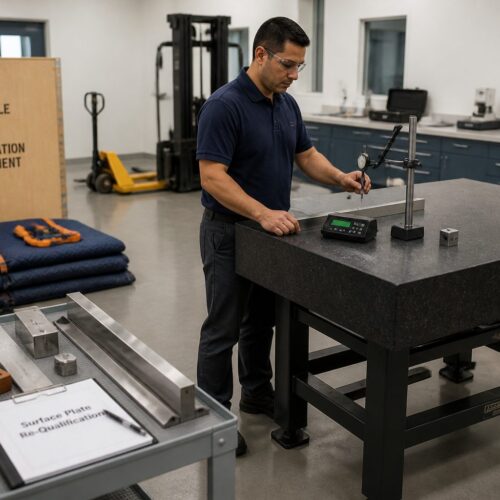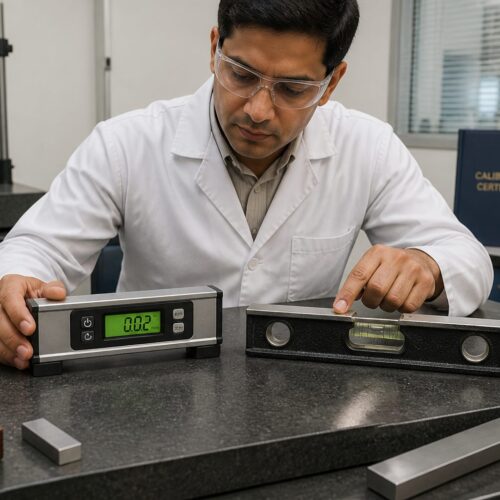

Maintaining the accuracy of your surface plate is essential for any precision measurement task. Regular calibration ensures your plate meets specified flatness tolerances, but what happens in between those scheduled services? A quick surface plate repeatability test can give you confidence in your measurements every day.
This simple check helps you monitor the stability of your plate and its immediate environment. It is a vital step in maintaining quality control and preventing costly measurement errors. Understanding how to perform a basic surface plate repeatability test empowers you to catch potential issues early.
You do not need specialized equipment beyond what many shops already possess for this practical spot check method. We will walk through the process, explain what your results mean, and discuss how to keep your metrology operations running smoothly.
What Repeatability Is (and What It Is Not)
Repeatability, in the context of a surface plate, refers to the ability to get the same measurement result multiple times at the same location. It means your measurement system consistently yields similar readings under identical conditions. A good surface plate repeatability test shows minimal variation between successive readings.
This concept is distinct from accuracy, which describes how close a measurement is to the true value. Your plate might be highly repeatable, always giving the same reading, but that reading could still be far from the actual dimension if the plate itself is out of calibration. Repeatability focuses on the consistency of the measurement process itself.
Think of it this way: a target shooter might hit the same spot every time, but if that spot is not the bullseye, they are repeatable but not accurate. For surface plates, high repeatability indicates a stable measurement platform. A precise `gage repeatability` study often includes an appraiser component, but our `spot check method` focuses solely on the plate’s inherent consistency.
Poor repeatability suggests issues with your setup, the plate’s stability, or environmental factors. It tells you something in your measurement process is inconsistent. This inconsistency can lead to unpredictable results, even if your plate was recently calibrated for flatness.
Understanding this difference is crucial for effective metrology. A `surface plate repeatability test` helps you maintain confidence in your measurements day-to-day. It is a quick diagnostic, not a full flatness calibration, but it offers valuable insight into your operational stability.

Tools You Need for a Repeatability Spot Check
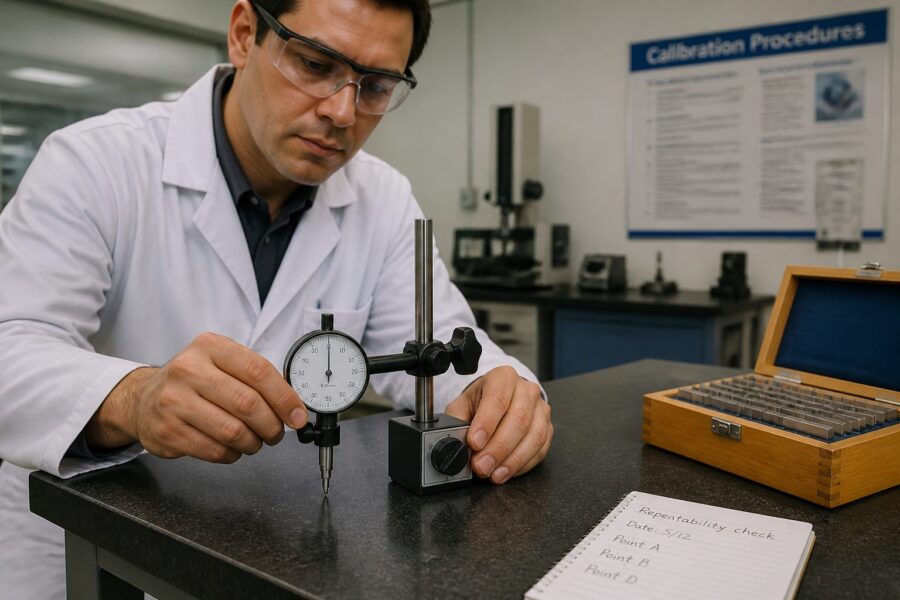
Performing a `repeat reading gage` test requires a few common metrology tools. Most shops already have these items on hand, making a quick `spot check method` easy to implement. You will need a reliable indicator and a stable stand.
A good quality electronic or dial indicator with 0.00005″ or 0.001mm resolution is ideal for this `surface plate repeatability test`. The indicator needs to be mounted on a heavy, stable stand that will not tip or shift during measurements. Your choice of indicator and stand directly impacts the reliability of your readings.
| Tool | Description | Key Feature for Repeatability |
|---|---|---|
| Electronic or Dial Indicator | High-precision instrument for measuring small distances. | 0.00005″ / 0.001mm resolution or better. |
| Indicator Stand | Heavy, stable base with adjustable arm for indicator. | Solid, non-tipping design; fine adjustment capability. |
| Cleaning Supplies | Denatured alcohol or approved surface plate cleaner, lint-free cloths. | Ensures a perfectly clean measurement surface. |
| Temperature Monitor | Thermometer for ambient air and plate surface. | Helps identify thermal instability. |
Choosing Test Locations Without Bias
Selecting the right test locations for your `surface plate repeatability test` is more important than you might think. Randomly picking spots can give you a false sense of security or lead to misleading results. A structured approach ensures your `spot check method` is truly informative.
You should choose locations that represent the areas where you typically perform critical measurements. If you always use the center of the plate, then focus your repeatability check there. However, it is also smart to include corners and edges, as these spots can reveal different types of plate instability.
A common strategy involves creating a grid pattern across your plate. This grid does not need to be exhaustive, but it should cover the major quadrants. Mark these points lightly with a pencil or use small, non-marring stickers to ensure you return to the exact same spot for each reading.
Avoid choosing points that are already known to be problematic, unless your goal is specifically to monitor a known issue. The idea is to get a general sense of the plate’s consistent behavior. We want to detect new issues, not just confirm old ones.
Consider the typical size of parts you measure. If you work with large components, your test points should be spread out to cover that working envelope. For smaller parts, a tighter cluster of points might be more appropriate, but still include some peripheral areas. This thoughtful selection of points makes your `repeat reading gage` data more relevant to your daily operations.
Step-by-Step Repeatability Test Procedure
Executing a `surface plate repeatability test` correctly involves careful preparation and consistent technique. Rushing through the steps can introduce errors, making your results unreliable. Take your time and follow these instructions precisely for the best data.
First, thoroughly clean your surface plate using an approved granite cleaner and a lint-free cloth. Any dust or debris on the plate surface will significantly skew your readings. Ensure both the plate and the indicator stand base are spotless before you begin.
Position your indicator stand firmly on the surface plate, ensuring it is stable and will not move. Place the indicator tip directly over your first chosen test point. Make sure the indicator stem is perpendicular to the plate surface to minimize cosine error, which is crucial for accurate `gage repeatability` measurements.
Zero the indicator at this first point. Then, carefully lift the indicator stand a few inches off the plate and set it back down in the exact same spot. Take a reading. Repeat this lift-and-reset process at least five times for each test point, recording each individual reading. This repeated measurement at the same spot is the core of any `repeat reading gage` analysis.
Move the indicator stand to your next predetermined test point and repeat the entire process: zero, lift, reset, read, record. Continue this for all your chosen locations. Consistency in your handling of the indicator and stand is paramount throughout this `spot check method` procedure.
How to Record Results So They’re Useful Later
Collecting data from your `surface plate repeatability test` is only half the battle; recording it effectively makes it useful for long-term analysis. Haphazard notes will not help you identify trends or problems over time. A structured record-keeping approach is essential for any `repeat reading gage` program.
Create a simple log sheet or use a spreadsheet to capture all relevant information. This includes the date, time, ambient temperature, and the specific test points you measured. Clearly label each reading for easy reference later on.
- Date and time of test
- Ambient room temperature
- Surface plate temperature
- Specific test point identification (e.g., “Center,” “Front-Left”)
- All individual readings for each point (e.g., 5 readings per point)
- Average reading for each point
- Range of readings for each point (Max – Min)
- Name of the person performing the test
- Indicator serial number used
What Good Repeatability Looks Like for Your Work
Understanding what constitutes “good” repeatability depends heavily on your specific application and the tolerances you work with. There is no universal standard, but general guidelines help interpret your `surface plate repeatability test` results. Your shop’s precision requirements dictate acceptable variation.
For most precision measurement tasks, a `gage repeatability` range of less than 0.00005″ (0.001mm) at any single point is excellent. This means that when you lift and reset your indicator multiple times, all readings fall within this tight window. Such consistency indicates a very stable measurement setup.
If your application demands extreme precision, like in aerospace or semiconductor manufacturing, you might aim for even tighter repeatability, perhaps within 0.00002″ (0.0005mm). The key is that your repeatability range should be a small fraction of the smallest tolerance you measure. You want your measurement uncertainty to be negligible compared to your part tolerances.
Conversely, if your `repeat reading gage` shows a variation of 0.0001″ (0.0025mm) or more at a single point, that is often a red flag. This level of inconsistency suggests a problem that could be affecting your measurements. Even if your parts have looser tolerances, such variation makes reliable measurement difficult.
Good repeatability gives you confidence that any variation in your part measurements is due to the part itself, not your measurement setup. It means your `spot check method` confirms a reliable foundation for all subsequent work. Consistent results from your `surface plate repeatability test` are a sign of a healthy metrology environment.
Common Causes of Poor Repeatability
When your `surface plate repeatability test` shows inconsistent readings, several factors could be at play. Identifying the root cause is the first step toward resolving the issue and restoring confidence in your measurements. Many problems are surprisingly simple to fix.
One of the most common culprits is dirt or debris. Even a tiny particle between the indicator stand base and the surface plate can throw off readings significantly. A speck of dust or a machining chip can prevent the stand from seating consistently, causing your `repeat reading gage` to show wide variations.
Environmental factors also play a large role. Temperature fluctuations can cause both the granite plate and your indicator stand to expand or contract. Drafts from open doors or HVAC systems can create localized temperature differences, leading to unstable readings during a `gage repeatability` check. Vibration from nearby machinery or foot traffic is another frequent cause of poor repeatability.
Issues with your indicator or stand can also be responsible. A loose indicator mount, a sticky indicator spindle, or a stand that is not heavy enough to be stable can all lead to inconsistent results. Worn or damaged contact points on the indicator can also be a factor, so inspect your equipment carefully.
Finally, operator technique can affect `gage repeatability`. Inconsistent pressure when placing the stand, slightly different angles of approach, or even breathing heavily near the indicator can introduce variability. Ensuring a consistent, gentle touch is essential for accurate `spot check method` results.
Quick Fixes You Can Try Before Calling for Service
Before you panic about a bad `surface plate repeatability test` result, try some simple troubleshooting steps. Many repeatability issues have quick and easy solutions that do not require professional service. You might resolve the problem yourself with a little care.
First, give everything a thorough cleaning. Wipe down the entire surface plate, paying close attention to your test areas, using an approved cleaner and a lint-free cloth. Clean the base of your indicator stand as well; even a tiny film can cause inconsistencies. This simple step often dramatically improves `gage repeatability`.
Next, check your environment. Close doors and windows to eliminate drafts, and try to perform your `repeat reading gage` test when nearby machinery is not running. Give the plate and indicator time to normalize to the room temperature, especially if they have been moved or the temperature has changed recently. Stabilizing the environment often fixes fluctuations.
Inspect your indicator and stand for any obvious problems. Make sure the indicator is securely mounted and its movement is smooth and free. Check that the stand is stable and all its locking mechanisms are tight. Sometimes, simply tightening a screw on the stand can restore excellent repeatability.
Review your technique. Practice placing the indicator stand gently and consistently, ensuring the indicator stem is always perpendicular. Try having a different, experienced operator perform a `spot check method` to see if the issue persists; sometimes, a fresh pair of hands can identify subtle technique differences. These quick checks can save you time and money.
When a Repeatability Issue Signals Flatness Problems
While repeatability and flatness are distinct concepts, a severe or localized repeatability problem can sometimes hint at underlying flatness issues. A `surface plate repeatability test` primarily checks consistency, but extreme inconsistency might point to a deeper structural concern. It is important to know when to escalate your concerns.
If you observe poor `gage repeatability` consistently at specific points, but not others, this unevenness might be a clue. For example, if readings are wildly inconsistent only in one corner, it could suggest localized wear, damage, or even an issue with the plate’s support system. A full calibration would confirm or deny this suspicion.
A sudden, widespread drop in repeatability across the entire plate, particularly if accompanied by other signs of damage, is a serious concern. This might indicate the plate has suffered an impact or is experiencing significant thermal stress. In such cases, your `repeat reading gage` is sounding an alarm for more comprehensive inspection.
Remember that a `spot check method` is not designed to measure flatness directly. It cannot tell you if the plate is concave or convex overall. However, if your repeatability is so bad that you cannot even get consistent readings, it makes any flatness measurement impossible to trust. You cannot measure flatness reliably without first having good repeatability.
If you have tried all the quick fixes and still cannot achieve acceptable repeatability, especially if the issue is widespread or localized to a critical area, it is probably time to contact a professional calibration service. They can perform a full flatness calibration and diagnose any underlying issues with your surface plate. Do not ignore persistent poor `surface plate repeatability test` results.
Building a Simple Between-Calibration Schedule
Integrating a `surface plate repeatability test` into a regular schedule extends the life and reliability of your surface plate. Waiting for annual calibration to discover problems is a reactive and often costly approach. A proactive `spot check method` empowers you to stay ahead of issues.
How often you perform a `repeat reading gage` check depends on your usage frequency and precision requirements. For plates used daily in high-precision work, a weekly or bi-weekly check is a good idea. Less frequently used plates might only need a monthly or quarterly check.
Establish a routine that fits your workflow. For example, designate a specific day and time each week for the `gage repeatability` check. This consistency helps ensure the tests are not overlooked and become a standard part of your quality control process. Make it as habitual as cleaning your plate.
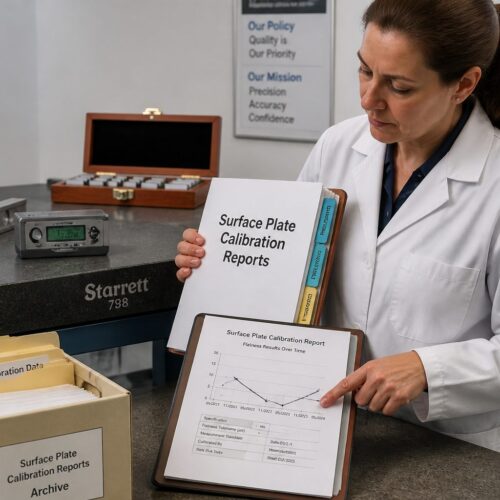
Keep a dedicated logbook or digital record of all your repeatability test results. This historical data is invaluable for identifying trends, detecting gradual degradation, and justifying professional calibration when needed. A good record helps you demonstrate due diligence in your metrology practices.
This between-calibration schedule does not replace professional calibration, but it complements it. It provides ongoing assurance that your plate remains a stable and reliable reference plane. Implementing a consistent `surface plate repeatability test` schedule is a small investment that yields big returns in measurement confidence and product quality.
Conclusion
A reliable surface plate is the cornerstone of accurate dimensional metrology. While professional calibrations are crucial, implementing a regular `surface plate repeatability test` provides ongoing peace of mind. This simple `spot check method` empowers you to monitor your plate’s stability between official services.
Understanding repeatability, knowing what tools to use, and following a clear procedure are essential for effective monitoring. Your ability to consistently get the same reading at the same spot is a fundamental indicator of your measurement system’s health. Do not underestimate the value of this basic check.
Recording your `repeat reading gage` results systematically builds a history for your plate, allowing you to spot trends and address issues proactively. Good repeatability means you can trust your measurements, ensuring product quality and avoiding costly errors. Bad repeatability, on the other hand, signals a problem you need to investigate.
Many common causes of poor `gage repeatability`, such as dirt, temperature fluctuations, or equipment issues, are easily resolved with quick fixes. However, persistent problems should prompt a call to a professional calibration service. Knowing when to troubleshoot yourself and when to seek expert help is a skill in itself.
By establishing a simple, consistent schedule for your `surface plate repeatability test`, you are actively safeguarding your metrology investments. This proactive approach ensures your surface plate remains a dependable foundation for all your precision measurement needs. Take control of your measurement confidence today.