
Precision measurement on a surface plate demands meticulous attention to detail, and often, the most overlooked factor is temperature. Even slight variations can introduce significant errors, compromising the accuracy of your metrology work. Mastering surface plate temperature control tips is not just about expensive equipment; it is about developing smart, everyday habits.
Achieving true thermal stabilization requires a holistic approach, considering everything from room airflow to the heat sources near surface plate setups. This article will guide you through practical strategies to maintain consistent temperatures around your granite calibration standards. We will explore simple adjustments and routines that can dramatically reduce measurement drift, ensuring your work adheres to the highest standards of accuracy.
Understanding how temperature influences your measurements is the first step toward better control and more reliable results. Implementing these surface plate temperature control tips will improve the integrity of all your precision inspections. Consistency is key in metrology, and temperature is a major player in that game.
Why temperature changes show up as measurement differences
Materials expand when they get warmer and contract when they cool down. This basic principle of thermal expansion directly impacts the accuracy of any measurement performed on a surface plate. Your granite surface plate itself, along with the parts being measured and the gages used, all react to temperature fluctuations.
Imagine trying to measure a component that is slightly warmer than your surface plate. The part will be physically larger than its specified dimensions at the standard reference temperature, often 68°F (20°C). This difference can lead to incorrect readings, even if your instruments are perfectly calibrated.
Even a seemingly small temperature change of just a few degrees can cause significant dimensional shifts in precision parts. For steel, a 10-inch part will expand by approximately 0.00006 inches for every 1°F increase. This might seem tiny, but in high-precision metrology, it is a massive error.
The issue becomes more complex when different materials are involved, as they expand at different rates. If you are measuring an aluminum part with steel gages on a granite surface plate, each material will react uniquely to thermal shifts. This creates a challenging environment for accurate comparative measurements.
Maintaining proper thermal stabilization is therefore not merely a recommendation; it is a fundamental requirement for reliable metrology. Without consistent temperatures, all your efforts in precise setup and careful measurement can be undermined. This is why effective surface plate temperature control tips are so important.
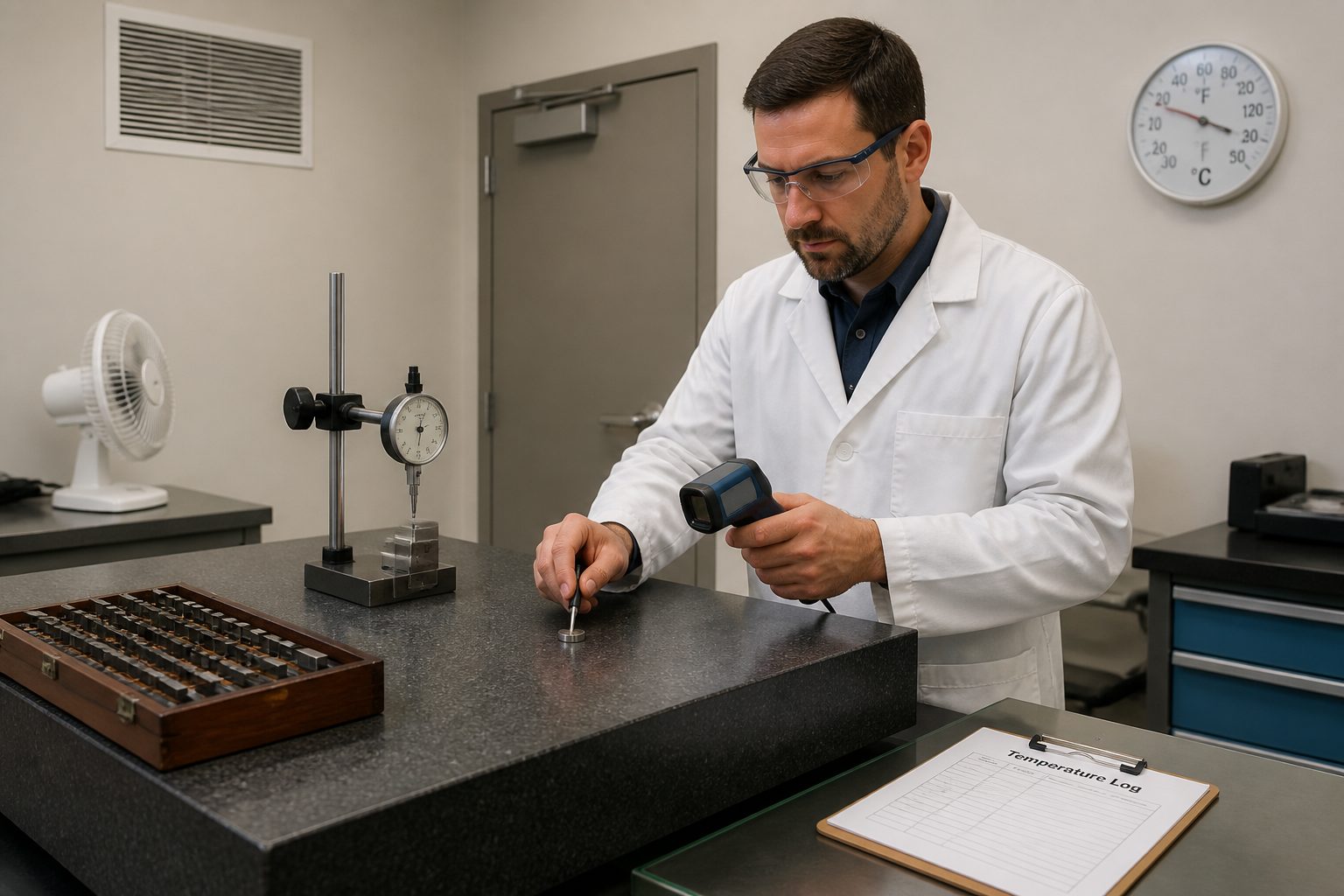
Surface plate measurements rely on the assumption of a stable thermal environment where all elements are at a uniform temperature. When this assumption breaks down, the integrity of your results quickly deteriorates. Understanding this thermal behavior is the foundation for preventing measurement errors.
Your measurement instruments are also affected by temperature changes. Micrometers, height gages, and other tools can show slight variations in their own dimensions, further contributing to measurement drift. Consistent temperature ensures the integrity of your entire measurement system.
The biggest heat sources you may not notice
Many common items in a shop or lab can act as unexpected heat sources near surface plate setups, silently sabotaging your measurements. Identifying and mitigating these hidden culprits is a critical step in achieving reliable thermal stabilization. Even seemingly innocuous objects can emit enough heat to cause issues.
Personal computers, monitors, and even the lighting fixtures directly above or near the surface plate generate heat. These items operate constantly, creating a localized thermal imbalance that can directly affect the granite and any parts resting on it. Relocating these items or shielding them can make a big difference.
| Heat Source Category | Specific Examples | Impact on Measurements |
|---|---|---|
| Electronics & Lighting | Monitors, PCs, LED lamps, fluorescent fixtures | Localized heating, thermal gradients on plate surface |
| Personnel & Activity | Operators leaning on plate, frequent movement nearby | Body heat transfer, air currents disturbing thermal stability |
| Machinery & Tools | Grinders, air compressors, power tools, running motors | Radiant heat, exhaust heat, vibration-induced heat |
| Storage & Containers | Parts bins, chemical containers, warm liquid reservoirs | Stored thermal energy radiates to surrounding area |
| HVAC & Airflow | Direct vent registers, leaky ducts, forced air currents | Sudden temperature swings, uneven thermal distribution |
Setting up the plate location for stable conditions
The physical placement of your surface plate is perhaps the most fundamental aspect of effective surface plate temperature control tips. A well-chosen location can inherently minimize thermal fluctuations, while a poor one will require constant battles against environmental changes. Think of it as building a strong foundation for your metrology lab.
Avoid placing surface plates near exterior walls or windows, as these areas are highly susceptible to outdoor temperature swings and direct sunlight. Sunlight can rapidly heat one side of the granite, causing uneven expansion and significant measurement errors. Interior spaces generally offer more stable thermal conditions.
Keep your surface plate away from frequently opening doors or loading docks. Each time a door opens, it introduces an influx of air at a different temperature, disrupting the thermal balance of the room. This constant flux makes achieving thermal stabilization nearly impossible.
Position the surface plate as far as possible from any machinery that generates heat, such as CNC machines, ovens, or welding stations. These machines radiate substantial heat into the surrounding environment, creating localized warm spots that will affect your measurements. Maintain a clear buffer zone around your precision equipment.
Consider the flooring underneath the surface plate stand. Concrete floors tend to be more thermally stable than raised access floors or areas over uninsulated spaces. A stable foundation helps prevent temperature transfer from the ground up.
Ensure the room itself has good insulation and a stable HVAC system that can maintain a consistent ambient temperature. A well-regulated room is the primary defense against thermal drift in your precision measurements. Invest in a robust environmental control system if possible.
Think about the flow of people and materials around the plate. High traffic areas can create air currents and introduce body heat, both detrimental to stable conditions. Opt for a quieter, less disturbed corner of your facility for your critical measurement tasks.
Managing airflow from vents, fans, and open doors
Room airflow plays a surprisingly significant role in maintaining stable conditions for precision measurements on a surface plate. Uncontrolled air movement, whether from HVAC vents or open doors, can introduce rapid temperature changes and gradients. Addressing these airflow issues is a key part of effective surface plate temperature control tips.
Never position your surface plate directly in the path of an HVAC supply or return vent. These vents deliver conditioned air, which is often several degrees different from the ambient room temperature, causing localized cooling or heating of the granite. Redirecting or baffling these vents is essential for thermal stability.
Avoid using personal fans or large industrial fans near the measurement area. While they might improve comfort, they create turbulent airflow that can rapidly cool or heat different sections of your surface plate and parts. Consistent, gentle air movement is preferable to strong, localized blasts.
Keep doors and windows to the measurement area closed as much as possible, especially during critical measurement periods. Every time a door opens, it allows air from a different thermal environment to rush in, disturbing the carefully maintained conditions. This is particularly true for doors leading to outdoor areas or unconditioned spaces.
Consider installing air baffles or diffusers on HVAC vents that are unavoidable near the surface plate. These devices help to spread the airflow more evenly and reduce the velocity of the air directly hitting your equipment. The goal is to minimize direct impingement of air onto the plate surface.
Even the movement of personnel can create air currents that affect thermal stability. Encourage operators to move deliberately and avoid brisk movements around the surface plate during measurements. Reducing unnecessary activity around the plate helps maintain a calm, stable air environment.
If your facility experiences significant drafts, consider using temporary screens or partitions to create a more enclosed and stable micro-environment around the surface plate. These barriers can help shield the plate from sudden gusts and maintain more consistent room airflow. Proactive management of air currents is a simple yet powerful strategy.
Letting parts acclimate before you measure
One of the most fundamental and often overlooked surface plate temperature control tips is allowing parts to fully acclimate to the measurement environment. Bringing a part directly from a machine shop or storage area to a precision surface plate will almost guarantee inaccurate readings. Thermal stabilization is a process, not an instant state.
Parts must reach the exact same temperature as the surface plate and the measurement instruments before any reliable inspection can begin. This process, known as thermal soak or acclimation, allows the material to expand or contract to its stable size at the ambient temperature. Patience here directly translates to accuracy.
- Place parts directly on the surface plate
- Allow ample time for temperature equalization
- Consider part material and mass for acclimation time
- Use a temperature probe to verify part temperature
- Avoid handling parts unnecessarily during acclimation
- Keep parts covered to prevent dust accumulation
- Ensure the measurement room is at a stable temperature
Handling warm parts and recently machined components
Dealing with warm parts, especially recently machined components, presents a significant challenge for precision metrology. These parts carry residual heat from manufacturing processes, and simply placing them on a surface plate will cause immediate thermal issues. Specialized surface plate temperature control tips are essential here.
Never place a warm part directly onto your granite surface plate. The localized heat transfer can cause the granite to expand unevenly, potentially damaging the plate and definitely compromising any subsequent measurements. This is a common mistake that can have lasting negative effects.
Allow recently machined components to cool down significantly in a staging area before bringing them into the temperature-controlled measurement room. This preliminary cooling reduces the thermal load on your precision environment. A dedicated cooling rack or bench can be very useful.
Once in the measurement room, place warm parts on a separate, non-critical surface, ideally a metal plate with good thermal conductivity. This helps the parts reach ambient temperature faster without impacting your primary granite calibration standards. Airflow around the part in this staging area can also aid cooling.
For very large or heavy components, the acclimation period can be extensive, sometimes taking many hours or even a full day. The mass of the material dictates how long it will take to absorb or dissipate heat. Plan your inspection schedule accordingly to accommodate these longer waits.
Use insulated gloves or tongs when handling parts that might be warmer or colder than the room temperature. This minimizes direct heat transfer from your hands to the component, preventing localized thermal changes just before measurement. Even brief hand contact can introduce enough heat to affect readings.
If you must measure a part that is still slightly warm, use a contact thermometer or thermal imager to confirm its temperature and calculate the necessary thermal expansion correction. While not ideal, this approach provides a way to adjust for known temperature differences. However, true thermal stabilization is always preferred.
Using simple temperature checks without overcomplicating it
You do not need a complex, expensive thermal chamber to implement effective surface plate temperature control tips. Simple, consistent temperature checks can provide ample data to ensure reliable measurements. The goal is consistent awareness, not perfect scientific precision.
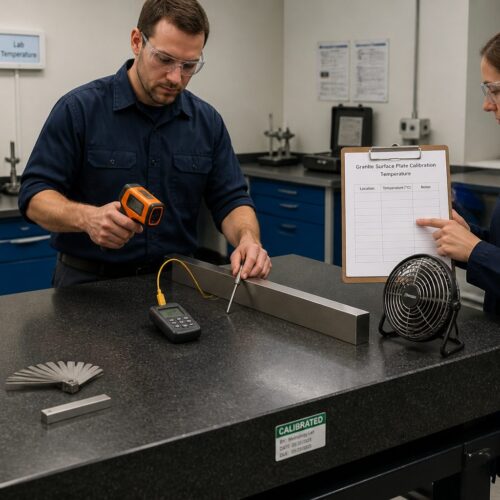
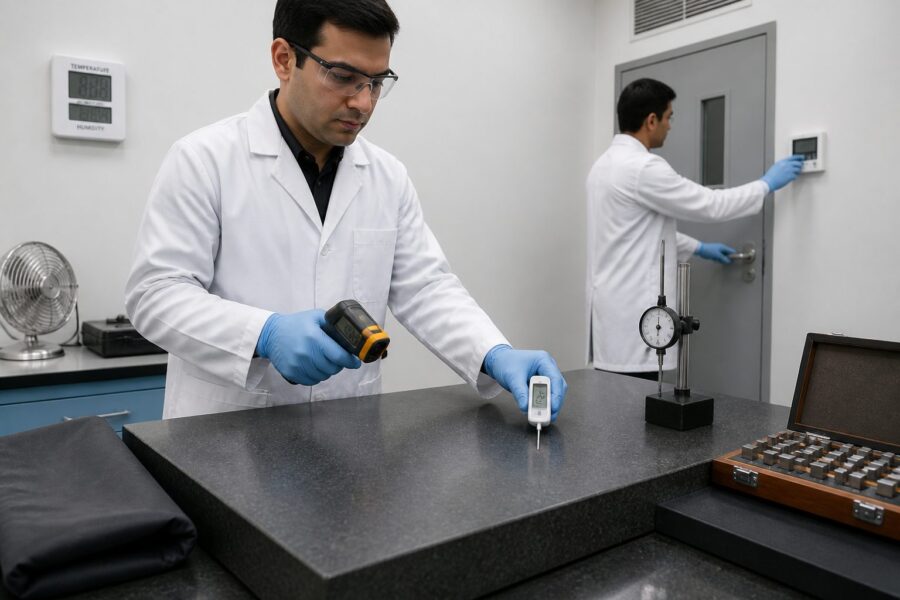
Keep a calibrated digital thermometer with an external probe readily available near your surface plate. Regularly check the temperature of the granite itself, the parts you are about to measure, and the ambient air. This simple routine provides immediate feedback on your thermal conditions.
For quick checks, an infrared thermometer can be useful for non-contact surface temperature readings of parts and the plate. Remember that IR thermometers measure surface temperature, which might differ slightly from the core temperature of a part. Use it for comparative analysis rather than absolute values.
Establish a baseline temperature for your measurement room, typically 68°F (20°C), and strive to maintain it within a narrow range, perhaps ±1°F (±0.5°C). Documenting these readings over time helps identify patterns or recurring thermal issues. Consistency is far more valuable than absolute accuracy in these checks.
Place a small, stable thermometer directly on your surface plate to monitor its temperature continuously. This provides a direct reading of the working surface, which is the most critical temperature for your measurements. Ensure the thermometer itself does not become a heat sink or source.
Encourage operators to make mental notes of any significant changes in room temperature or drafts. Human observation can often catch subtle thermal shifts that automated systems might miss. Empower your team to be proactive thermal detectives.
Record temperature readings alongside your measurement data, especially for critical inspections. If an unexpected deviation occurs, having the temperature data provides valuable context for troubleshooting. This simple practice builds a history of your measurement environment.
Scheduling work to minimize thermal swings
Strategic scheduling of your metrology work can significantly enhance surface plate temperature control. By aligning your most critical inspections with periods of maximum thermal stability, you can inherently reduce measurement drift. Thinking ahead about thermal conditions is a powerful but often underutilized strategy.
Perform your most sensitive measurements during off-peak hours or overnight if possible. During these times, facility activity is typically lower, reducing disturbances from personnel, machinery, and fluctuating room airflow. The environment tends to be calmer and more thermally stable.
Schedule routine maintenance or calibration of your surface plate and instruments for periods when the room has been stable for an extended time. This ensures that your calibration is performed under the most ideal thermal conditions. A well-calibrated instrument in a stable environment yields the best results.
Group similar materials or parts together for measurement sessions. This minimizes the number of times you introduce different thermal masses into the environment, allowing the room and the surface plate to maintain a more consistent temperature. Efficient batching can prevent unnecessary thermal disruptions.
Avoid scheduling critical measurements immediately after significant events that could disturb thermal stability. Examples include turning on new machinery, opening large loading dock doors, or after a major HVAC system adjustment. Give the environment time to re-stabilize.
Plan for sufficient acclimation time for all parts, building this into your production schedule. Rushing parts to the surface plate before they have thermally stabilized is a guaranteed way to introduce errors. Proper acclimation is a non-negotiable step for precision.
Consider the daily cycle of your facility’s HVAC system. If there are periods when the system cycles off or adjusts significantly, try to avoid critical work during those times. Understanding your building’s thermal rhythm helps you work with it, not against it, for better thermal stabilization.
What to do during seasonal changes and HVAC cycles
Seasonal changes and the inherent cycling of HVAC systems present unique challenges to maintaining consistent surface plate temperature control. These external factors can introduce significant thermal swings that require proactive management. Adapting your strategy to the environment is key for continuous accuracy.
During summer months, when outdoor temperatures are high, ensure your HVAC system is adequately sized and maintained to handle the increased cooling load. An overworked or undersized system will struggle to maintain stable temperatures, especially during peak heat. Regular filter changes are a must.
In winter, cold drafts near windows and doors can be a major problem, even with a strong heating system. Seal any gaps or cracks around external openings near your metrology lab to prevent cold air infiltration. These seemingly small leaks can cause localized cold spots on your surface plate.
Pay close attention to the transition periods between seasons, such as spring and autumn. During these times, outdoor temperatures can fluctuate wildly, making it harder for HVAC systems to maintain a steady indoor temperature. Be extra vigilant with your temperature checks during these periods.
Understand your HVAC system’s set points and cycling behavior. Some systems have wider temperature deadbands, allowing for greater fluctuations before engaging. If possible, adjust these settings to a tighter range for your metrology area to promote better thermal stabilization.
Consider implementing supplemental heating or cooling, like a small, localized heater or air conditioner, if your main HVAC system struggles to maintain stability in the metrology area. These should be used with extreme caution to avoid creating new localized hot or cold spots. Position them away from direct airflow onto the plate.
Monitor humidity levels, especially during seasonal shifts. High humidity can affect some measurement equipment and also influence how quickly temperatures stabilize. While temperature is primary, humidity is a secondary factor to consider for overall environmental control.
Building a practical “stabilization” routine for your team
Effective surface plate temperature control is not a one-time fix; it is an ongoing commitment that requires a consistent routine from your entire team. Establishing clear, practical habits ensures that thermal stabilization becomes an ingrained part of your metrology process. Everyone must understand their role in maintaining accuracy.
Start each shift with a quick environmental check: verify the room temperature, check the surface plate temperature, and ensure all heat sources near surface plate locations are minimized. This proactive approach sets the stage for accurate measurements throughout the day.
Implement a clear protocol for part acclimation, including designated staging areas and minimum required soak times based on part size and material. Post these guidelines prominently near the surface plate for easy reference. Consistency in this step is non-negotiable for precision.
Train all personnel on the importance of room airflow management. This includes instructions on keeping doors closed, avoiding personal fans, and reporting any drafts or HVAC issues. Education empowers your team to actively contribute to a stable environment.
Encourage the use of temperature logs where operators record ambient, part, and plate temperatures at the start of each critical measurement. This simple documentation habit reinforces awareness and provides valuable data for troubleshooting. It makes thermal control a tangible task.
Conduct regular, brief team meetings or toolbox talks to reinforce these surface plate temperature control tips and address any recurring issues. Open communication helps identify new heat sources near surface plate areas or challenges with thermal stabilization. Continuous improvement comes from shared understanding.
Designate a “thermal champion” on your team who is responsible for overseeing environmental conditions and promoting best practices. This individual can act as a resource and ensure that thermal considerations remain a priority. A dedicated point person can drive consistent adherence to these routines.
Conclusion
Maintaining precise surface plate temperature control is fundamental to achieving accurate and reliable measurements in metrology. It is a continuous effort that involves understanding thermal physics and implementing diligent daily practices. Overlooking temperature is one of the quickest ways to introduce errors into your precision work.
By identifying and mitigating heat sources near surface plate setups, managing room airflow, and ensuring proper thermal stabilization of parts, you significantly enhance the integrity of your inspections. These surface plate temperature control tips are not just theoretical; they are practical steps that yield tangible improvements. Consistency in environmental conditions directly translates to consistency in your measurement results.
Establishing a culture of thermal awareness among your team is equally important. When everyone understands the impact of temperature on measurements, they become active participants in maintaining optimal conditions. This collective effort ensures that your granite calibration standards are used in an environment conducive to their inherent accuracy.
Remember that even small temperature differences can lead to critical errors in high-precision applications. A proactive approach to temperature management saves time, reduces rework, and builds confidence in your measurement data. It is an investment in the quality of your entire metrology process.
Implement these surface plate temperature control tips and watch your measurement drift decrease and your reliability increase. Your commitment to thermal stability will pay dividends in the precision and trustworthiness of every inspection. Aim for a stable environment, and your measurements will thank you for it.
A well-managed thermal environment is a hallmark of a professional metrology lab. It distinguishes accurate, repeatable results from those plagued by unexplained variations. Embrace these practices to elevate the quality of your precision work.
Ultimately, the pursuit of precision is a continuous journey, and temperature control stands as a cornerstone of that endeavor. By mastering these habits, you ensure your measurements reflect the true dimensions of your components. Make thermal consistency a priority in your daily operations.