
Precision measurement demands a foundation that is unwavering, accurate, and durable. This is why granite surface plates stand as the bedrock of metrology labs and manufacturing floors worldwide. Understanding the unique granite surface plate material properties is not just academic; it directly impacts the accuracy and longevity of your critical measurement tools.
The choice of granite for these instruments isn’t accidental; it’s a testament to its exceptional physical characteristics. We rely on granite for its inherent stability and resistance to environmental factors, which are essential for maintaining tight tolerances. Delving into the material science surface plates helps us appreciate why this natural stone outperforms other options.
Proper care and effective use of a surface plate depend entirely on recognizing these inherent properties. By exploring the core characteristics of metrology-grade granite, we can ensure our precision equipment continues to deliver the reliable measurements our work demands. This knowledge empowers users to make informed decisions about maintenance, environment, and handling, ultimately preserving accuracy.
Why Granite is the Material of Choice for Surface Plates
Granite has earned its reputation as the premier material for surface plates through centuries of practical application and rigorous testing. Its natural formation provides a unique combination of qualities that synthetic materials struggle to replicate. This natural stone offers a cost-effective solution without compromising the precision necessary for modern metrology.
One primary reason is granite’s intrinsic stability, which means it resists deformation under load or over time. Unlike metal, granite doesn’t rust, corrode, or suffer from magnetic interference, simplifying its integration into various workshop environments. These inherent advantages make it an ideal base for highly sensitive measuring equipment.
The process of “lapping” granite to an incredibly flat surface is also more straightforward and stable than with other materials. This allows manufacturers to achieve the micron-level flatness required for Grade AAA or Grade 0 inspection plates. The resulting surface provides an unyielding reference plane for any measurement task, showcasing superior granite surface plate material properties.
Furthermore, granite’s low coefficient of thermal expansion contributes significantly to its accuracy, especially in environments with fluctuating temperatures. This property ensures that the plate’s dimensions remain largely constant, minimizing measurement errors caused by temperature changes. Without this thermal stability granite, maintaining consistent precision would be a much harder challenge.
Finally, granite’s vibration dampening characteristics help isolate delicate instruments from external disturbances. This natural ability to absorb mechanical vibrations creates a quieter, more stable measurement environment, which is absolutely critical for ultra-high precision applications. We choose granite because it delivers consistent performance where other materials fall short.
Key Physical Properties of Metrology-Grade Granite
Metrology-grade granite possesses a specific set of physical properties that distinguish it from ordinary stone. These characteristics are carefully evaluated and controlled during the selection and manufacturing process to guarantee performance. Understanding these fundamental granite surface plate material properties helps us appreciate the engineering behind these essential tools.
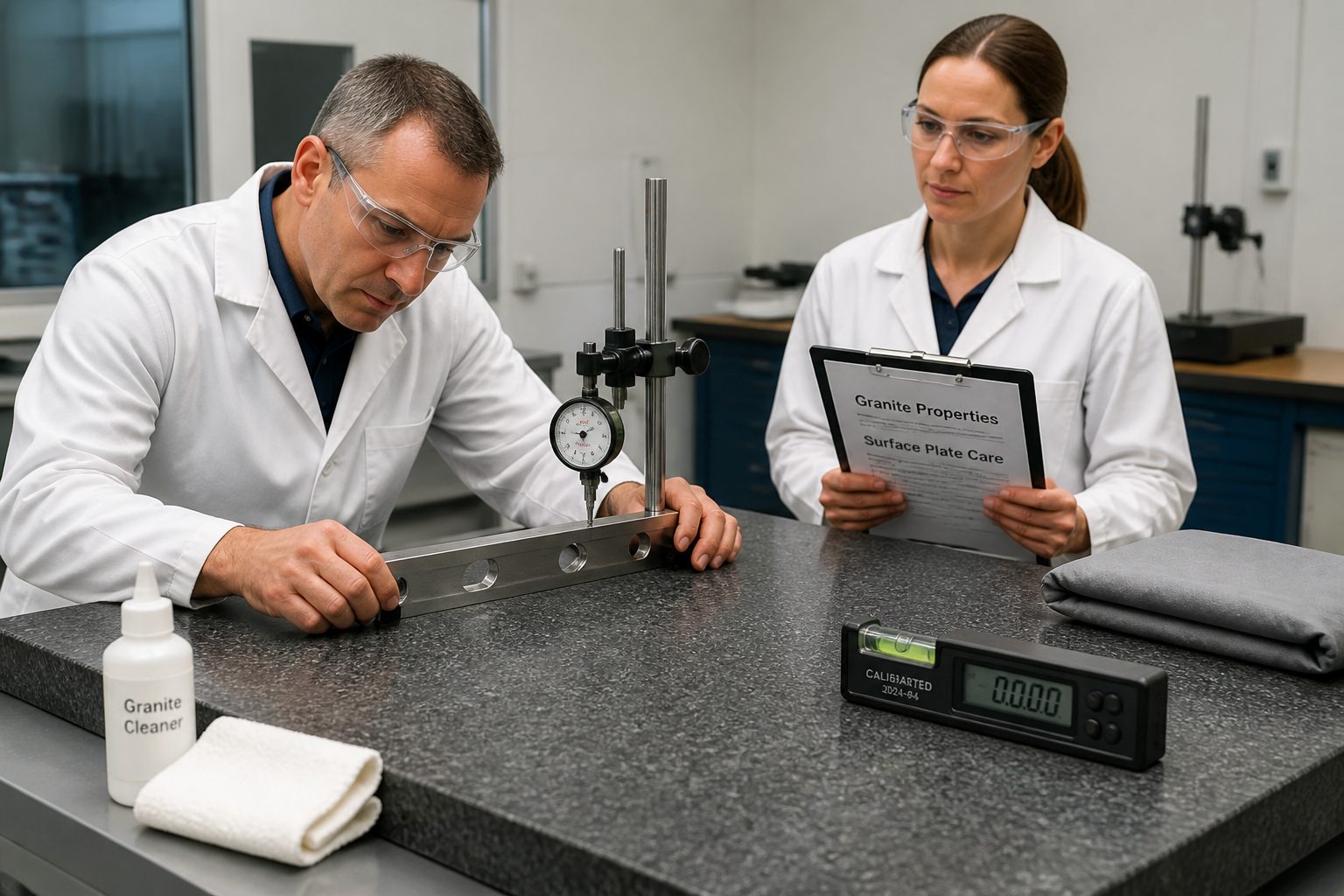
Manufacturers look for particular mineral compositions, grain structures, and densities to ensure the granite can meet stringent flatness and stability requirements. Not all granite is suitable for surface plates; only select quarries yield the quality needed for precision applications. This careful selection process is a cornerstone of reliable metrology equipment.
| Property | Description | Impact on Surface Plate Performance |
|---|---|---|
| Hardness (Mohs Scale) | Resistance to scratching and abrasion. | Ensures longevity and wear resistance, maintaining flatness. |
| Thermal Expansion Coefficient | How much material expands or contracts with temperature change. | Crucial for dimensional stability and measurement accuracy in varying temperatures. |
| Density | Mass per unit volume. | Contributes to overall stability, vibration dampening, and rigidity. |
| Porosity | Volume of open pores within the material. | Affects stain resistance, cleaning ease, and potential for moisture absorption. |
| Modulus of Elasticity | Material’s stiffness or resistance to elastic deformation. | Indicates rigidity and ability to maintain flatness under load. |
| Vibration Dampening | Ability to absorb mechanical energy. | Reduces external interference, creating a stable measurement environment. |
The Significance of Hardness and Wear Resistance for Longevity
The hardness of granite is a critical factor in its suitability for surface plates, directly influencing the plate’s lifespan and ability to maintain its precision. Harder granites, like black gabbro, exhibit superior resistance to scratching and abrasion from everyday use. This property ensures that the finely lapped surface remains intact, preserving the plate’s accuracy over many years.
Wear resistance is equally important, as tools and workpieces constantly slide across the surface plate during measurement operations. Softer materials would quickly develop depressions and uneven spots, compromising the flatness that defines a reliable reference plane. A durable surface means fewer recalibrations and a lower total cost of ownership.
The mineral composition of the granite dictates its hardness, with a higher content of quartz and feldspar contributing to a more robust surface. This is why specific types of granite are preferred; their natural geology provides the necessary resilience for demanding metrology applications. Understanding granite hardness metrology helps us select the best plates.
When you choose a surface plate, you are investing in a long-term precision tool, and its wear resistance directly determines that investment’s value. A plate that quickly degrades becomes a liability, introducing errors into your measurements and requiring premature replacement. Prioritizing hardness upfront saves you headaches and money down the line.
Regular inspection for wear patterns remains important, even with the hardest granite, as constant use can eventually take its toll. However, a high-quality, hard granite surface plate will withstand far more abuse than a lesser material, delivering consistent accuracy for decades. Its inherent resilience is a major reason for its widespread adoption in precision work.
Understanding Thermal Expansion and Its Impact on Accuracy
Thermal expansion is a fundamental property that describes how much a material changes in size with temperature fluctuations. For precision measurement, even minuscule changes can introduce significant errors, making granite’s low coefficient of thermal expansion incredibly valuable. This characteristic is a cornerstone of reliable thermal stability granite in metrology.
Compared to steel, granite expands and contracts at a much slower rate, meaning its dimensions remain far more constant across a typical operating temperature range. Imagine trying to measure to microns on a surface that is constantly growing and shrinking; it would be impossible to achieve consistent results. Granite solves this problem inherently.
This low thermal expansion is particularly important in environments where temperature control might not be perfectly maintained, such as in less climate-controlled workshops. While ideal conditions are always preferred, granite offers a degree of forgiveness that other materials do not. It provides a more stable reference plane in real-world conditions.
The material science surface plates demonstrates that the mineral composition of granite, particularly the presence of quartz and feldspar, contributes to this excellent thermal stability. These minerals have tightly bound structures that resist significant volumetric changes when exposed to heat. This natural resistance is not something you can easily engineer into other materials.
Operators must still allow the surface plate to acclimate to the ambient room temperature before beginning critical measurements to ensure the highest accuracy. Even with granite’s superior thermal properties, extreme or rapid temperature shifts should be avoided to prevent any potential distortion. Proper environmental control complements granite’s natural advantages beautifully.
Porosity and Absorption: Implications for Cleaning and Stains
Granite, being a natural stone, possesses a certain degree of porosity, which refers to the presence of tiny pores or voids within its structure. This characteristic directly impacts how the surface plate interacts with liquids and contaminants, influencing cleaning and stain resistance. Understanding these granite surface plate material properties helps guide maintenance practices.
Different types of granite exhibit varying levels of porosity; darker granites generally have a denser, less porous structure than lighter ones. This density difference means darker granites are often more resistant to absorbing oils, coolants, and other workshop fluids. Choosing a less porous granite can simplify upkeep significantly.
- Always clean spills immediately
- Use only approved, non-abrasive cleaning solutions
- Avoid harsh chemicals like strong acids or alkalis
- Wipe down regularly with a damp cloth and mild detergent
- Ensure the surface is completely dry after cleaning
- Consider periodic sealing for enhanced protection (check manufacturer guidance)
- Never use abrasive scrubbers or wire brushes
The Role of Density and Stability in Precision Measurement
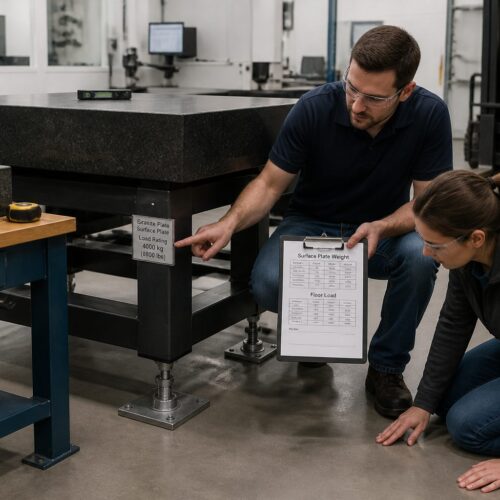
The density of granite plays a crucial role in the overall stability and performance of a surface plate, directly influencing its ability to provide an unyielding reference plane. A higher density means more mass per unit volume, which contributes significantly to the plate’s rigidity and resistance to deflection. This is a key aspect of granite surface plate material properties.
This inherent mass also provides excellent vibration dampening capabilities, isolating delicate measurements from external mechanical disturbances. Imagine trying to measure something to a micron while the table subtly vibrates; the results would be unreliable. High-density granite naturally absorbs these vibrations, creating a quiet measurement environment.
The stability derived from granite’s density is fundamental for maintaining the precise flatness required for metrology. Unlike lighter materials that might sag or flex under their own weight or the weight of workpieces, dense granite remains remarkably flat. This steadfastness ensures that every point on the surface plate truly represents its intended reference plane.
When you consider the material science surface plates, the crystalline structure of dense granite contributes to its long-term dimensional stability. It resists internal stresses and creep, meaning it won’t slowly deform over years of use like some other materials might. This consistent performance is invaluable in critical inspection processes.
Investing in a surface plate made from high-density, metrology-grade granite means investing in a foundation that will not yield or waver. This physical characteristic underpins all other aspects of its precision, making it an indispensable asset in any serious metrology lab. We trust dense granite to hold its form, ensuring our measurements are always accurate.
How Different Granite Types Affect Performance and Care
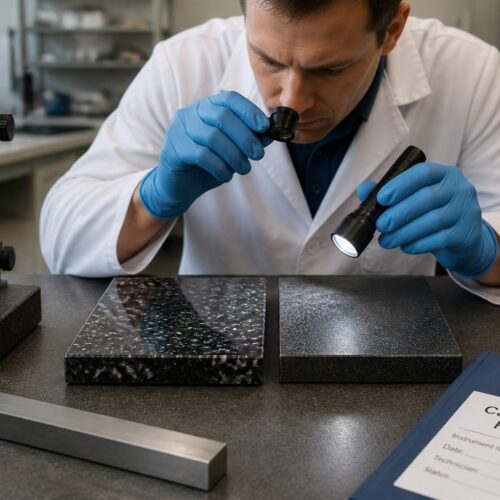
Not all granites are created equal when it comes to metrology applications; the specific type of granite significantly influences a surface plate’s performance and required care. Different geological origins yield variations in mineral composition, grain size, and color, each with distinct granite surface plate material properties. These distinctions are not merely aesthetic.
Black granites, such as Black Gabbro or Impala Black, are highly favored for precision surface plates due to their exceptional density, hardness, and low porosity. Their fine grain structure allows for incredibly smooth lapping and offers superior wear resistance. These properties make them robust choices for demanding metrology tasks.
On the other hand, lighter-colored granites, like Crystal Pink or Salisbury Pink, tend to be less dense and more porous. While still offering good stability, they might be more susceptible to staining and require slightly more diligent cleaning practices. Their larger grain size can also make achieving ultra-fine finishes a bit more challenging.
The choice of granite type also impacts thermal stability granite, with denser black granites generally exhibiting a lower coefficient of thermal expansion. This means they are less sensitive to temperature fluctuations, which is a major advantage in environments without strict climate control. For the highest precision, black granite often wins out.
Ultimately, selecting the right granite type involves balancing budget, required precision, and environmental conditions. While black granites often represent the pinnacle of performance for critical applications, other granites can still provide excellent value for less stringent requirements. Always consult with your supplier about the specific properties of their granite. Each type has its own strengths and weaknesses.
Leveraging Material Knowledge for Optimal Care Practices
Understanding the unique granite surface plate material properties is not just for manufacturers; it directly informs how users should care for and maintain these precision tools. Knowing about porosity, hardness, and thermal expansion allows for proactive maintenance strategies. This knowledge ensures your surface plate remains accurate and extends its operational life.
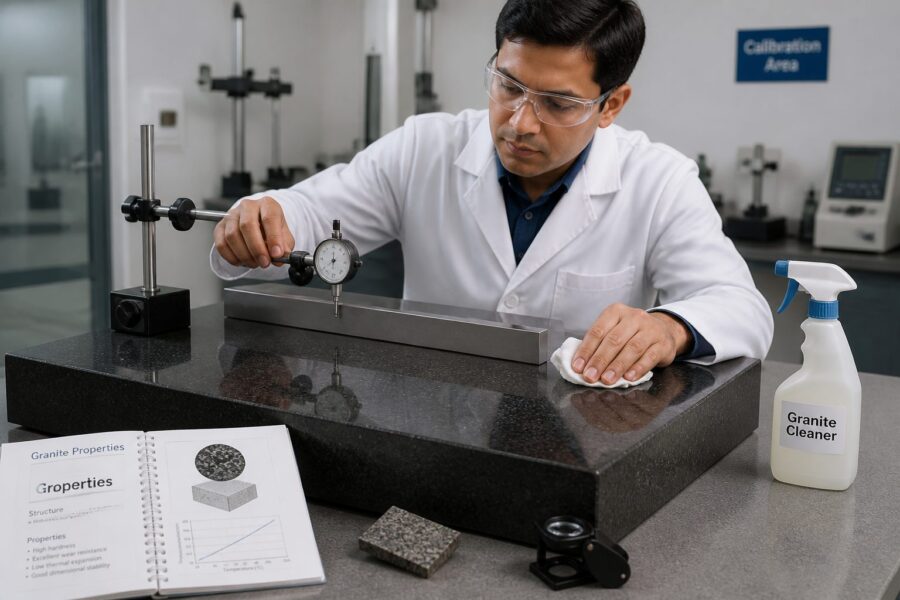
For instance, recognizing that granite has a degree of porosity guides your choice of cleaning agents and spill response. You should always use non-corrosive, pH-neutral cleaners specifically designed for granite to prevent absorption and staining. Immediate cleanup of any liquid is important to avoid permanent marks.
Awareness of granite hardness metrology helps you understand why some tools might leave micro-scratches over time and prompts you to use proper handling techniques. Avoid dragging heavy or abrasive objects directly across the surface; instead, lift and place them carefully. This simple practice significantly reduces wear and tear.
Knowing about thermal stability granite means you understand the importance of allowing the plate to acclimate to the room temperature before use. Bringing a cold plate into a warm room and immediately taking measurements will introduce errors. Patience with temperature equalization is a virtue in metrology.
This deep understanding of the material science surface plates empowers you to create an ideal environment for your equipment. It guides decisions about humidity control, temperature consistency, and even the type of support stands used. Proper care based on material knowledge protects your investment and preserves measurement integrity.
Protecting Granite’s Natural Properties During Use
Even with its impressive durability, a granite surface plate requires careful handling during daily operations to preserve its natural properties and maintain accuracy. Protecting these inherent granite surface plate material properties ensures the plate continues to function as a reliable reference plane. Small actions can have a big impact on longevity.
One fundamental practice is to avoid concentrating use in a single area of the plate. Regularly rotate your workpieces and measurement setups to distribute wear evenly across the entire surface. This prevents localized depressions and extends the time between re-calibration or resurfacing.
Always use clean, dry tools and workpieces on the surface plate. Any debris, chips, or abrasive particles trapped between the workpiece and the plate can cause scratching or embed into the surface. A quick wipe-down of both the plate and the item being measured prevents such damage.
When working with coolants or cutting fluids, ensure they do not come into direct contact with the granite surface for extended periods. While granite is resistant, prolonged exposure to certain chemicals can lead to staining or even subtle surface degradation. Prompt cleanup is always the best defense.
Never use the surface plate as a workbench for hammering, grinding, or other impact-generating tasks. These activities can chip the edges, create micro-fractures, or even compromise the overall flatness. The surface plate is a precision instrument, not a general-purpose work surface.
When Material Properties Indicate End-of-Life Considerations
Even the most robust granite surface plate will eventually show signs of wear, indicating that its granite surface plate material properties are no longer sufficient for precision work. Recognizing these indicators is crucial for maintaining accuracy and preventing costly measurement errors. Ignoring these signs can compromise your entire metrology process.
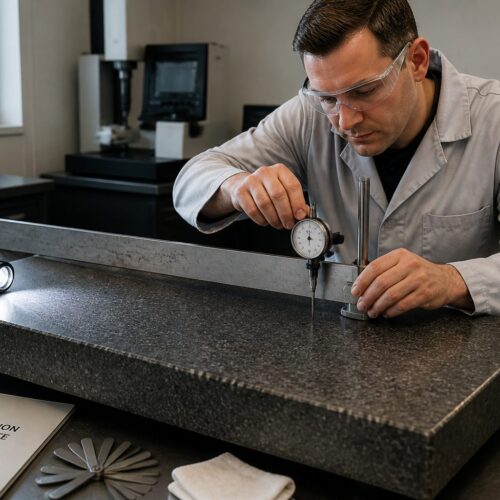
The primary sign of end-of-life or the need for resurfacing is a loss of flatness beyond acceptable tolerances. Regular calibration checks by a certified technician will reveal if the surface has developed high or low spots that exceed the specified grade. This is the most objective measure of a plate’s health.
Visible wear patterns, such as dull spots, discolored areas, or extensive scratching in frequently used zones, also suggest that the granite hardness metrology is no longer adequate. While minor cosmetic flaws are often harmless, widespread surface degradation indicates a loss of the original precision. These visual cues should prompt further investigation.
Deep gouges or significant chipping, especially along the edges, can also compromise the plate’s overall structural integrity and stability. Even if the main surface remains flat, damage to the supporting structure or edges can affect accurate measurements. Such damage often requires professional assessment for repair or replacement.
Sometimes, environmental factors, despite granite’s thermal stability granite, can lead to irreversible damage if the plate has been subjected to extreme thermal shock or prolonged exposure to corrosive chemicals. These conditions can cause internal stresses or surface etching that cannot be easily repaired. Prevention remains better than cure in these scenarios.
Educating Users on Granite’s Unique Characteristics
Effective use and long-term preservation of granite surface plates depend heavily on educating users about their unique material characteristics. Many operators might view a surface plate as just a flat stone, overlooking the intricate granite surface plate material properties that make it a precision instrument. This lack of understanding can lead to improper handling and premature wear.
Training should cover the importance of granite hardness metrology, explaining why specific tools or abrasive materials should never be used on the surface. Users need to understand that while granite is hard, it is not impervious to damage from concentrated forces or sharp objects. Proper tool placement is key to longevity.
Explaining the concept of thermal stability granite helps users appreciate why allowing the plate to acclimate to room temperature is not merely a suggestion but a necessity for accurate measurements. This knowledge fosters a respect for the environmental controls needed in a metrology lab. It helps bridge the gap between theory and practical application.
Discussions around porosity and absorption can highlight the importance of immediate spill cleanup and the use of appropriate cleaning solutions. Users often assume granite is completely non-absorbent, leading to improper cleaning practices that can stain or damage the surface. Education prevents these common mistakes.
Ultimately, a comprehensive understanding of the material science surface plates transforms users from passive operators into active stewards of their precision equipment. This empowered approach leads to better care, fewer errors, and a longer, more productive life for these critical metrology tools. Investing in user education is an investment in accuracy itself.
Conclusion
Granite surface plates are indispensable tools in the world of precision measurement, and their remarkable performance stems directly from their unique material properties. We rely on granite’s inherent hardness, thermal stability, density, and low porosity to provide an unwavering reference plane. These characteristics elevate it above other materials, solidifying its role in metrology.
Understanding these granite surface plate material properties is not merely academic curiosity; it’s a practical necessity for anyone involved in precision work. This knowledge empowers users to implement optimal care practices, select the right type of granite for their needs, and recognize when a plate requires professional attention. It helps extend the life and accuracy of these vital instruments.
By respecting the material science surface plates and adhering to best practices, we ensure that our granite surface plates continue to deliver the consistent, reliable measurements that underpin quality and innovation across countless industries. This commitment to understanding and care protects your investment in precision. It also upholds the integrity of every measurement taken.