
Precision metrology relies fundamentally on a stable and accurate reference surface, which is exactly what a granite surface plate provides. These impressive tools are essential for industries demanding the highest levels of measurement accuracy, from aerospace to medical device manufacturing. However, the sheer size and density of these granite slabs mean their installation demands careful planning, especially concerning their weight and the structural support they require.
Understanding the granite surface plate weight floor support requirements is not just a logistical detail; it is a critical engineering challenge. Ignoring these considerations can lead to disastrous consequences, including compromised measurement accuracy, structural damage to your facility, or even safety hazards. This guide breaks down the essential factors involved in properly supporting your heavy metrology equipment support, ensuring both precision and safety.
We will examine how to calculate the weight of your plate, interpret floor load capacities, and understand the importance of proper stand design. We will also discuss the nuances of concrete versus wood floors, methods for vibration isolation, and the critical steps for planning a new installation under various structural constraints. Prioritizing these elements is key to maintaining the integrity of your metrology operations.
How to Calculate the Weight of Your Surface Plate
Determining the precise weight of your granite surface plate is the crucial first step in any installation project. Granite, being a dense natural stone, carries substantial mass, and this weight increases dramatically with the plate’s dimensions. You need to know the exact weight to assess your floor’s capability and plan for adequate heavy metrology equipment support.
The calculation involves a simple formula: Volume × Density. First, measure the length, width, and thickness of your granite plate in inches to determine its total volume. Next, multiply this volume by the average density of inspection grade black granite, which is approximately 0.11 pounds per cubic inch.
For instance, a common 36″ x 48″ x 8″ surface plate has a volume of 13,824 cubic inches. Multiplying this by 0.11 lbs/in³ gives an approximate weight of 1,520 pounds, which is a significant load. This calculation gives you a solid baseline for your granite surface plate weight floor support requirements.
Remember that this is a general estimate; actual granite density can vary slightly depending on the specific quarry and mineral composition. Always refer to the manufacturer’s specifications for the most accurate weight information for your particular plate. They often provide detailed product data sheets that include the exact weight for each size and grade.
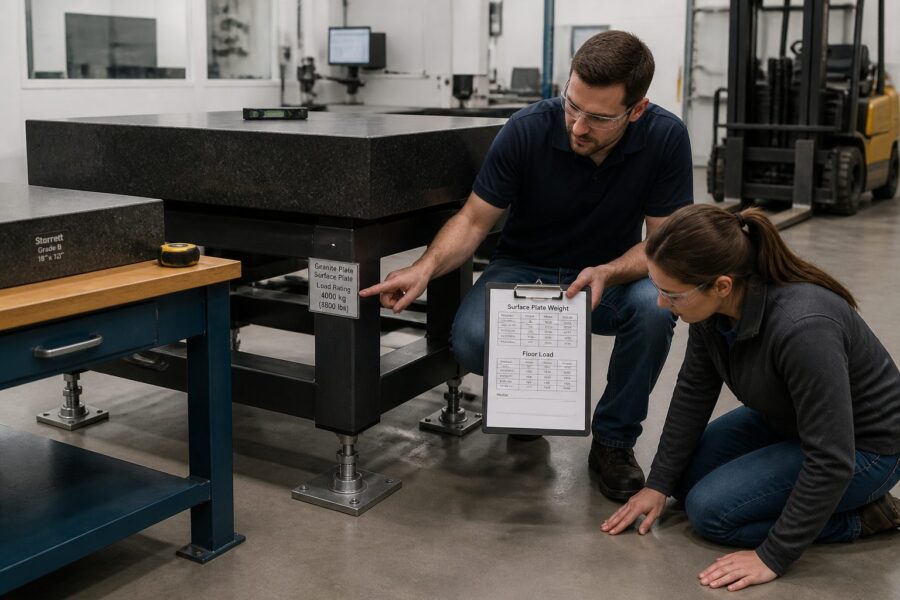
It is also wise to account for the weight of any additional equipment that will sit on or around the surface plate. This includes measuring instruments, fixtures, and even the weight of the stand itself. All these components contribute to the overall surface plate floor load capacity that your floor must bear.
Some companies use different grades of granite, like pink or gray, which can have slightly different densities than black granite. While the variation is usually minor, it is another reason to cross-reference with your supplier’s data. A few pounds difference might not seem like much, but it adds up on larger plates and critical installations.
Accurate weight assessment is not just about the plate; it is about the entire metrology setup. Every component adds to the total load, making it essential to have a comprehensive understanding before moving forward with any structural modifications or stand procurement. This thorough approach helps prevent surprises and ensures a secure foundation for your precision work.
Floor Load Ratings and What They Mean for Your Setup
Understanding your building’s floor load rating is absolutely essential before installing any heavy equipment, especially a substantial granite surface plate. This rating, typically expressed in pounds per square foot (PSF) or kilopascals (kPa), indicates the maximum weight a floor area can safely support. Exceeding this limit can lead to structural damage, floor deflection, and even catastrophic failure.
You can usually find floor load capacities in your building’s original blueprints or by consulting with a structural engineer. It is important to distinguish between “live load” (temporary, movable weights like people and equipment) and “dead load” (permanent structural elements). Surface plates are typically considered a live load, but their static, concentrated nature requires special attention.
A small workbench-sized plate might be fine on most commercial floors, but larger plates, measuring several feet in length and weighing thousands of pounds, demand a review by a professional. Structural engineers can calculate the specific point loads and stress distribution caused by your surface plate installation. They provide recommendations for reinforcement if the existing floor cannot safely support the granite surface plate weight floor support requirements.
Ignoring these ratings puts your facility and personnel at risk, and it also compromises the very precision you seek from your metrology equipment. Even slight floor deflection under load can introduce errors into your measurements, defeating the purpose of a high-accuracy surface plate. This is why understanding your surface plate floor load capacity is so critical.
Many building codes specify minimum floor load capacities for different occupancy types, but these are general guidelines. Heavy metrology equipment support often requires exceeding these minimums or at least verifying localized strength. Always assume that concentrated heavy loads need individual assessment, not just a general floor rating.
When reviewing blueprints, pay attention to the specific construction details, such as beam spacing, slab thickness, and reinforcement. These details directly impact how well a floor can handle the concentrated weight of a surface plate. A floor designed for general office use will react very differently to a several-thousand-pound granite slab compared to a floor built for industrial machinery.
Even if your floor appears robust, a structural engineer can identify potential weaknesses or areas where load distribution might be uneven. Their expertise ensures that the foundation for your metrology operations is not just sufficient, but optimally designed for long-term stability and accuracy. This professional guidance is an investment in both safety and metrological integrity.
Stand Design and Its Role in Even Weight Distribution
The stand supporting your granite surface plate is not merely a piece of furniture; it is a fundamental component of your metrology system. A properly designed stand ensures that the immense weight of the granite is evenly distributed across its support points, preventing localized stress and plate distortion. Uneven support can cause the granite to sag or twist, introducing errors into your measurements and compromising its flatness.
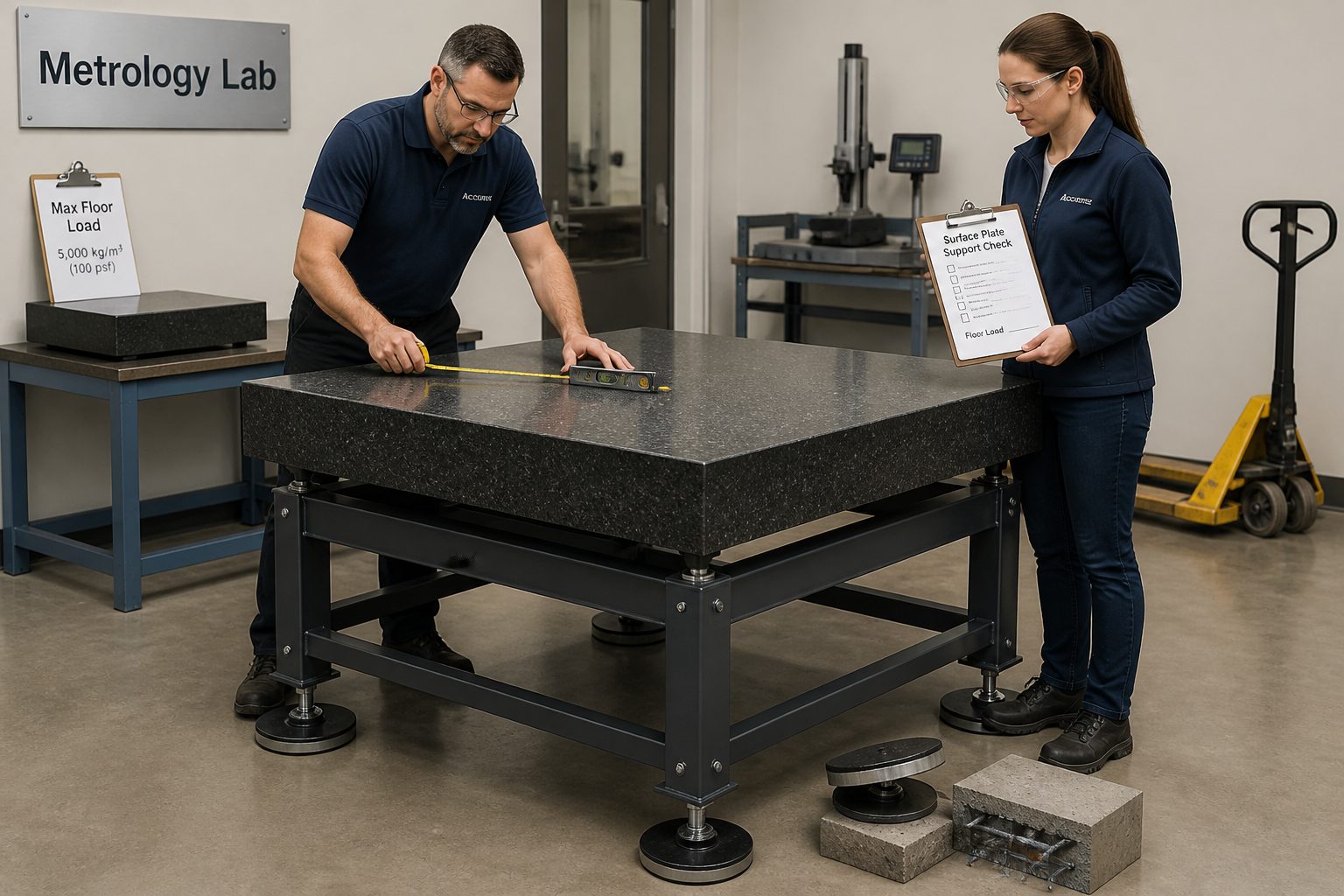
Quality granite plate stand requirements dictate a rigid, robust structure, typically made from heavy-gauge steel, with multiple adjustable leveling points. These leveling points allow for precise adjustment, ensuring the plate sits perfectly flat and stress-free on its supports. This meticulous setup is vital for maintaining the plate’s inherent accuracy.
| Plate Size (L x W x T) | Approx. Weight (lbs) | Recommended Support Points |
|---|---|---|
| 18″ x 24″ x 4″ | 190 | 3 |
| 24″ x 36″ x 6″ | 575 | 3 |
| 36″ x 48″ x 8″ | 1520 | 3 or 4 |
| 48″ x 72″ x 10″ | 4000 | 4 or 6 |
| 60″ x 96″ x 12″ | 7900 | 6 or 8 |
| 72″ x 120″ x 14″ | 13,800 | 8 or 10 |
Concrete vs. Wood Floors: Support Differences That Matter
The type of flooring in your facility plays a significant role in determining the feasibility and requirements for supporting a granite surface plate. Concrete floors are generally more robust and better suited for heavy loads, but they are not universally capable of handling any weight. Their strength depends on slab thickness, concrete mix, and underlying reinforcement.
Even with concrete, concentrated loads from large surface plates can exceed the local capacity of the slab, potentially causing cracking or deflection. For very heavy plates, a dedicated concrete pad or reinforced section might be necessary, specifically designed to distribute the granite surface plate weight floor support requirements over a larger area. This prevents stress points and ensures long-term stability.
Wood floors, common in older buildings or certain office environments, present a far greater challenge for heavy metrology equipment support. Wood joists and subflooring are prone to deflection under significant weight, which can severely compromise measurement accuracy and even lead to structural failure. Installing a large surface plate on a standard wood floor is rarely advisable without extensive structural modifications.
Reinforcement for wood floors often involves adding new support beams, strengthening existing joists, or constructing a localized support platform that transfers the load directly to the building’s foundation. These modifications can be complex and expensive, requiring careful planning and execution by experienced structural engineers. The goal is to create a rigid, non-deflecting base.
Older buildings with either concrete or wood floors often have unknown histories of modifications or wear, making a thorough inspection by an engineer even more critical. What appears solid on the surface might have underlying issues that are only revealed under heavy load. A professional assessment protects your investment and ensures safety.
Consider the potential for differential settlement, especially in older structures or those built on unstable ground. Even small shifts in the foundation can affect the levelness of your surface plate. A properly designed support system on any floor type helps mitigate these risks and maintain calibration.
The choice of flooring also influences the type of vibration isolation systems you might need, as different materials transmit vibrations with varying efficiency. Planning for the floor type early in the process saves considerable time and expense later by addressing potential issues before they become problems. This foresight is a cornerstone of effective metrology setup.
Vibration Transmission Through Floors and How to Isolate It
Vibration is the silent enemy of precision metrology, capable of rendering even the most accurate surface plate useless if not properly managed. Floors, regardless of their load-bearing capacity, can act as conduits for vibrations originating from foot traffic, nearby machinery, HVAC systems, or even external sources like road traffic. These subtle movements directly impact measurement stability and accuracy.
Effective vibration isolation is therefore a non-negotiable aspect of supporting heavy metrology equipment. The goal is to decouple the surface plate from its environment, preventing unwanted motion from transferring to the granite surface. This requires thoughtful consideration of the stand, the floor, and the surrounding operational context.
- Dedicated concrete inertia blocks
- Pneumatic isolation pads or air springs
- Elastomeric mounts (rubber or neoprene pads)
- Spring-based isolation systems
- Active vibration cancellation technology
- Isolation tables with integrated damping
- Careful placement away from heavy machinery
- Solid, rigid stands with leveling feet
- Reinforced floor sections to minimize deflection
- Regular environmental vibration monitoring
Planning a New Installation With Structural Constraints
When planning a new granite surface plate installation, especially in an existing facility, structural constraints are often the primary hurdle. It is wise to engage a structural engineer early in the process, ideally during the initial site assessment phase. Their expertise is invaluable in navigating limitations and designing safe, compliant solutions for your granite surface plate weight floor support requirements.
An engineer can assess the existing structural integrity, identify potential weak points, and recommend necessary modifications, such as reinforcing floor joists, adding new support columns, or pouring a dedicated foundation pad. These modifications are often significant and can impact project timelines and budgets. Ignoring this step risks costly retrofits or, worse, structural failure.
Consider the logistical challenges of getting a massive granite plate into its final position. Access routes, doorframe sizes, and elevator capacities all need careful planning. You might need specialized rigging equipment and a professional installation team experienced in moving heavy metrology equipment support. This is not a DIY job for large plates.
Budgeting for structural modifications, specialized stands, and professional installation is just as important as budgeting for the surface plate itself. Skimping on these aspects undermines the entire investment in precision metrology. A comprehensive budget prevents unexpected costs and ensures a smooth project execution.
Think about the long-term implications of your installation. Will the area be subject to future expansions or changes in equipment? Designing a flexible support system that can accommodate minor adjustments or future upgrades can save significant hassle later. Good planning means anticipating not just current needs, but future possibilities.
Environmental factors beyond structural load also warrant consideration. Stable temperature and humidity are crucial for maintaining the accuracy of both the granite plate and the instruments used on it. Ensure the chosen location is free from extreme fluctuations, as these can cause material expansion or contraction, affecting precision.
Safety protocols during installation are paramount. Moving and positioning thousands of pounds of granite requires meticulous planning, specialized tools, and experienced personnel. A detailed safety plan, reviewed by all involved parties, helps prevent accidents and protects both equipment and individuals. Never underestimate the risks associated with such heavy loads.
Conclusion
The successful installation of a granite surface plate is a testament to careful planning and a deep understanding of structural mechanics. It extends far beyond simply placing a heavy object on the floor; it demands a holistic approach to ensure stability, precision, and safety. Prioritizing the granite surface plate weight floor support requirements is fundamental to the integrity of your entire metrology operation.
From accurately calculating the plate’s weight to understanding your building’s floor load capacity, every detail contributes to a reliable foundation. A properly engineered stand ensures even weight distribution, preventing costly plate distortion and maintaining the critical flatness of the measuring surface. This meticulous attention to detail is what separates a good setup from a truly exceptional one.
Engaging structural engineers and experienced installation professionals is not an optional expense, but rather a vital investment in your metrology infrastructure. Their expertise helps navigate the complexities of different floor types, identify potential structural weaknesses, and implement effective reinforcement or vibration isolation strategies. This professional guidance ensures a compliant and secure installation.
Remember that vibration isolation plays a critical role in preserving measurement accuracy, shielding your sensitive metrology from environmental disturbances. Implementing appropriate isolation solutions protects your investment and guarantees the consistent precision required for demanding applications. Without it, even the finest plate cannot perform its best.
Ultimately, a well-planned installation for heavy metrology equipment support saves time, money, and prevents future headaches. It minimizes the risk of structural damage, enhances operational safety, and most importantly, preserves the inherent accuracy of your granite surface plate. Treat the support structure with the same respect you give the plate itself.
By diligently addressing all aspects of granite surface plate weight floor support requirements, you create an environment where precision measurements are not just possible, but consistently repeatable and reliable. This commitment to foundational stability empowers your team to achieve the highest standards of quality control and product development. Your metrology success truly begins from the ground up.