
Ensuring the longevity and accuracy of a precision granite surface plate demands meticulous attention, particularly during its movement. These foundational tools in metrology are surprisingly delicate despite their robust appearance. Improper handling can introduce micro-deformations or even significant damage, compromising their flat calibration over time.
Every professional in quality control or manufacturing knows that the true value of a surface plate lies in its unwavering precision. Protecting that precision means understanding the best practices for surface plate handling and lifting. It’s about more than just muscle; it’s about technique, planning, and respect for the instrument.
This guide will walk you through the essential steps to safely move your surface plate, whether it’s a small inspection plate or a massive master reference. We will cover everything from initial planning to the final placement, helping you maintain the integrity of your valuable metrology equipment. Careful planning and execution prevent costly recalibration or replacement down the line.
Why handling matters as much as calibration
Many believe that once a surface plate is calibrated, its accuracy is set in stone, literally. However, the physical stresses endured during relocation can easily undo the meticulous work of a calibration technician. Incorrect surface plate handling and lifting practices are a leading cause of flatness degradation.
Granite, while incredibly stable, is not immune to stress. Applying uneven pressure, using improper lifting points, or allowing the plate to flex can cause permanent distortion. This distortion might not be immediately visible, but it will certainly show up during your next calibration check.
Consider the cost of recalibration, which often includes shipping, expert labor, and downtime for your operations. Preventing damage through proper surface plate handling and lifting is far more economical. It ensures your metrology processes remain uninterrupted and reliable.
A surface plate is essentially a giant, extremely precise measuring tool. Just like any other delicate instrument, it requires careful treatment to maintain its specified tolerance. Neglecting proper handling protocols is a direct threat to measurement accuracy.
The integrity of your measurements directly correlates with the integrity of your surface plate. Investing time in understanding and implementing safe moving procedures pays dividends in consistent quality control. It’s an investment in your entire metrology program.
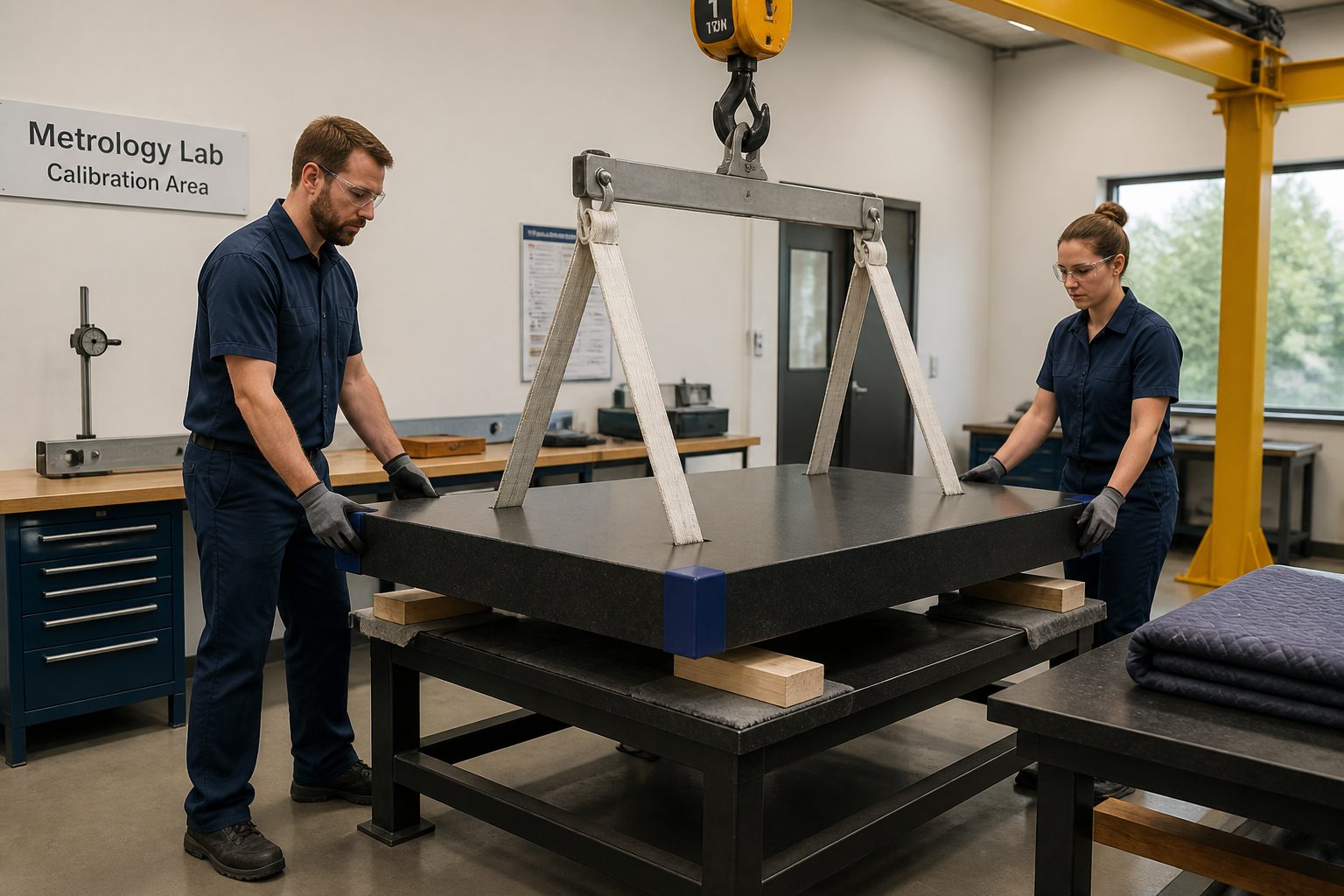
Even small shifts in flatness can lead to significant measurement errors, impacting product quality and compliance. Every time you move a surface plate, you introduce a risk to its precision. Minimizing this risk through educated handling is paramount.
Understanding plate support: 3-point vs multi-point contact
The foundation of a granite surface plate’s stability lies in its support system, both when stationary and during movement. Most precision surface plates are designed to be supported at specific lifting points, typically a three-point kinematic support. This arrangement naturally compensates for minor floor irregularities, ensuring the plate’s inherent flatness is maintained.
Multi-point contact, while seemingly more stable, can actually introduce stress and warp the plate if not perfectly level. An uneven multi-point support system can force the granite to conform to the unevenness, compromising its flatness. Understanding this distinction is critical for both long-term placement and temporary movement.
| Support Type | Description | Best Use Case | Potential Risks |
|---|---|---|---|
| 3-Point Kinematic | Three precisely located support points, often adjustable. | Standard for most precision surface plates. | Incorrect point placement can cause sag. |
| 4-Point Support | Four support points, often used for very large or heavy plates. | Requires extremely precise leveling of all points. | One high point can induce twisting stress. |
| Multi-Point (Continuous) | Full-surface contact, like a solid base or pallet. | Temporary transport on a rigid, flat surface. | Any unevenness in the base will transfer to the plate. |
| Edge Support | Supports only the perimeter of the plate. | Never recommended for precision plates. | Severe deflection and permanent warping. |
Pre-move planning: route, clearance, and floor condition
Before any surface plate handling and lifting begins, thorough pre-move planning is absolutely essential. Rushing this stage is a common mistake that leads to accidents, damage, and delays. A detailed plan ensures a safe moving procedure from start to finish.
First, map out the entire route from the plate’s current location to its destination. Identify any obstacles such as narrow doorways, tight corners, stairs, or changes in floor level. Measure all clearances carefully, including door widths, ceiling heights, and elevator dimensions, ensuring the granite plate stand and plate will fit.
Inspect the floor condition along the entire path. Look for cracks, uneven surfaces, drains, or loose tiles that could impede movement or cause instability. Ensure the floor is clean and clear of debris that could cause slips or punctures to moving equipment.
Consider the load-bearing capacity of floors, especially if moving a very heavy plate or using heavy machinery. Consult building plans or a structural engineer if there’s any doubt about the floor’s ability to support the combined weight of the plate, its stand, and moving equipment. This step is non-negotiable for large plates.
Assess the destination area to ensure it is ready for the plate’s arrival. Clear the space, confirm proper lighting, and prepare any necessary tools for leveling the plate once it’s in place. A well-prepared destination prevents last-minute scrambling.
Finally, gather all necessary equipment: lifting points, straps, slings, spreader bars, dollies, pallet jacks, or forklifts. Ensure all equipment is in good working order and rated for the weight of the surface plate. Proper preparation minimizes surprises and maximizes safety.
Lifting methods and what to avoid
Selecting the correct lifting method for your surface plate is paramount to preventing damage. The approach will largely depend on the plate’s size and weight, but the underlying principles of even weight distribution remain constant. Improper lifting can easily crack or warp the granite.
For smaller plates, two strong individuals might carefully lift using appropriate handholds, ensuring their backs are protected. However, even these small plates benefit from mechanical assistance whenever possible. Manual lifting always carries a higher risk of human error or injury.
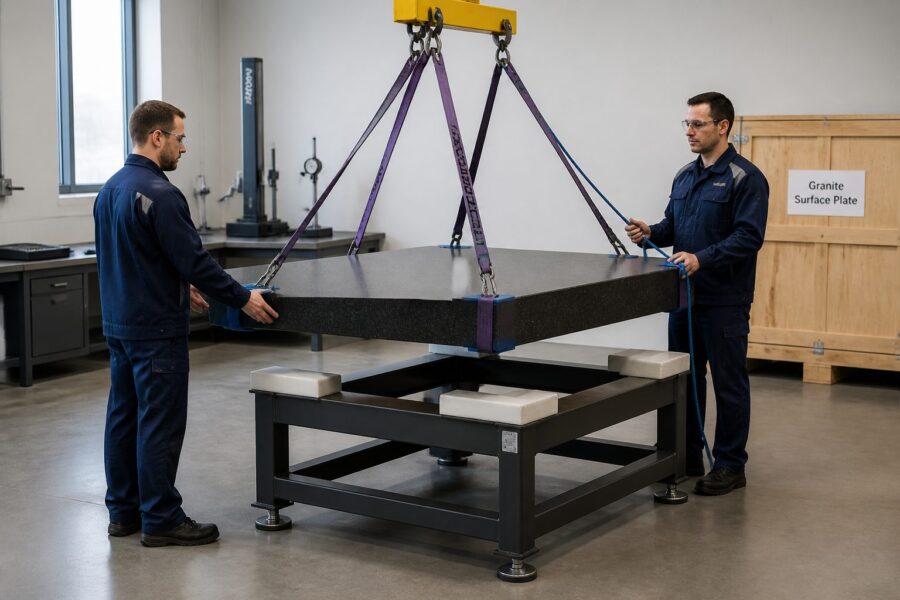
Larger plates absolutely require mechanical lifting equipment such as forklifts, gantry cranes, or specialized plate lifters. Always use a spreader bar with slings to prevent inward pressure on the plate’s edges. This distributes the weight evenly across the granite, preventing stress concentration.
Never lift a surface plate by its edges alone or attempt to slide it without proper support underneath. Sliding can chip the bottom edges and introduce abrasive particles to the measuring surface. Any method that creates localized stress points is a recipe for disaster.
Avoid using chains directly on the granite, as they can chip the surface or edges, even with padding. Chains exert too much concentrated force and lack the flexibility of webbing slings. Always opt for wide, flat slings or straps designed for heavy, delicate loads.
Do not use an ordinary pallet jack or forklift directly under the plate unless it is specifically designed for such an operation and provides full, even support. Many standard pallet jacks lift from a few narrow points, which is insufficient for granite plates. This can cause the plate to sag or crack under its own weight.
Using straps, slings, and spreader bars without stressing granite
The choice and application of lifting accessories are critical for safe surface plate handling and lifting. Straps, slings, and spreader bars are your best friends in this process, provided they are used correctly. They ensure that the immense weight of the granite is distributed evenly, preventing undue stress.
Always use wide, synthetic webbing slings or straps that are rated for the plate’s weight, with a generous safety factor. These materials are less likely to scratch or damage the granite’s finished surfaces or edges compared to chains or wire ropes. Inspect all slings for wear, cuts, or fraying before each use.
- Select slings with adequate weight capacity
- Position slings to engage lifting points
- Use soft padding between slings and granite
- Ensure slings are free from twists or knots
- Employ a spreader bar to maintain sling angle
- Verify load balance before lifting
- Never use damaged or worn slings
A spreader bar is indispensable for any significant surface plate handling and lifting operation. It keeps the lifting slings parallel and prevents them from pulling inward on the plate’s edges, which can cause cracking or bowing. The spreader bar should be wide enough to span the plate’s width effectively, maintaining the correct angle for the slings.
When positioning the slings, aim for the designated lifting points on the underside of the plate, if available. For plates without specific lifting points, position slings to provide support as close to the natural balance points as possible, typically about one-fifth of the length in from each end. Padding the contact points with thick rubber or wood blocks can further protect the granite surface from direct contact with the slings.
Ensure the load is balanced before lifting it clear of its original support. A test lift, raising the plate just an inch or two, allows you to check for stability and make any necessary adjustments to sling placement. This cautious approach prevents uncontrolled swinging or tipping during the full lift.
Never attempt to lift a surface plate with slings wrapped haphazardly or without a spreader bar on larger plates. The stress concentration from improper rigging can easily compromise the plate’s structural integrity. Following these guidelines is key to a successful and damage-free move.
Moving a plate on its stand vs moving the plate alone
Deciding whether to move a surface plate on its granite plate stand or as a separate component is a critical decision in the surface plate handling and lifting process. Each method presents its own set of challenges and advantages. The size, weight, and design of both the plate and the stand heavily influence this choice.
Moving a plate while it remains affixed to its granite plate stand can often simplify the process, especially for smaller to medium-sized plates. Many modern granite plate stands are designed with robust casters or leveling feet that can be temporarily retracted for transport. This integrated approach reduces the number of individual lifts required, minimizing the risk of damage during separation and reassembly.
However, moving the plate and stand together significantly increases the overall weight and dimensions of the load. This can pose challenges for clearance, floor loading, and the capacity of lifting equipment. Always ensure the granite plate stand itself is structurally sound enough to withstand the stresses of transport with the plate attached.
For very large or extremely heavy surface plates, separating the plate from its granite plate stand is usually the safer and more practical option. This allows each component to be moved independently, reducing the individual load weight. It also provides better access to the plate’s lifting points, facilitating a more secure lift.
When separating, ensure the plate is properly blocked and supported before unbolting it from the stand. Use appropriate lifting equipment to remove the plate, then move the stand, and finally place the plate onto its new stand. This sequential approach ensures controlled movement at every stage.
The choice between moving together or separately also impacts the type of equipment needed. Moving a combined unit might require a larger forklift or gantry, while separate moves could utilize smaller, more agile equipment. Always prioritize safety and plate integrity over convenience in this decision.
Setting the plate down: leveling and settling time
The final stage of surface plate handling and lifting—setting the plate down—is just as important as the lift itself. Proper placement and leveling are crucial for maintaining the plate’s accuracy and ensuring its long-term stability. Rushing this step can negate all the careful work done during transport.
Once the surface plate is in its new location, carefully lower it onto its granite plate stand or designated support structure. Ensure the plate makes contact evenly with all support points simultaneously. Uneven contact can immediately induce stress and warp the granite, especially if the supports are not properly adjusted.
For plates designed with a three-point kinematic support, adjust the leveling screws until the plate is stable and level. Use a precision level or electronic inclinometer to check for levelness in multiple directions across the plate’s surface. This ensures the plate rests naturally without external forces acting upon it.
After leveling, it is absolutely vital to allow the surface plate to “settle” for a period before performing any calibration or critical measurements. This settling time allows the granite to acclimate to its new environment and adjust to the forces of gravity and its support system. The duration can vary from a few hours for smaller plates to 24-48 hours or more for larger, heavier plates.
During the settling period, the granite will slowly adjust, and minor deflections caused by the move will dissipate. Attempting to use the plate too soon can lead to inaccurate readings as the material is still stabilizing. Patience here prevents false measurements and the need for immediate recalibration.
Re-check the levelness after the settling period, as minor shifts can occur. Make any final adjustments to the granite plate stand to ensure optimal stability and flatness. This meticulous process guarantees the plate is ready for precision work.
Protecting corners and edges during transport
The corners and edges of a granite surface plate are particularly vulnerable during surface plate handling and lifting. Chipping or cracking these areas not only detracts from the plate’s aesthetic appeal but can also compromise its structural integrity and future calibration. Proactive protection is a must for any safe moving procedure.
Before any movement, secure protective corner guards made of sturdy rubber, wood, or dense foam. These guards absorb impacts and prevent direct contact with hard surfaces or other objects during transit. They act as a crucial buffer against accidental bumps.
Wrap the entire perimeter of the plate with heavy-duty cardboard, plywood, or thick padding, especially if it will be moved through tight spaces. This additional layer of protection shields against scrapes and abrasions that can occur during maneuvering. Even a small chip can grow into a larger crack over time.
When using forklifts or pallet jacks, ensure the forks never make direct contact with the plate’s edges or corners. Always use proper dunnage or a full-surface pallet designed to support the entire base of the plate. Direct contact from metal forks is a common cause of edge damage.
Instruct all personnel involved in the surface plate handling and lifting process to be acutely aware of the plate’s extremities. Emphasize slow, controlled movements, especially when navigating doorways or turning corners. A moment of carelessness can lead to lasting damage.
If the plate must be transported on its side for clearance reasons, ensure it is fully supported along its entire length. Use a custom-built frame or heavy-duty crating that distributes the weight evenly and protects all exposed edges. Never transport a plate on its side without proper, full-length support.
Post-move checks: cleanliness, rocking, and obvious damage
Once the surface plate is settled in its new home, the work isn’t quite finished. A series of post-move checks are essential to confirm its condition and readiness for use. These checks are a vital part of any safe moving procedure and protect your investment.
First, thoroughly clean the surface plate. Even with careful handling, dust and debris can accumulate during movement, especially if it was uncovered. Use appropriate granite cleaner and lint-free cloths to ensure the surface is pristine and ready for precision measurements.
Next, perform a rocking test. Gently push down on each corner and along the edges of the plate to check for any instability or rocking. Any movement indicates improper leveling or an issue with the granite plate stand, requiring immediate adjustment to the support points. A stable plate is a prerequisite for accurate work.
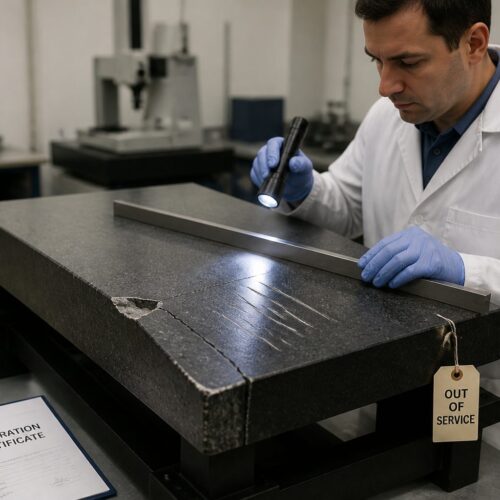
Visually inspect the entire surface plate for any obvious damage that might have occurred during surface plate handling and lifting. Look for new chips, cracks, or deep scratches, particularly along the edges and corners. Pay close attention to the measuring surface itself for any imperfections.
Compare the current condition to pre-move photographs, if you took them, to identify any changes. Document any new damage, no matter how small, as it could impact future calibration or indicate a need for repair. This documentation is important for accountability and future reference.
Finally, consider scheduling a flatness inspection or full recalibration, especially for large, critical, or high-accuracy plates. Even if no visible damage is present, the stresses of the move can induce subtle changes in flatness. A professional check provides peace of mind and verifies the plate’s continued suitability for precision work.
Creating a standard move procedure for your team
To ensure consistent safety and prevent damage, every organization that regularly moves surface plates should develop a standardized move procedure. This formal document outlines all steps, responsibilities, and equipment requirements for surface plate handling and lifting. It removes guesswork and promotes a culture of safety.
A standard operating procedure (SOP) for surface plate moves should include detailed instructions for pre-move planning, equipment selection, lifting techniques, and post-move checks. It should specify the types of slings, spreader bars, and dollies to be used for different plate sizes. Clear guidelines prevent improvisation, which often leads to mistakes.
Assign clear roles and responsibilities to team members involved in the moving process. Designate a team leader who is responsible for overseeing the entire operation, from planning to final placement. Everyone needs to understand their specific tasks and the importance of communication during the move.
Include a checklist within the SOP to ensure no critical steps are missed. This checklist should cover items like route inspection, equipment inspection, protective gear, and final leveling. Checklists are simple yet highly effective tools for preventing errors.
Regularly train all personnel involved in surface plate handling and lifting on the standard move procedure. Practical, hands-on training reinforces the theoretical knowledge and builds confidence. Refresher courses should be conducted periodically, or whenever new equipment or procedures are introduced.
Review and update the standard move procedure annually or after any incident or near-miss. Incorporate lessons learned and feedback from the team to continuously improve the process. A living document that evolves with experience is far more effective than a static one.
Finally, ensure that all safety regulations, both internal and external, are integrated into the SOP. This includes adherence to OSHA guidelines for lifting and material handling. A comprehensive, well-communicated, and regularly practiced safe moving procedure is the best defense against damage and injury.
Conclusion
The precision of a granite surface plate is a fragile asset, easily compromised by improper surface plate handling and lifting. Treating these metrology workhorses with the respect they deserve is not just good practice; it is essential for maintaining measurement accuracy. Every move, no matter how small, requires careful planning and execution.
By understanding the principles of proper support, utilizing appropriate lifting points and equipment, and following a detailed safe moving procedure, you can significantly reduce the risk of damage. Protecting your surface plate means protecting the integrity of your entire quality control process. It ensures reliable data and avoids costly replacements or recalibrations.
Investing in thorough training for your team and establishing clear, standardized protocols for surface plate handling and lifting pays dividends in the long run. It fosters a safer work environment and preserves the accuracy of your critical metrology equipment. Remember, a well-cared-for surface plate is a cornerstone of consistent quality.