
Maintaining the precision of your granite surface plate is absolutely essential for accurate measurements in any metrology lab or workshop. A dirty surface can introduce subtle errors, making your calibration standards unreliable and impacting the quality of your work. Knowing how to clean a granite surface plate correctly keeps your equipment in top condition and preserves its inherent flatness.
You might think cleaning a slab of granite is straightforward, but these aren’t just any countertops; they are precision instruments. Incorrect cleaning methods can actually degrade the surface, leading to costly re-calibration or even replacement. This guide will walk you through the proper techniques and specific products to use, ensuring your granite plate maintenance supports your metrology needs.
We’ll cover everything from daily wipe-downs to tackling stubborn grime, focusing on methods that protect the integrity of your investment. Following these metrology cleaning steps will extend the life of your surface plate and guarantee consistent, accurate readings for years to come. Let’s get into the specifics.
What Makes Granite Surface Plates Different From Regular Granite
Granite surface plates are far more than just polished stone; they represent a pinnacle of material science and precision engineering. The granite used for these plates comes from specific quarries, chosen for its exceptional density, hardness, and thermal stability. This particular selection minimizes the effects of environmental changes on the plate’s flatness.
Unlike kitchen countertops, which prioritize aesthetics and stain resistance, surface plates are engineered for dimensional stability and consistent performance. They undergo a rigorous lapping process to achieve incredible flatness tolerances, measured in millionths of an inch. This level of precision is what makes them indispensable for accurate metrology.
Manufacturers select black granite, like gabbro, often because it has a finer grain structure and a lower quartz content compared to lighter granites. Lower quartz content means less susceptibility to wear from abrasive particles, which helps maintain the plate’s long-term accuracy. This material choice directly impacts the plate’s resistance to chipping and scratching under normal use conditions.
The manufacturing process involves rough cutting, stress relieving, and then a series of progressively finer lapping stages. Skilled technicians hand-lap the final surface, constantly checking its flatness against master calibration standards. This painstaking work ensures the plate meets strict federal and international specifications for accuracy.
Understanding these differences helps explain why general granite cleaners or harsh chemicals are completely inappropriate for a surface plate. You are cleaning a highly precise instrument, not a decorative household item, and its delicate surface requires specialized care. Improper cleaning could easily compromise the very flatness you rely on.
What You Should Clean (and What You Should Never Touch)
When you clean a granite surface plate, you are primarily targeting dust, grime, oil films, and any foreign particles that could interfere with accurate measurements. These contaminants build up from handling, airborne debris, and workpiece contact, creating a microscopic layer that distorts readings. Regular cleaning removes these interferences, ensuring the plate remains a true reference plane.
However, you should never attempt to “re-lap” or resurface the plate yourself, or use any abrasive materials that might scratch the precision ground surface. The surface finish is a result of highly specialized processes, and any attempt to alter it without proper training and equipment will ruin the plate’s accuracy. Focus only on removing surface contaminants, not on altering the granite itself.
| Category | What to Clean / Remove | What to Absolutely Avoid |
|---|---|---|
| Everyday Use | Dust, fingerprints, light oil film, general workshop grime | Harsh abrasives, sandpaper, scouring pads, steel wool |
| Stubborn Contaminants | Dried coolant, tape residue, marker ink, light adhesive | Acidic cleaners (vinegar, lemon juice), alkaline cleaners (ammonia, bleach) |
| Maintenance | Gauge block residue, rust preventative spray residue | Any attempt to “polish” or “buff” the surface with compounds |
| General Care | Sweat, skin oils, microscopic debris from tools | Solvents like acetone, paint thinner, or mineral spirits (unless specified for granite) |
| Environmental | Airborne particles, shop dust, lint, atmospheric fallout | Chisels, grinders, or any tools that could chip or gouge the granite |
Choosing a Cleaner: What Works and What Leaves Residue
Selecting the right surface plate cleaner is perhaps the most important decision you make when performing granite plate maintenance. The wrong product can leave behind a film, chemically etch the surface, or even introduce new measurement errors. You need a cleaner specifically designed for precision granite, one that evaporates completely without leaving any trace.
Many common household cleaners contain waxes, silicones, or emulsifiers that will absolutely leave a residue on your surface plate. This residue might feel smooth to the touch, but it creates a microscopic layer that can elevate gauge blocks or parts, throwing off your measurements. Avoid anything labeled “polish,” “shine,” or “protective coating” for this reason.
Isopropyl alcohol (IPA) is a widely recommended option for light cleaning and daily wipe-downs. It effectively cuts through oils and evaporates quickly, leaving minimal residue behind. You can find IPA in various concentrations, but a 70% or 91% solution works well for most applications, diluted with distilled water if needed.
Specialized commercial granite surface plate cleaners are also available from metrology suppliers. These products are formulated to be residue-free, fast-drying, and safe for precision granite. Often, they contain a blend of alcohols and surfactants designed to lift contaminants without harming the stone.
Regardless of what you choose, always check the label for any warnings about residue or incompatibility with precision surfaces. A small test on an inconspicuous area, if possible, can sometimes confirm its suitability, though with a surface plate, that’s rarely practical. Your best bet is to stick with products specifically endorsed for metrology equipment. Remember, the goal is cleanliness without adding anything back onto the surface.
Tools You Need: Wipes, Pads, and Spray Bottles That Are Safe
Having the right tools makes all the difference when you clean a granite surface plate, ensuring both effectiveness and safety for your precision equipment. You need materials that are lint-free, non-abrasive, and designed to absorb contaminants without redepositing them. Using improper cloths can introduce more problems than they solve.
Microfiber cloths are an excellent choice for wiping down surface plates. Their fine fibers effectively trap dust and grime, and they are generally lint-free, which is absolutely critical for preventing new contamination. Always use clean, dedicated microfiber cloths that haven’t been washed with fabric softener, as softeners can leave a film.
For applying your surface plate cleaner, a simple spray bottle works best. This allows for even application and prevents oversaturation, which can be messy and inefficient. Ensure the spray bottle is clean and only used for your granite cleaner to avoid cross-contamination from other chemicals.
Disposable industrial wipes, particularly those designed for cleanroom environments or precision electronics, are another reliable option. These wipes are usually low-lint or lint-free and provide a fresh, uncontaminated surface for each cleaning session. They are particularly useful for heavily soiled areas, as you can simply discard them after use.
Some technicians also use specialized foam pads for applying cleaner, especially for larger plates. These pads provide a uniform pressure and can help spread the cleaning solution evenly across the surface. Always ensure any pad you use is soft, non-abrasive, and completely free of embedded particles that could scratch the granite.
Step-by-Step Cleaning Method for Daily Use
Performing daily metrology cleaning steps helps prevent the buildup of grime, which significantly reduces the need for deeper cleaning later on. Consistent, light cleaning preserves the accuracy and extends the lifespan of your granite surface plate. This routine should become a standard part of your daily workflow.
Always start by clearing the plate of all tools and workpieces, giving yourself a completely unobstructed surface to work with. Then, follow these simple steps to effectively clean your granite plate without risking damage or residue accumulation. This process is quick and highly effective for maintaining peak performance.
- Clear the surface plate of all items.
- Use an air bulb or soft brush to remove loose dust.
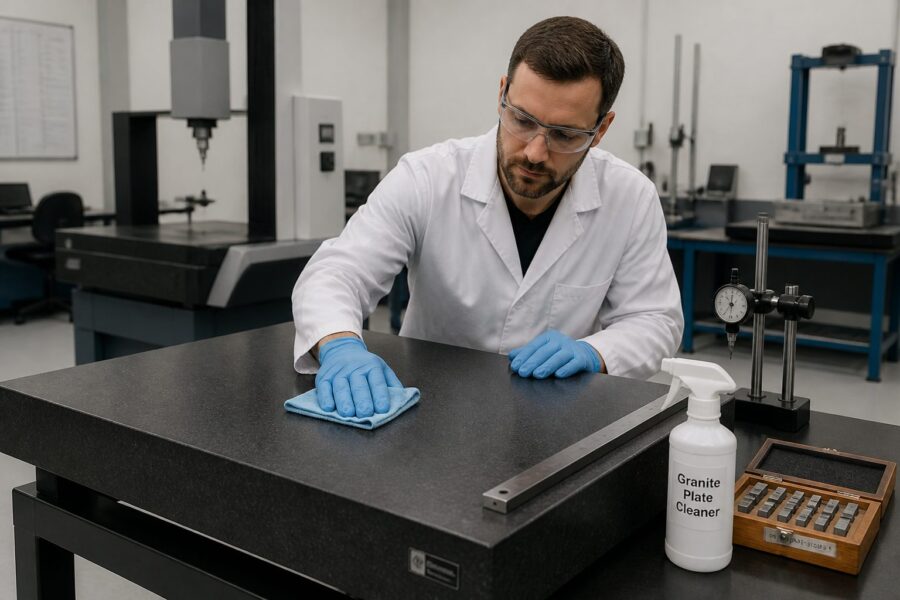
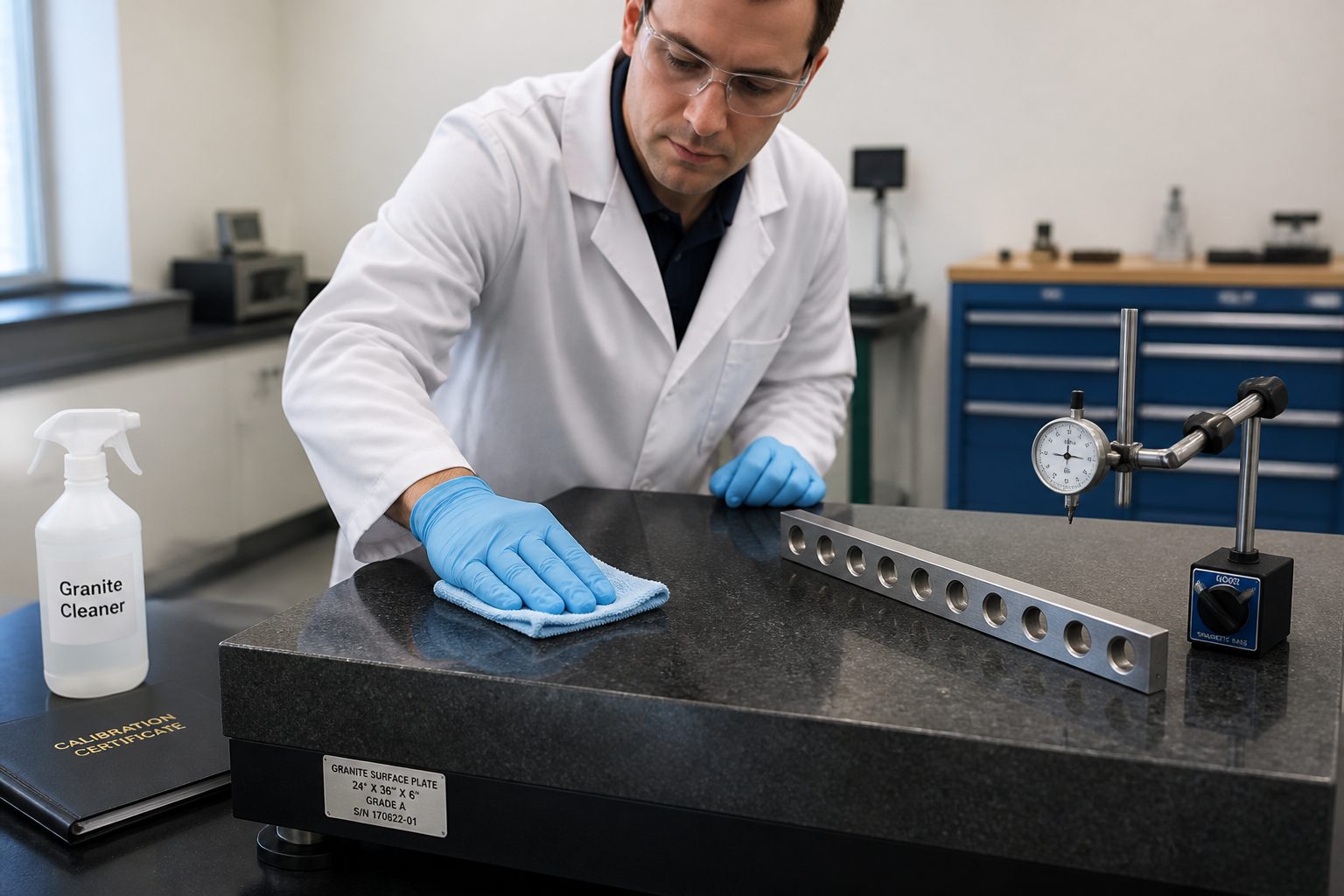
- Lightly spray a residue-free granite surface plate cleaner onto a clean microfiber cloth.
- Wipe the entire surface in overlapping strokes, working from one end to the other.
- Immediately follow with a dry, clean microfiber cloth to buff the surface.
- Check for any streaks or remaining film, re-wiping if necessary.
- Allow the surface to air dry completely before placing anything back on it.
Removing Stubborn Film, Tape Adhesive, and Marker Transfer
Sometimes, daily cleaning isn’t enough to tackle more persistent contaminants like dried coolant, old tape residue, or marker ink. These stubborn films require a slightly more aggressive approach, but still demand careful selection of cleaning agents and techniques. You need to lift these substances without resorting to harsh abrasives.
For dried coolant or heavy oil films, a slightly stronger application of your specialized surface plate cleaner might be necessary. Spray the cleaner directly onto the affected area and let it sit for a very short period, perhaps 10-15 seconds, to help break down the contaminant. Do not let it dry on the surface.
Tape adhesive can be notoriously difficult to remove without leaving a sticky residue. Isopropyl alcohol often works well for this; apply it to a clean, lint-free cloth and gently rub the adhesive. You might need to make several passes, using a fresh section of the cloth each time, to fully lift the sticky material.
Marker transfer, especially from permanent markers, requires a solvent that can dissolve the ink without damaging the granite. Again, isopropyl alcohol is generally effective, but for very stubborn marks, a small amount of denatured alcohol on a clean cloth can be tried. Always use minimal amounts and wipe thoroughly afterward.
After tackling any stubborn spots, always perform a complete daily cleaning procedure over the entire surface. This ensures any residues from the spot treatment are completely removed, and the overall flatness of the granite surface plate remains uncompromised. Your granite plate maintenance relies on thoroughness and the correct sequence of actions.
How to Avoid “Cleaning-Induced” Measurement Errors
Ironically, improper cleaning can sometimes introduce new errors into your measurements, defeating the entire purpose of granite plate maintenance. These “cleaning-induced” errors typically stem from residue, temperature changes, or microscopic damage. Understanding these pitfalls helps you maintain the integrity of your metrology setup.
The most common error comes from leaving a film or residue on the surface plate. Even an invisible layer of cleaner residue can create a tiny, uneven elevation, causing your gauge blocks or workpieces to sit slightly proud of the true surface. This leads to consistent, but incorrect, readings that are incredibly frustrating to diagnose.
Another potential issue is thermal expansion or contraction if you use cleaning solutions that significantly alter the plate’s temperature. While granite is thermally stable, rapidly applying very cold or very hot liquids can temporarily affect its flatness. Always use cleaners at room temperature to avoid this transient distortion.
Using abrasive cloths or cleaning agents can cause microscopic scratches or pits on the surface. These imperfections, though tiny, can create localized high or low spots that interfere with the precise seating of instruments. This is why lint-free, non-abrasive materials are so important when you clean a granite surface plate.
Finally, ensure the plate is completely dry before resuming any measurements. Residual moisture, even if it’s just a thin film, can also act as an interface layer, affecting the contact between your measuring tools and the plate. A thorough final wipe and brief air-drying period are essential metrology cleaning steps to prevent this.
Drying and Final Wipe: Preventing Streaks and Lint
The drying and final wipe stages are just as important as the initial cleaning steps for maintaining your granite surface plate. A perfectly clean plate can still yield inaccurate results if it’s left with streaks or lint. This final polish ensures a pristine, ready-to-use surface.
After applying your surface plate cleaner and wiping away the grime, immediately follow with a completely dry, clean, lint-free microfiber cloth. This second wipe removes any remaining moisture and buffs the surface, preventing streaks from forming as the cleaner evaporates. Work quickly and thoroughly across the entire surface.
Streaks often indicate that either too much cleaner was used or the drying cloth wasn’t absorbent enough or clean enough. If you see streaks, lightly mist a fresh, clean microfiber cloth with cleaner and re-wipe the streaky area, then immediately follow with another dry cloth. Persistence here pays off for a truly clean finish.
Lint is a common culprit for measurement errors, as even tiny fibers can create minute high spots on the plate. Always use high-quality, lint-free cloths and avoid wiping with paper towels or shop rags that shed fibers. Consider using compressed air (filtered and oil-free) to gently blow away any lingering dust or lint before the final wipe.
Allow the surface plate to air dry for a few minutes after the final wipe, especially if the air in your workshop is humid. This ensures complete evaporation of any remaining cleaner, leaving a perfectly dry and unblemished surface. A properly dried and wiped surface is ready for the most demanding metrology tasks, a testament to good granite plate maintenance.
Setting a Cleaning Frequency Based on Use and Environment
How often you clean a granite surface plate depends heavily on its specific use and the environmental conditions of your workspace. There isn’t a one-size-fits-all answer, but establishing a consistent cleaning schedule is a fundamental part of effective granite plate maintenance. Neglecting this leads to accuracy issues and unnecessary wear.
For plates used in high-precision labs with controlled environments and minimal contact, a daily wipe-down might suffice, with a deeper clean once a week. These environments generally have less airborne dust and fewer oily contaminants, making the maintenance relatively straightforward. The key is preventing any build-up.
In a busy machine shop or manufacturing environment, where metal dust, coolant spray, and oil are prevalent, daily deep cleaning is likely necessary. Contaminants accumulate much faster here, and they are often more abrasive or corrosive. You need to remove these substances before they can damage the plate surface.
Consider the type of materials you are inspecting on the plate. Machined parts, especially those that have been oiled or cooled, will leave more residue than clean, dry components. If you’re working with greasy parts, plan for a thorough cleaning after each batch, or even more frequently.
Environmental factors like humidity also play a role; higher humidity can cause dust to stick more readily and might promote the growth of microscopic films. If your shop has high foot traffic or open doors, more airborne particles will settle on the surface plate. Adjust your metrology cleaning steps to match these real-world conditions.
Ultimately, a good rule of thumb is to clean the plate before each critical measurement session and at the end of each shift. If you visibly see dust, fingerprints, or any film, stop what you are doing and clean it immediately. Proactive cleaning saves you from costly measurement errors and preserves your investment.
Simple Cleaning Log You Can Use to Stay Consistent
Keeping a cleaning log might seem like an extra step, but it is an incredibly effective tool for consistent granite plate maintenance. A simple log helps ensure that cleaning tasks are performed regularly and provides a record of your surface plate’s care history. This documentation can be invaluable for troubleshooting or calibration audits.
The log doesn’t need to be elaborate; a basic spreadsheet or even a printed sheet taped near the surface plate will work perfectly. The goal is to track when the plate was cleaned, who performed the cleaning, and what type of cleaning was done. This creates accountability and ensures no cleaning is missed.
Include columns for the date, time, and the name or initials of the person who cleaned the plate. You might also add a column to note the type of cleaning performed, such as “daily wipe” or “deep clean for stubborn residue.” This level of detail helps identify patterns or issues over time.
A cleaning log is especially useful in multi-user environments, where different individuals might be responsible for the surface plate. It prevents assumptions about who last cleaned it and ensures everyone knows the current status of the equipment. This transparency supports a culture of precision and care.
Reviewing the log periodically can help you fine-tune your cleaning frequency. If you notice a particular cleaning type is needed more often, it might indicate a change in your work environment or processes. This simple tool empowers you to optimize your metrology cleaning steps and keep your equipment in peak condition.
Conclusion
Knowing how to clean a granite surface plate correctly is not just about aesthetics; it is fundamental to maintaining measurement accuracy and extending the life of your precision equipment. Treating your surface plate with the care it deserves safeguards your investments and ensures reliable results. Remember, these are not ordinary pieces of stone.
By using the right cleaners and tools, following proper metrology cleaning steps, and establishing a consistent granite plate maintenance routine, you prevent costly errors. A clean surface plate is a foundation for confidence in your measurements, an essential element of any quality control system. Don’t cut corners on this vital task.
Regular daily cleaning with a residue-free surface plate cleaner and lint-free cloths will address most contamination issues. For more stubborn grime, targeted methods with appropriate solvents can restore the surface without damage. Always prioritize methods that remove contaminants without introducing new films or abrasions.
Implementing a simple cleaning log can greatly improve consistency and accountability, especially in busy workshops. This documentation helps track maintenance, optimize cleaning frequency, and ensures everyone understands their role in preserving the plate’s integrity. Good habits lead to good data.
Ultimately, a well-maintained granite surface plate speaks volumes about your commitment to precision and quality. Your dedication to proper cleaning reflects directly on the accuracy of your work and the longevity of your valuable metrology tools. Make these cleaning practices a non-negotiable part of your daily operations.