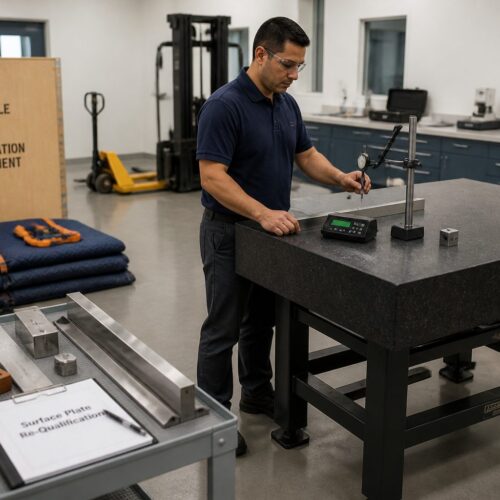

Choosing the right granite surface plate for precision measurement is more complex than simply picking the biggest or most expensive option. The real game-changer in metrology is understanding granite surface plate flatness tolerance. This specification dictates how flat the working surface of your plate truly is, directly impacting the accuracy of every measurement you take.
Ignoring these tolerances can lead to significant measurement uncertainty, costing you time, material, and reputation. A plate that seems perfectly flat to the naked eye can still introduce errors if its flatness tolerance doesn’t match your application’s requirements. We are going to break down how to make an informed decision, ensuring your metrology setup is as precise as it needs to be.
Understanding the different surface plate grades and their implications will help you optimize your quality control processes. This guide will walk you through everything from defining flatness to selecting the ideal grade for your specific tasks. You will learn how to choose the right surface plate for your demanding applications.
What “Flatness Tolerance” Means in Daily Use
Flatness tolerance describes the maximum permissible deviation from a theoretically perfect plane across the entire working surface of a granite surface plate. Imagine laying a perfectly flat sheet of glass over your plate; the tolerance is the largest gap you would find between the glass and the plate. This deviation is typically measured in micro-inches or micrometers, indicating an incredibly small range of acceptable variation.
In practical terms, this means that every point on the surface plate must lie within two parallel planes separated by no more than the specified tolerance value. When you place a part on the plate, any slight undulations on the surface will affect how truly flat the part appears. This directly influences the readings from height gages, dial indicators, or other precision instruments you are using.
For example, if you are checking the height of a component, a plate with a loose flatness tolerance might cause your instrument to register a different height depending on where on the plate you take the measurement. This inconsistency introduces error into your system, making it difficult to trust your final results. Maintaining a high standard for your granite surface plate flatness tolerance is essential for reliable metrology.
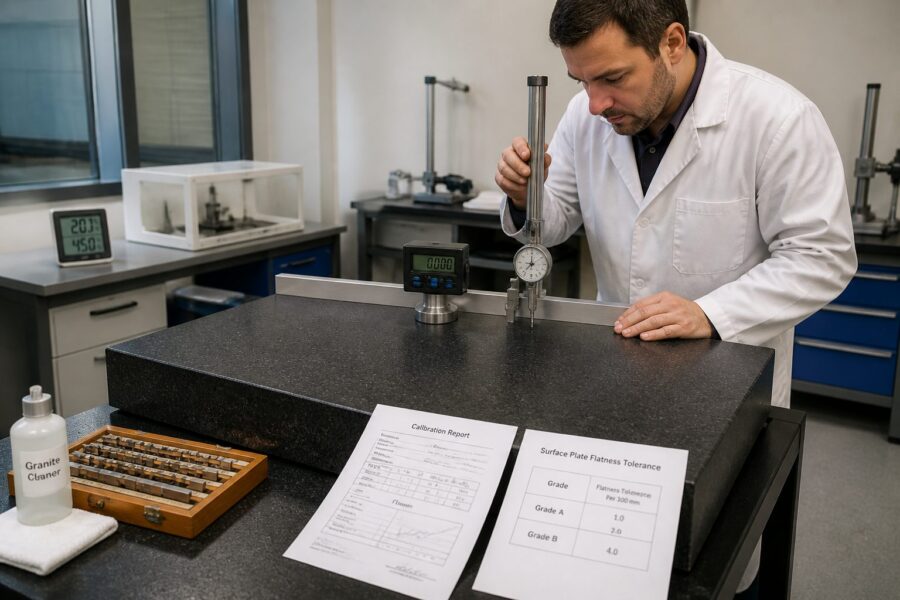
The total indicator reading (TIR) method is commonly used to assess this flatness. A precise instrument sweeps across the surface, recording the highest and lowest points relative to a reference plane. The difference between these extreme points is the flatness deviation, which must fall within the plate’s specified tolerance.
Without a clear understanding of your plate’s actual flatness, you are operating with an unknown variable in your measurement chain. This can lead to scrapped parts, rework, and a general lack of confidence in your quality assurance department. Knowing your granite surface plate flatness tolerance is the first step toward true precision.
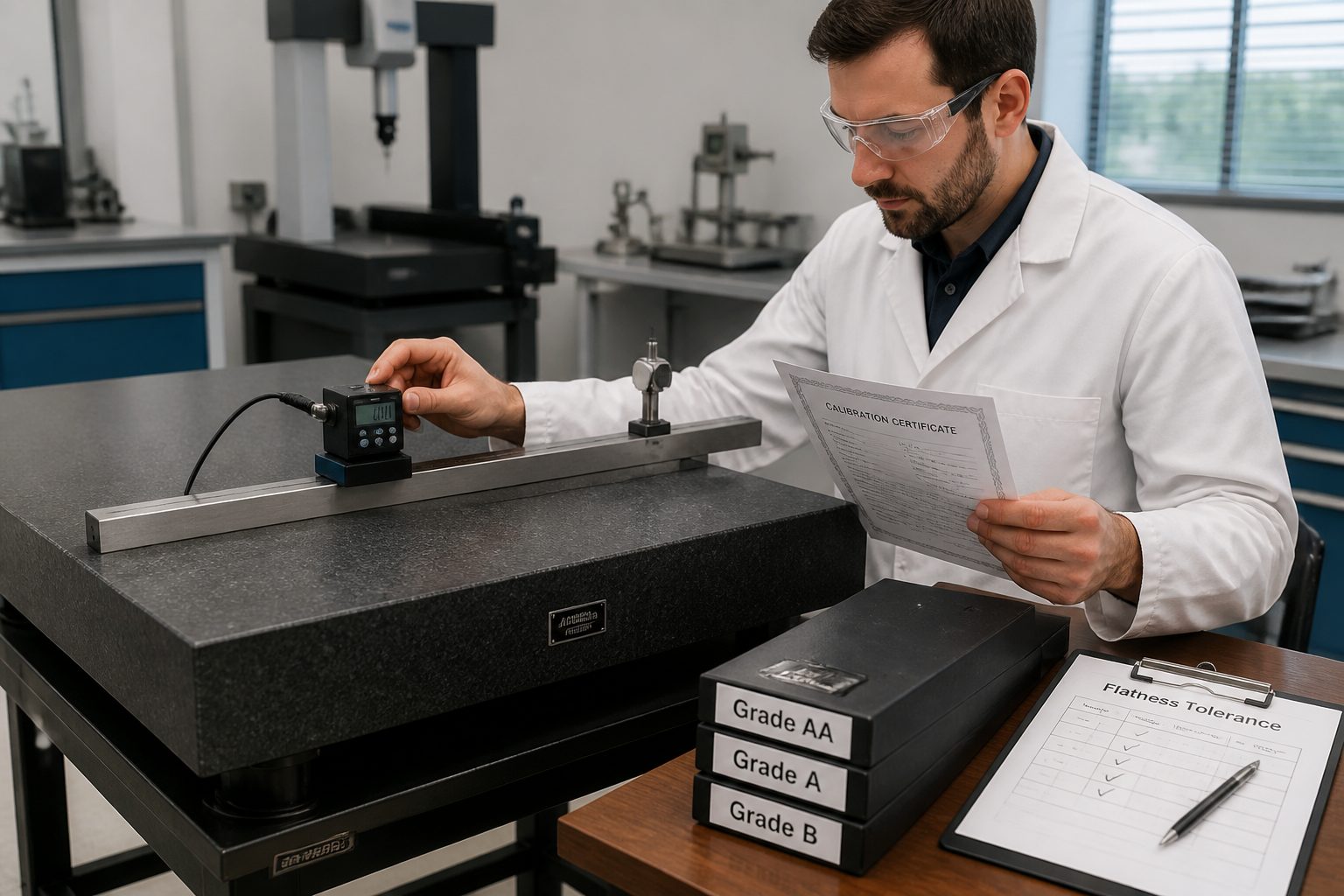
Common Surface Plate Grades and Typical Use Cases
Granite surface plates are categorized into different surface plate grades, each with a specific flatness tolerance designed for particular applications. These grades are defined by standards like Federal Specification GGG-P-463c, which sets out the requirements for inspection and calibration equipment. Understanding these distinctions is fundamental to proper equipment selection.
The most common grades are Laboratory (AA), Inspection (A), and Tool Room (B), each offering progressively looser tolerances. Choosing the appropriate grade directly impacts your ability to achieve the desired measurement accuracy. This decision is not just about cost but also about the level of precision your work demands.
| Surface Plate Grade | Flatness Tolerance (per 24″ x 24″ area) | Typical Use Cases |
|---|---|---|
| Laboratory (AA) | 0.000025 inches (0.635 µm) | Primary reference standards, gauge block calibration, critical research and development |
| Inspection (A) | 0.000050 inches (1.27 µm) | High-precision production inspection, CMM staging, quality control departments |
| Tool Room (B) | 0.000100 inches (2.54 µm) | General workshop inspection, tool setup, machine shop measurements |
| Utility/Shop (Commercial) | 0.000200 inches (5.08 µm) | Rough layout work, less critical shop applications, general assembly |
Matching Plate Grade to Your Measurement Tasks
Selecting the correct surface plate grade is a critical decision that directly impacts the reliability of your measurements. You need to align the granite surface plate flatness tolerance with the required precision of your components. Don’t overspend on an AA grade plate if a Grade B will suffice, but definitely don’t under-spec if your work demands extreme accuracy.
Consider the tolerance of the parts you are measuring; a good rule of thumb is that your measurement equipment should be at least 3 to 10 times more accurate than the tolerance of the feature being inspected. If your part has a critical dimension with a tight tolerance of 0.0001 inches, a Grade B plate with a 0.0001-inch tolerance is simply not good enough. You would need an Inspection Grade A or even a Laboratory Grade AA plate to maintain a proper measurement ratio.
For operations like calibrating gauge blocks or master artifacts, a Laboratory Grade AA plate is indispensable. These applications demand the absolute highest level of precision, where even the slightest deviation can propagate significant errors. You are setting the standard for other measurements, so your reference must be impeccable.
In a typical quality control lab performing routine part inspection, an Inspection Grade A plate usually hits the sweet spot. It offers excellent flatness for most precision components without the premium cost associated with the absolute highest grade. This grade is a workhorse for many manufacturing environments.
Conversely, for general layout work, setting up jigs, or less critical shop floor measurements, a Tool Room Grade B plate is often perfectly adequate. The slightly looser granite surface plate flatness tolerance is acceptable for these applications, providing a cost-effective solution. You still get the stability of granite without paying for unnecessary precision.
Always evaluate your measurement process and the acceptable measurement uncertainty for your final product. This careful consideration ensures you invest wisely and maintain the integrity of your metrology. Your plate grade must support the ultimate goal of your quality system.
How Load, Part Size, and Contact Points Change Needs
The physical interaction between your workpiece, the measurement instruments, and the surface plate can significantly influence measurement results. It is a common misconception that a plate’s stated granite surface plate flatness tolerance is static under all conditions. In reality, factors like load distribution, the size of your part, and where it makes contact can introduce deflections.
A heavy workpiece placed off-center can cause a subtle but measurable deflection in the surface plate itself. While granite is incredibly stable, even the best plates have some elasticity, especially larger ones. This deflection means the effective flatness under load might be slightly different from its calibrated, unloaded state.
Larger parts tend to span more of the plate’s surface, potentially averaging out small local deviations but also increasing the chances of encountering overall plate non-flatness. Smaller parts, on the other hand, might be more susceptible to localized high or low spots. The interaction is dynamic and requires careful thought.
The number and location of contact points between your part and the plate are also crucial. A part with three stable contact points will sit differently than one with a large, irregular base. Understanding how your part rests on the plate helps predict potential measurement inconsistencies.
Consider the support system for your surface plate; inadequate support can exacerbate deflection issues. A plate that is not properly leveled or supported on its designated bearing points will not maintain its specified flatness, regardless of its original grade. The entire system must be robust.
For extremely heavy workpieces or critical measurements, some metrology setups use air bearings or specialized isolation tables to minimize external vibrations and deflections. While this might seem excessive, it underscores the importance of environmental factors on your granite surface plate flatness tolerance. You must account for real-world usage.
Understanding Uncertainty vs Plate Tolerance
Many people confuse tolerance vs accuracy, especially when discussing measurement uncertainty. While a surface plate has a specific flatness tolerance, this is just one component of your overall measurement uncertainty. It is essential to distinguish between these concepts for truly reliable metrology.
Measurement uncertainty represents the doubt that exists about the result of any measurement, encompassing all potential sources of error in a measurement process. Your granite surface plate flatness tolerance contributes to this uncertainty, but it is not the sole factor. Other elements also play significant roles.
- Instrument resolution and repeatability
- Temperature variations in the environment
- Operator skill and technique
- Cleanliness of the plate and workpiece
- Vibration from surrounding machinery
- Calibration status of all measuring equipment
- Thermal expansion of the workpiece
Repeat Measurements: What Your Plate Must Support
The true test of any metrology setup is its ability to deliver consistent results over time and across multiple measurements. Your granite surface plate flatness tolerance directly impacts the repeatability and reproducibility of your inspection processes. If your plate isn’t flat enough, you’ll see frustrating variations in your data.
Repeatability refers to the variation in measurements taken by a single operator using the same equipment under the same conditions. A poorly maintained or incorrectly graded surface plate will introduce random errors, making it difficult for an operator to get the same reading twice. This problem undermines confidence in the entire process.
Reproducibility, on the other hand, concerns the variation when different operators or different equipment are used to measure the same characteristic. If your surface plate’s flatness is inconsistent across its surface, two different operators might measure the same part in slightly different locations and get different results. This issue points to a fundamental flaw in your reference plane.
To support robust repeat measurements, your surface plate must maintain its specified granite surface plate flatness tolerance even after repeated use and under varying conditions. This requires not only a high-quality initial plate but also consistent cleaning and proper care. Neglecting these aspects degrades your plate’s performance over time.
If your measurement system analysis (MSA) reveals unacceptable levels of gauge R&R (Repeatability & Reproducibility), the surface plate is often one of the first places to investigate. A worn or out-of-tolerance plate can be a hidden source of variation that impacts all subsequent measurements. You need a stable foundation.
Investing in a higher-grade plate or ensuring regular calibration for your existing plates can drastically improve your measurement consistency. The goal is to minimize the plate’s contribution to measurement uncertainty, allowing you to focus on other variables. Your plate should be a reliable constant in your measurement equation.
How Calibration Data Confirms Usable Tolerance
A new surface plate comes with a certificate of calibration, but this document only tells part of the story. Regular calibration is absolutely essential to confirm that your granite surface plate flatness tolerance remains within specification over its lifespan. Over time, even granite plates can wear, especially in high-traffic areas.
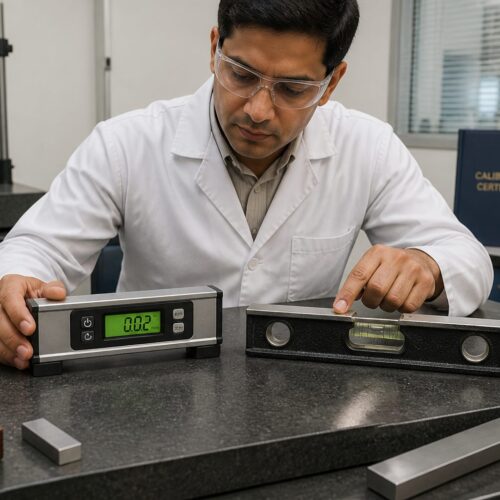
During calibration, trained technicians use precise instruments, such as autocollimators or electronic levels, to map the entire surface of the plate. They identify the highest and lowest points, calculating the overall flatness deviation. This process generates detailed data that reveals the plate’s current condition.
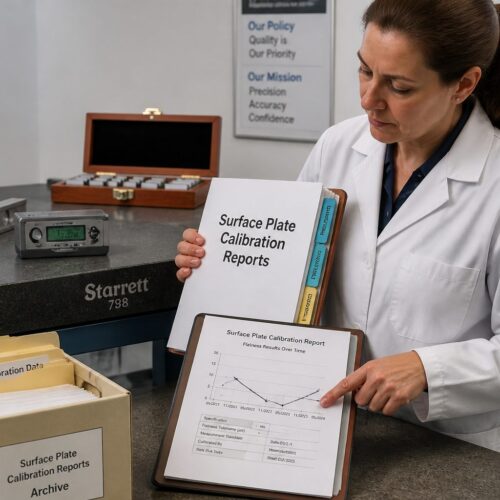
The calibration certificate provides a clear, quantitative assessment of your plate’s actual flatness, often including a graphical representation. This data allows you to verify if the plate still meets its original surface plate grades or if it has drifted into a lower grade. You can then make informed decisions about its continued use.
If your plate is no longer meeting its specified granite surface plate flatness tolerance, the calibration data will highlight exactly where the deviations occur. This information is invaluable for determining if reconditioning is feasible or if replacement is necessary. You gain visibility into the plate’s true performance.
Always review your calibration certificates thoroughly, paying close attention to the uncertainty values associated with the calibration itself. A robust calibration provides confidence in the reported flatness. This documentation is your proof that your reference surface is trustworthy.
Many facilities opt for annual or biennial calibration, depending on usage frequency and environmental conditions. This proactive approach helps catch deviations before they impact production quality. Don’t wait for measurement problems to arise before checking your plate’s health.
Ultimately, calibration data is the only objective way to confirm that your plate is fit for its intended purpose. It bridges the gap between theoretical specifications and real-world performance. Trusting your measurements starts with trusting your calibration reports.
Signs Your Current Grade Is Too Loose (or Too Tight)
Recognizing when your current surface plate grade is no longer suitable for your operations is crucial for maintaining quality and efficiency. Sometimes, the issue is obvious, but often, the signs are subtle and require careful observation. Identifying these issues can save you significant headaches down the line.
If your plate’s granite surface plate flatness tolerance is too loose, you might notice inconsistent measurement results for the same part, even when using the same instrument and operator. You get different readings simply by moving the part to another area of the plate. This inconsistency is a red flag indicating a poor reference surface.
Another sign of a loose tolerance plate is difficulty in achieving desired gauge R&R results during measurement system analyses. The plate’s inherent non-flatness will contribute to excessive variation, making it impossible to pass your studies. Your measurement uncertainty becomes too high for your needs.
Conversely, if your surface plate grade is too tight for your application, you might be overspending on equipment that provides unnecessary precision. For example, using an AA grade plate for rough layout work is a waste of resources. The higher cost of acquisition and calibration does not provide a proportional benefit for simpler tasks.
Signs of an overly tight grade include excessive wear on the plate from applications that do not require such precision, leading to faster degradation of its high tolerance. You are essentially using a precision instrument for a job that could be done with a more robust, lower-grade tool. This leads to premature replacement or reconditioning costs.
Another indicator is when operators are meticulously cleaning and handling a plate for measurements that could easily tolerate a few micro-inches of variation. This over-attention to detail for non-critical tasks can slow down workflow and introduce unnecessary complexity. Your operational efficiency suffers.
Regularly reassess your measurement needs and compare them against your current equipment’s capabilities. This periodic review ensures your surface plates are appropriately matched to your work. Don’t be afraid to adjust your strategy as your production needs evolve.
Buying New vs Reconditioning: Tolerance Tradeoffs
When your granite surface plate no longer meets its specified flatness tolerance, you face a choice: purchase a new plate or have your existing one reconditioned. Both options have distinct advantages and disadvantages, particularly concerning cost, lead time, and the achievable granite surface plate flatness tolerance. You need to weigh these factors carefully.
Buying a new surface plate guarantees a fresh start with a certified, high-precision surface. You get the exact surface plate grades you need, often with a longer warranty and the latest manufacturing improvements. This option is ideal if your current plate is severely damaged, undersized, or if you need a different grade entirely.
However, new plates come with a higher upfront cost and potentially longer lead times, especially for custom sizes or very high grades. You also need to factor in shipping and installation, which can be significant for larger plates. It is a substantial capital expenditure.
Reconditioning, or “relapping,” involves grinding and polishing the worn surface of your existing plate to restore its original flatness tolerance. This process extends the life of your investment, often at a fraction of the cost of a new plate. It is an environmentally friendly option as well, reducing waste.
The primary tradeoff with reconditioning is that it requires your plate to be out of commission for a period, impacting your measurement capabilities. While most reconditioning services are efficient, you still need to plan for downtime. The depth of wear can also limit how many times a plate can be reconditioned before it becomes too thin.
A reputable reconditioning service can restore a plate to its original surface plate grades, sometimes even improving it. They use the same precise methods as manufacturers to ensure the flatness meets the required standards. Always ensure the service provides a new calibration certificate after the reconditioning is complete.
The decision often comes down to budget, urgency, and the condition of your existing plate. If your plate has minor wear and you can manage the downtime, reconditioning is usually the more economical choice. For significant damage or a complete upgrade, a new plate might be more appropriate.
Practical Checklist for Specifying a Plate
Specifying a new granite surface plate or evaluating an existing one requires a systematic approach. This checklist will help you consider all the critical factors beyond just the basic dimensions. Making an informed decision ensures your metrology foundation is sound.
First, clearly define the required granite surface plate flatness tolerance based on the tightest tolerances of the parts you will measure. Use the 3:1 or 10:1 rule of thumb for measurement accuracy relative to part tolerance. Do not guess; base this on actual engineering requirements.
Next, determine the appropriate size of the surface plate. Ensure it is large enough to comfortably accommodate your largest workpieces and measurement instruments, allowing for ample working space. You want to avoid crowding the plate, which can lead to errors.
Consider the maximum weight of the parts and instruments that will be placed on the plate. This affects the required thickness of the granite and the design of the support stand to prevent deflection. A heavier load demands a more robust plate and stand combination.
Evaluate the environmental conditions of the intended location. Factors like temperature stability, vibration, and cleanliness all influence the plate’s performance. Consider an isolation stand if vibrations are a concern, or a temperature-controlled environment for ultra-high precision.
Specify additional features such as threaded inserts for clamping, ledges for accessory attachment, or special finishes. These small details can significantly improve the plate’s utility and ease of use in your specific application. Think about your workflow.
Always request a certificate of calibration traceable to national standards, like NIST, with any new or reconditioned plate. This document verifies the plate’s flatness tolerance and provides crucial data for your quality system. It is your assurance of quality.
Finally, plan for ongoing maintenance and future calibration. Understand the recommended cleaning procedures and calibration intervals for your chosen surface plate grades. Proactive care extends the life and accuracy of your investment.
Conclusion
Choosing the correct granite surface plate flatness tolerance is not a trivial decision; it is foundational to accurate metrology. This choice directly impacts the reliability of your measurements, the quality of your products, and your operational efficiency. Overlooking these details can lead to costly mistakes and a lack of confidence in your data.
By understanding the different surface plate grades, the factors that influence plate flatness, and the role of calibration, you can make informed decisions. Matching your plate’s precision to your specific measurement tasks ensures you are neither overspending nor compromising on accuracy. It is about smart investment.
Remember that the plate’s tolerance is just one piece of the puzzle in overall measurement uncertainty. Environmental conditions, operator skill, and the calibration of other instruments all play a role. A holistic approach to your metrology setup will yield the best results.
Regular calibration is your best defense against drift and wear, providing objective data on your plate’s true condition. This proactive maintenance ensures your surface plates remain reliable reference standards for years to come. Do not underestimate the power of consistent checks.
Whether you are buying new or considering reconditioning, carefully weigh the tradeoffs to select the option that best suits your needs and budget. The longevity and accuracy of your metrology department depend on these thoughtful decisions. Your commitment to precision starts with a truly flat surface.
Ultimately, a well-chosen and well-maintained granite surface plate is an indispensable tool in any precision manufacturing or inspection environment. It acts as the bedrock for all your dimensional measurements. Invest in the right flatness tolerance, and you invest in your quality assurance.