
A surface plate is the bedrock of precision measurement, but its accuracy relies heavily on its foundation. Neglecting surface plate stand maintenance can silently undermine your metrology, leading to costly errors and compromised results.
Many technicians focus solely on the plate’s granite surface, overlooking the critical role the stand plays in supporting its inherent flatness and stability. Proper care for your stand ensures the plate performs as intended, providing a true reference plane for all your work.
This guide will walk you through essential practices for surface plate stand maintenance, from routine inspections of leveling feet to preventing stand rust and implementing effective vibration isolation. Maintaining your stand is a small investment that pays huge dividends in measurement confidence.
How stand condition affects what you see on the plate
The condition of your surface plate stand directly influences the accuracy of every measurement taken on the plate’s surface. A compromised stand can introduce subtle distortions, even on a perfectly calibrated granite plate.
Imagine trying to measure a precise component on a table that subtly rocks or twists; the same principle applies to your surface plate. Any instability in the stand translates into measurement uncertainty, affecting your quality control.
An unevenly supported plate can develop localized stresses, causing the granite to flex microscopically over time. This flexing can temporarily or permanently alter the plate’s certified flatness, making your measurements unreliable.
Poor surface plate stand maintenance, such as neglected leveling feet, can allow the plate to settle unevenly, introducing a slight tilt or even a measurable twist. Such issues are often invisible to the naked eye but devastating to precision.
Furthermore, a stand showing signs of stand rust or structural fatigue will not provide the rigid support necessary for consistent metrology. This leads to inconsistent readings that are difficult to diagnose and correct, wasting valuable production time.
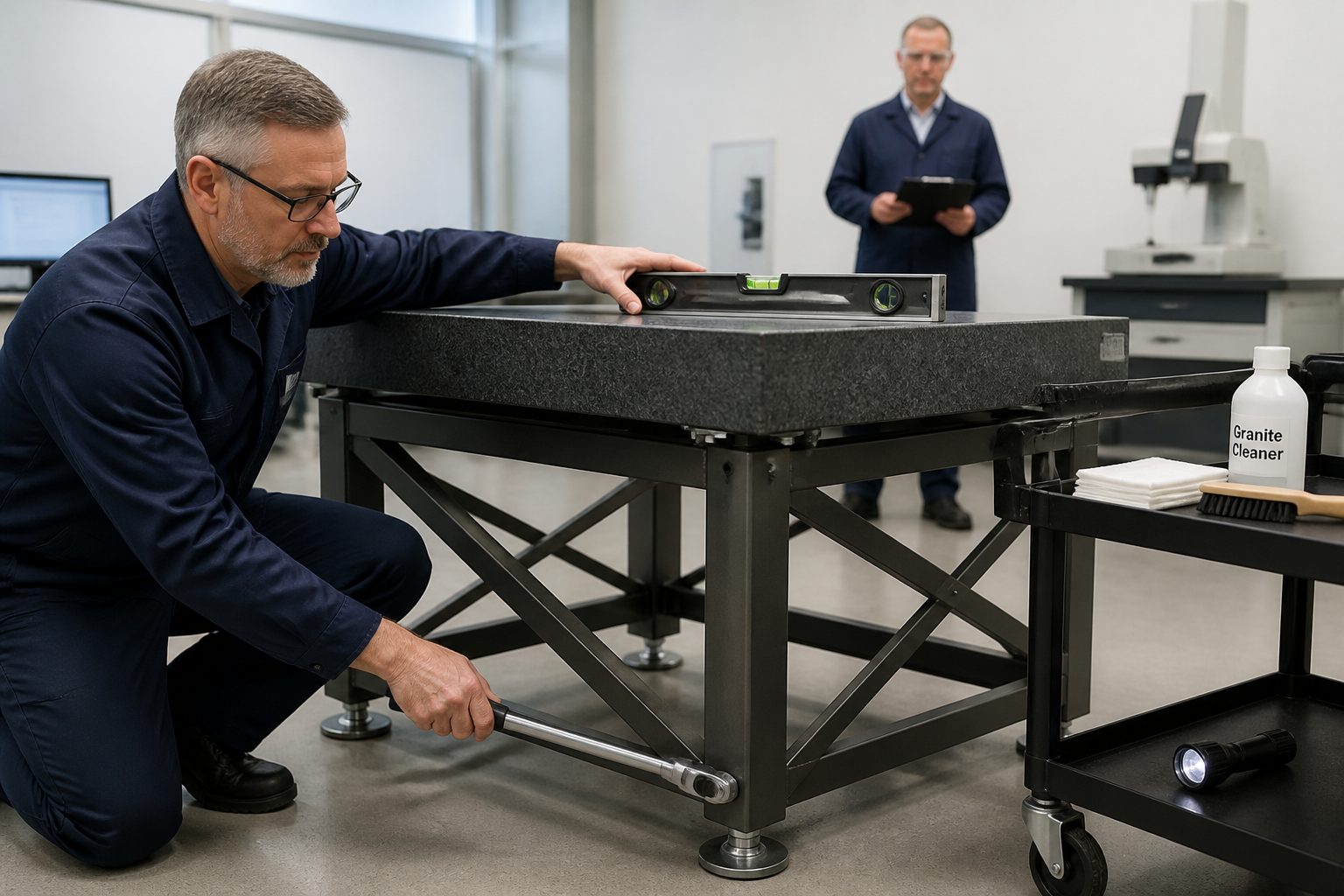
Even minor stand vibrations, which might seem insignificant, can cause instruments to chatter or provide unstable readings. Effective vibration isolation is therefore not just a luxury but a requirement for high-precision applications.
Ultimately, ignoring your surface plate stand maintenance means you are not truly measuring against a stable, flat reference. You are introducing variables that can easily invalidate your most careful work, impacting product quality.
Identifying your stand type and support layout
Understanding your specific surface plate stand type and its intended support layout is the first step in effective surface plate stand maintenance. Different designs require distinct approaches to inspection and care.
Most granite surface plates are supported at three points, forming a kinematic mount that ensures stability and prevents rocking. However, larger plates might use more complex support systems, often incorporating a greater number of leveling feet.
| Stand Type | Common Plate Size Range | Support Point Configuration |
|---|---|---|
| Welded Steel Frame | Up to 36″ x 48″ | Three adjustable leveling feet, often with fixed pads |
| Heavy-Duty Steel Cabinet | 48″ x 72″ to 72″ x 144″ | Three primary leveling feet, sometimes with additional fixed supports for stability |
| Modular Aluminum Profile | Custom sizes, often smaller | Four or more adjustable feet, requiring careful leveling to avoid twist |
| Pneumatic Vibration Isolation Stand | Any size, especially for high-precision | Three or four air springs with internal leveling, critical for vibration isolation |
Inspecting leveling feet, pads, and contact points
A thorough inspection of your leveling feet, support pads, and all contact points is paramount for effective surface plate stand maintenance. These components directly transfer the plate’s weight to the floor, influencing stability.
Begin by visually checking each leveling foot for any signs of damage, corrosion, or deformation. A bent or rusted leveling foot cannot provide proper support, leading to an unstable plate.
Examine the pads between the leveling feet and the floor; these are often made of rubber or plastic to protect the floor and aid in minor vibration isolation. Worn, cracked, or hardened pads can compromise stability and introduce movement.
The contact points where the granite plate rests on the stand’s support pads are equally important. Ensure these pads are clean, free of debris, and not excessively compressed or damaged, as this can create uneven pressure.
Sometimes, the stand employs adjustable screws or wedges directly under the plate’s designated support points. Check these for proper engagement and ensure they are not overtightened, which can induce stress into the granite.
Look for any gaps between the stand’s structure and the floor, especially around the leveling feet. Even small gaps indicate improper contact and potential rocking, which will affect your precision measurements.
Rotate the leveling feet gently to ensure they move freely without binding or excessive play. Sticky or stiff feet make accurate leveling difficult, frustrating your surface plate stand maintenance efforts.
Pay close attention to the floor directly beneath each foot; any indentations or damage to the floor itself can also impact the stand’s stability. A stable floor is as important as a stable stand.
Cleaning under and around the stand without disturbing support
Regular cleaning under and around your surface plate stand is a crucial part of surface plate stand maintenance, but it must be done carefully to avoid disturbing the plate’s level. Accumulations of dust, grime, and debris can interfere with stability.
Before cleaning, identify the exact locations of your leveling feet and support points to ensure you do not inadvertently shift them. Marking their positions with tape can provide a useful visual reference.
Use a vacuum cleaner with a brush attachment to remove loose dust and particles from the floor around the stand and under the plate’s overhang. Avoid bumping the stand or any of its leveling feet during this process.
For tougher grime, dampen a cloth with a mild cleaner and carefully wipe the floor surfaces, taking extreme care not to apply pressure to the stand itself. Never spray cleaning solutions directly near the stand, as moisture can lead to stand rust.
Pay particular attention to the areas directly beneath the leveling feet; compressed dirt or small foreign objects can alter the effective height of a foot. Gently clear any obstructions without lifting or twisting the stand.
Regularly inspect the area for any signs of spills or leaks that might affect the stand’s structural integrity or cause stand rust. Promptly address any moisture issues to prevent long-term damage.
Proper cleaning also extends to the visible parts of the stand itself, wiping down the frame and legs to remove dust and fingerprints. This not only improves appearance but also allows for easier detection of emerging issues.
A clean environment minimizes the risk of foreign particles migrating under the leveling feet or contaminating the precision surface plate. This simple step supports overall metrology accuracy.
Tightening hardware and checking for looseness safely
Periodically checking and tightening all hardware on your surface plate stand is a vital aspect of surface plate stand maintenance. Loose bolts or fasteners can introduce subtle movements, compromising measurement stability.
When performing this check, work methodically and always ensure the plate remains fully supported; never loosen all fasteners simultaneously. Tighten bolts gradually and crosswise to distribute stress evenly.
- Inspect all visible bolts, nuts, and screws
- Use appropriate wrenches and torque settings
- Tighten support frame connections
- Secure bracing and cross-members
- Check leveling foot locking nuts
- Verify casters (if present) are locked or removed
- Ensure no components are rattling or vibrating
Rust and corrosion control for stand components
Stand rust and corrosion are insidious enemies of surface plate stability, silently degrading the structural integrity of your stand over time. Proactive rust and corrosion control are essential for long-term surface plate stand maintenance.
Steel stands are particularly susceptible to rust, especially in humid environments or areas prone to temperature fluctuations that cause condensation. Even minor rust can compromise load-bearing capabilities and appearance.
Regularly inspect all metal components of your stand for any signs of rust, including discoloration, pitting, or flaking paint. Pay close attention to welds, joints, and the undersides of cross-members where moisture might collect.
If you discover superficial stand rust, address it immediately by carefully cleaning the affected area with a wire brush or sandpaper. Follow this with a rust-inhibiting primer and a protective paint finish to seal the metal.
For more severe corrosion, consider consulting with a metalwork professional to assess the structural integrity of the affected component. Sometimes, replacement might be the only safe option to ensure continued stability.
Applying a thin layer of protective wax or a corrosion-inhibiting spray to exposed metal surfaces can create a barrier against moisture and air. This simple preventive measure significantly extends the stand’s lifespan.
Maintaining a consistent, low-humidity environment in your metrology lab is one of the most effective ways to prevent stand rust. Dehumidifiers can play a critical role in preserving both your plate and its stand.
Always ensure that any cleaning solutions used on or around the stand are non-corrosive and completely dry before leaving the area. Residual moisture is a primary contributor to rust formation on metal surfaces.
Checking for rocking, twist, and uneven floor contact
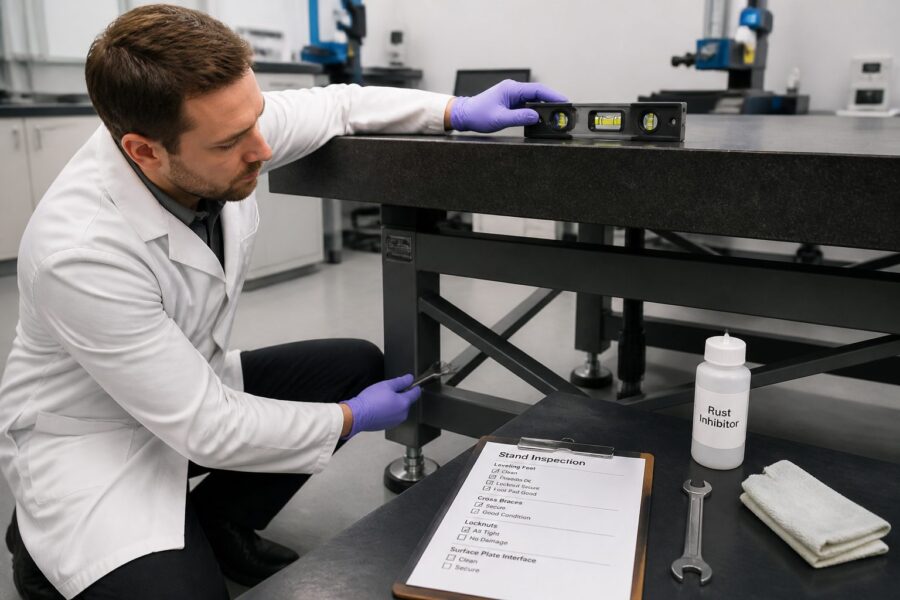
A stable surface plate stand should never rock, twist, or exhibit uneven floor contact; these issues are immediate red flags for compromised measurement integrity. Regular checks are vital for surface plate stand maintenance.
To check for rocking, gently push down on each corner of the surface plate, one at a time. Any perceptible movement indicates that the stand is not making solid, three-point contact with the floor.
Rocking usually means one or more leveling feet are not properly adjusted or are resting on an uneven patch of floor. Adjust the leveling feet incrementally until all movement is eliminated, ensuring even load distribution.
To detect twist, place a precision level or an electronic inclinometer across various diagonals and edges of the plate. Significant differences in readings suggest the stand itself might be twisting the granite.
A twisted stand can be caused by uneven floor surfaces, improperly tightened hardware, or even structural damage. Addressing these underlying causes is critical to restoring the plate’s inherent flatness.
Uneven floor contact can also be identified by looking for gaps under the leveling feet or pads. Even small gaps indicate that the stand is not fully supported, leading to potential instability and stress points.
Sometimes, the floor itself is the problem, with high spots or depressions preventing proper leveling. In such cases, shims can be carefully placed under the leveling feet, but this should be a temporary solution.
The ultimate goal is for the stand to sit perfectly flat and rigid on the floor, providing an unyielding foundation for the surface plate. This ensures that the plate’s flatness is truly reflected in your measurements.
Vibration sources and simple isolation improvements
External vibrations are silent destroyers of measurement accuracy, and effective vibration isolation is a critical component of advanced surface plate stand maintenance. Even subtle tremors can impact precision.
Identify potential vibration sources in your workspace, such as nearby machinery, heavy foot traffic, or even HVAC systems. Understanding the source helps in choosing the right isolation strategy.
Simple vibration isolation improvements often start with the leveling feet themselves. Many stands come with rubber or neoprene pads designed to absorb minor shocks and dampen high-frequency vibrations.
For more significant vibration issues, consider upgrading to specialized vibration isolation pads or mounts for your leveling feet. These often incorporate elastomers or air bladders for superior dampening capabilities.
Placing the entire stand on a dedicated vibration isolation platform can provide a comprehensive solution for highly sensitive applications. These platforms typically use pneumatic or spring-based systems to decouple the plate from floor vibrations.
Ensure that the surface plate is not in direct contact with any walls, workbenches, or other equipment that could transmit vibrations. Maintain a clear perimeter around the stand for optimal performance.
Even the floor itself can act as a vibration transmitter; heavy-duty anti-fatigue mats or specialized flooring materials can sometimes offer additional dampening. Every layer of isolation helps.
Regularly check that all vibration isolation components are in good condition, free from cracks, hardening, or excessive compression. Worn isolation pads lose their effectiveness over time, requiring replacement.
When to replace feet, pads, or the stand itself
Knowing when to replace components like leveling feet, pads, or even the entire stand is a critical decision in surface plate stand maintenance. Attempting to repair severely damaged parts can compromise accuracy.
Replace leveling feet if they are bent, heavily corroded, stripped, or no longer adjust smoothly. A faulty leveling foot prevents proper leveling and introduces instability, invalidating your efforts.
Support pads, whether under the plate or the leveling feet, should be replaced if they show signs of significant wear, cracking, hardening, or permanent compression. Degraded pads lose their dampening and support capabilities.
Any sign of structural damage to the stand, such as cracked welds, severely bent members, or extensive stand rust that compromises load-bearing integrity, warrants immediate attention. Do not compromise safety or accuracy.
If the stand consistently exhibits rocking, twisting, or an inability to maintain level despite careful adjustments, it might indicate a fundamental flaw or deformation in the frame. This suggests replacement is necessary.
Consider replacing the stand if your metrology requirements increase significantly, demanding a higher level of vibration isolation or stability than your current stand can provide. Sometimes an upgrade is simply necessary.
Older stands might lack the design features or material quality to adequately support modern, higher-precision surface plates. Investing in a new, purpose-built stand can be more cost-effective than constant troubleshooting.
Always prioritize measurement accuracy and operator safety when making replacement decisions. A compromised stand is a liability, not an asset, in any precision environment.
Creating a quarterly stand inspection checklist
Implementing a structured quarterly stand inspection checklist is the backbone of proactive surface plate stand maintenance. This ensures consistent care and early detection of potential issues.
A regular schedule prevents small problems from escalating into major disruptions, saving time and money in the long run. Consistency is key to maintaining measurement integrity.
Your checklist should begin with a visual inspection of all leveling feet, checking for damage, rust, or debris. Confirm that all leveling feet adjust smoothly and are securely locked in place.
Next, inspect all support pads, both under the plate and under the feet, for wear, hardening, or compression. Replace any pads showing signs of degradation to maintain proper dampening and support.
Include a check for stand rust on all metal components, especially welds and joints. Address any surface rust immediately and document areas requiring ongoing monitoring.
Perform the rocking and twist test as described earlier, gently pushing on corners and checking with a precision level. Adjust leveling feet as needed until the stand is perfectly stable and level.
Verify that all bolts, nuts, and fasteners are securely tightened throughout the stand’s frame and cross-members. Loose hardware is a common cause of subtle instability and requires immediate attention.
Review your workspace for new potential vibration sources and confirm that existing vibration isolation measures are still effective. Ensure there is no direct contact between the plate/stand and other equipment.
Finally, clean the area under and around the stand, ensuring no debris interferes with the leveling feet or floor contact. Document all findings and actions taken, creating a history for your surface plate stand maintenance efforts.
Conclusion
Effective surface plate stand maintenance is not merely an afterthought; it is a fundamental requirement for achieving and maintaining precision in metrology. The stand is the unsung hero supporting your critical measurements.
By consistently inspecting leveling feet, controlling stand rust, and ensuring robust vibration isolation, you actively protect your investment in high-quality granite surface plates. These efforts directly translate into reliable data.
Ignoring the stand’s condition is akin to building a skyscraper on shifting sands; the foundation must be impeccable for the structure to stand true. Your measurement results depend on this stable base.
A well-maintained stand minimizes the risk of measurement errors, reduces the need for frequent recalibration, and extends the overall lifespan of your valuable metrology equipment. It represents smart asset management.
Implement a regular inspection schedule, empower your team with the knowledge to perform basic checks, and address any issues promptly. Proactive surface plate stand maintenance is your best defense against accuracy drift.
Invest the time and resources into proper stand care, and you will reap the rewards of consistent, verifiable precision in all your critical manufacturing and inspection processes. Your metrology will thank you.