
Surface plates are the bedrock of precision measurement, providing an unyielding, flat reference plane for inspection and calibration tasks. These granite giants, revered for their stability and accuracy, demand careful handling and meticulous maintenance to preserve their integrity. Ignoring proper care can lead to costly damage, compromising the very precision they are designed to uphold.
When a surface plate isn’t in active use, whether for short-term downtime or a significant relocation, its protection becomes paramount. Implementing robust surface plate storage best practices ensures your investment remains accurate and ready for its next critical application. This guide walks you through the essential steps to safeguard your granite calibration standards, from initial cleaning to post-storage re-verification.
You want to protect your precision tools; this means understanding the environmental factors that can degrade granite and how to mitigate them. Proper storage is not merely about covering the plate, it involves a calculated approach to prevent damage, contamination, and dimensional instability. Let’s make sure your valuable metrology equipment is cared for correctly.
When storage is the right choice (and when it isn’t)
Deciding to store a surface plate is a practical consideration for many facilities, especially during facility upgrades or extended periods of inactivity. If a plate will sit unused for more than a few weeks, proper long term storage becomes a smart strategy. This proactive approach prevents incidental damage and environmental exposure that can occur in an active workspace.
However, storage is not always the best solution for every situation. For plates that see daily or even weekly use, keeping them readily accessible on their stands is generally more efficient. Frequent use helps maintain a stable temperature and prevents dust from settling deeply into the granite pores.
Consider the cost of preparing a plate for storage versus the benefits of keeping it ready for immediate use. Smaller plates, often used for quick checks, might not warrant extensive storage procedures for brief downtimes. Larger, more critical master plates, however, always benefit from dedicated long term storage care.
Relocation is a clear instance where comprehensive storage and packing is absolutely necessary. Moving a surface plate without proper protective packaging inevitably leads to damage, even over short distances. This is a non-negotiable step to ensure the plate arrives at its new location undamaged.
Conversely, leaving a valuable surface plate exposed in a dusty or humid environment, even when not in use, is never a good idea. This practice invites contamination, corrosion of accessories, and potential dimensional changes in the granite itself. Proper surface plate storage best practices are always a better option than neglect.
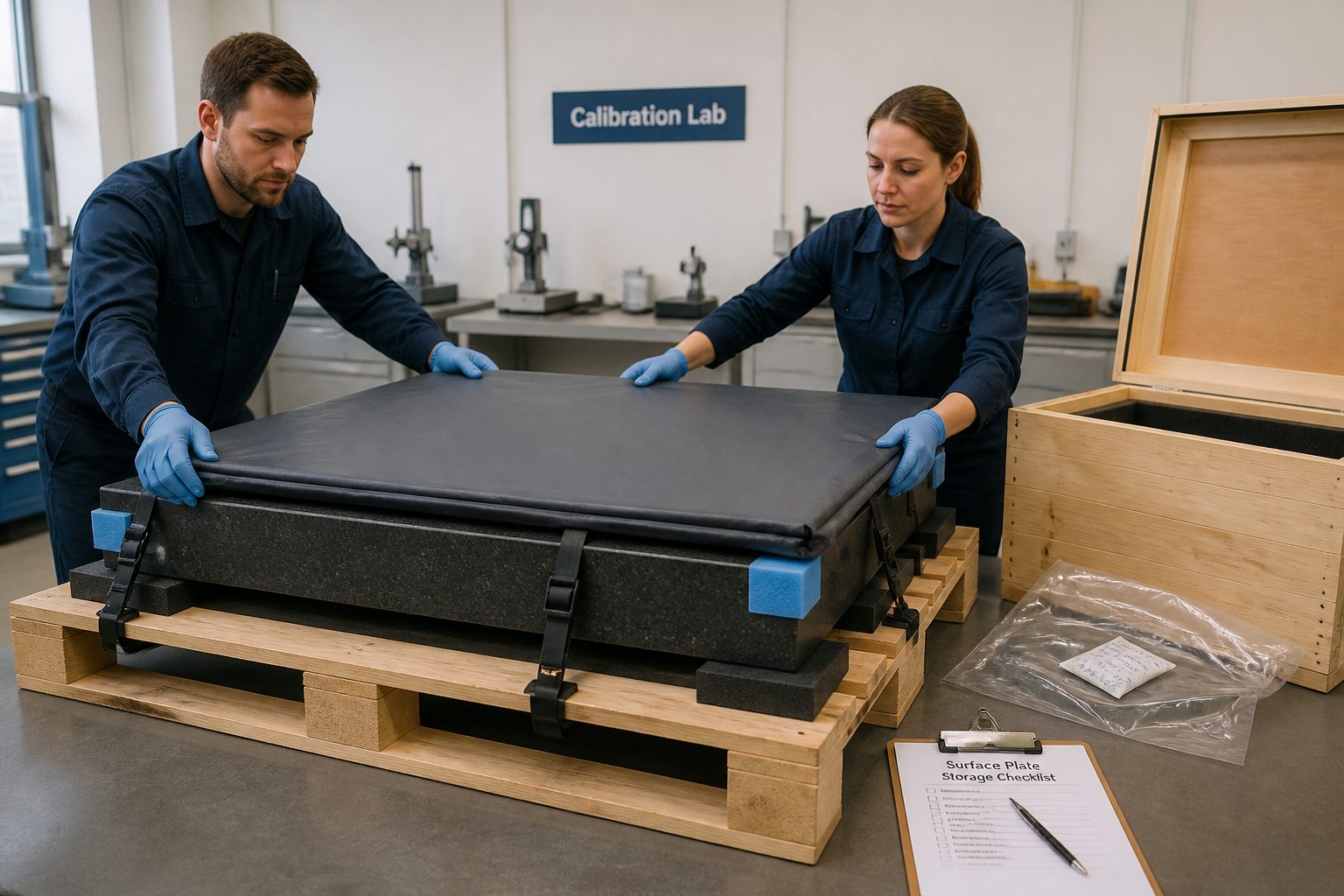
Short-term storage solutions can involve simply covering the plate on its existing stand with a robust, non-abrasive cover. This protects it from ambient dust and minor impacts while remaining largely available. Longer periods demand more intensive preparation and a dedicated storage environment.
Evaluate your facility’s environment and usage patterns before committing to full long term storage procedures. Sometimes, a simple heavy-duty cover and consistent environmental control in the lab is sufficient. The goal is always to protect the plate’s accuracy and extend its service life.
Cleaning and drying the plate before storage
Thorough cleaning is the first and most critical step before placing any surface plate into storage. Any contaminants left on the working surface can etch the granite or attract moisture, leading to long-term damage. You want to remove all traces of dirt, oil, and debris from the plate.
Begin by using a specialized surface plate cleaner, designed to lift grease and grime without leaving residues. Apply the cleaner sparingly and wipe it across the entire working surface with a clean, lint-free cloth. Work in small sections to ensure complete coverage and effective cleaning.
After cleaning, a crucial step is to meticulously dry the plate, leaving no moisture behind. Residual moisture can promote mold growth or even lead to mineral deposits on the granite surface over time. Use a second, dry, lint-free cloth to thoroughly buff the surface until it is completely dry to the touch.
Some technicians prefer to use denatured alcohol for a final wipe-down, as it evaporates quickly and leaves no residue. If you choose this method, ensure adequate ventilation and use it sparingly, as excessive alcohol can dry out the granite over time. The primary goal is a perfectly clean and dry surface.
Do not use abrasive cleaners or harsh solvents that could damage the finely lapped surface of the granite. Stick to products specifically formulated for surface plate maintenance. This careful approach maintains the plate’s precision and prevents unnecessary wear.
Remember to clean the sides and edges of the plate as well, not just the working surface. Dust and grime can accumulate in these areas and eventually migrate onto the critical measuring plane. A comprehensive cleaning effort contributes significantly to effective surface plate storage best practices.
Finally, inspect the plate under good lighting to ensure no streaks, smudges, or particles remain. A clean plate is a protected plate, ready for its long-term rest without fear of degradation from lingering contaminants. This meticulous preparation truly pays off in the long run.
Choosing storage orientation and proper support points
The orientation of your surface plate during storage directly impacts its long-term stability and accuracy. Incorrect support points can induce stress and cause temporary or even permanent deformation. You must always consider the plate’s design and intended use when deciding how to store it.
Generally, storing a surface plate face-up is the preferred method for most applications. This allows the plate to rest on its original support points, maintaining the stress distribution it experiences during normal operation. It also makes it easier to inspect and prepare for future use.
| Plate Size/Type | Recommended Storage Orientation | Key Considerations |
|---|---|---|
| Small to Medium (up to 36×48 inches) | Face-up on dedicated stand | Maintains natural stress, easy access for covering. |
| Large (over 36×48 inches) | Face-up on dedicated stand or custom supports | Critical for preserving accuracy; weight distribution is paramount. |
| Master Plates (any size) | Face-up on dedicated stand, minimal movement | Highest precision requires most stable environment. |
| Plates for Relocation | Face-up or on edge in custom crate | Depends on crate design, ensure full support, prevent shifting. |
| Vertical Storage (rare, for specific cases) | On edge, fully supported along bottom and sides | Only for very thick plates or specialized racks, distribute weight evenly. |
Ensure the plate rests on its specified support points, typically three points for smaller plates and five for larger ones. These points are engineered to minimize deflection and maintain the plate’s flatness. Using incorrect or insufficient support points can warp the granite over time.
If you must store a plate on its edge, perhaps due to space constraints, this requires extreme caution and specialized support. The entire bottom edge must be uniformly supported, and the sides should have bracing to prevent tipping or stress concentrations. This is rarely recommended for long-term storage of precision granite.
Never store a surface plate directly on an uneven floor or on makeshift supports like wooden blocks that are not properly aligned. Such practices can introduce localized stresses, leading to permanent deformation of the granite. Invest in proper stand and support points for any long term storage plan.
For very large or master plates, consider using vibration-dampening pads under the support points to isolate the plate from floor vibrations. This extra measure reduces micro-movements that could subtly affect the plate’s stability over extended periods. Proper support is a cornerstone of effective surface plate storage best practices.
Always consult the manufacturer’s recommendations for specific support point locations and preferred storage orientations for your particular surface plate. They know the design best and can offer the most accurate advice. Following these guidelines ensures your plate retains its calibrated accuracy.
Protecting the working surface from dust and impact
Once your surface plate is clean, dry, and correctly oriented, the next priority is to shield its delicate working surface. Dust, debris, and accidental impacts pose significant threats to the plate’s precision. A robust protective covering is absolutely essential for any storage scenario.
Start by covering the entire working surface with a layer of non-abrasive material, like a heavy-duty plastic sheeting or a specialized surface plate cover. This material should be clean and free of any particles that could scratch the granite. Avoid using blankets or tarps that shed fibers.
For added protection, especially during long term storage, consider applying a thin, even coat of a rust preventative or a specialized surface plate wax. This creates a barrier against moisture and airborne contaminants. Always choose products that are easy to remove without leaving residue.
After applying any protective coating, secure the cover tightly to prevent dust and moisture from infiltrating underneath. Use clamps or heavy-duty tape around the edges, ensuring a snug fit. The goal is to create a sealed environment for the granite surface.
Beyond simple covers, physical barriers are often necessary to protect against accidental impact. If storing the plate in an active workshop, consider constructing a sturdy wooden frame or barrier around the plate. This prevents tools or equipment from accidentally bumping into the granite.
Even in dedicated storage areas, a protective packaging solution like a custom-fitted wooden crate offers the best defense. This is especially true for master plates or during relocation. The crate provides a rigid shell against drops, bumps, and crushing forces.
Remember that even seemingly minor impacts can chip the edges or alter the flatness of a precision surface plate. Investing in proper protective measures is far less expensive than repairing or replacing a damaged plate. This diligent approach is a core component of effective surface plate storage best practices.
Regularly check stored plates, even those in long term storage, to ensure their protective covers remain intact. A torn cover or compromised seal can quickly negate all your careful preparation. Vigilance is key to maintaining the integrity of your granite calibration standards.
Controlling moisture and preventing condensation
Moisture is arguably the greatest enemy of stored surface plates, capable of causing more insidious damage than dust or minor impacts. Condensation, in particular, can lead to surface etching, mold growth, and even subtle dimensional changes in the granite. You must actively manage the humidity around your stored plates.
The ideal storage environment for a surface plate is a climate-controlled area with stable temperature and humidity levels. Aim for temperatures between 68-72°F (20-22°C) and relative humidity between 40-50%. These conditions minimize the risk of condensation forming on the granite surface.
Even with climate control, placing desiccant packs underneath the protective cover can provide an extra layer of defense. Silica gel packets or other moisture-absorbing materials will actively draw humidity away from the granite surface. Remember to replace or reactivate these desiccants periodically for continued effectiveness.
Avoid storing surface plates in basements, unheated garages, or other areas prone to significant temperature fluctuations and high humidity. These environments are breeding grounds for condensation, especially when warm, moist air meets the cooler granite. Such conditions are detrimental to long term storage.
If storing a plate in a non-climate-controlled space is unavoidable, wrap the entire plate in a vapor-proof barrier after the initial cover is applied. This could be thick polyethylene sheeting, sealed tightly with tape to create an airtight enclosure. The barrier traps the dry air around the plate and prevents outside moisture from reaching it.
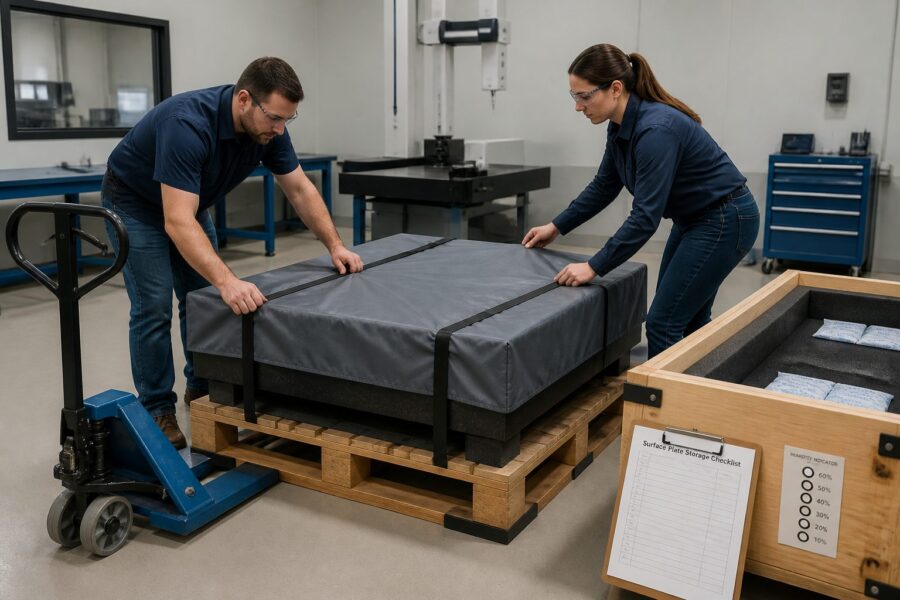
Consider placing the plate on a pallet or elevated platform to keep it off the cold floor. This simple step helps prevent temperature differentials that can lead to condensation forming on the underside of the plate. Elevating the plate also protects it from potential floor-level spills or minor flooding.
Regular monitoring of the storage environment is crucial, even for plates in long term storage. Use a hygrometer to track humidity levels and adjust as necessary. Proactive moisture control is a defining characteristic of excellent surface plate storage best practices.
Labeling, access control, and preventing “borrowed as a table” use
Proper labeling and strict access control are often overlooked aspects of surface plate storage best practices, but they are incredibly important. A well-labeled and secured plate prevents confusion, accidental misuse, and unauthorized access. You want to make it clear that this is not just any flat surface.
Clearly label the stored surface plate with its identification number, calibration status, and the date it was placed into storage. Include a prominent warning that it is precision equipment and should not be used as a workbench or temporary table. This simple step can save your plate from accidental damage.
- Plate identification number
- Last calibration date
- Next calibration due date
- Storage start date
- “PRECISION EQUIPMENT – DO NOT USE AS TABLE” warning
- Contact person for retrieval
Implement access control measures, especially for master plates or those in long term storage. This might involve storing them in a locked cabinet, a dedicated metrology room, or a restricted access area. Limiting who can touch or move the plate significantly reduces the risk of misuse.
The “borrowed as a table” phenomenon is a persistent threat in many workshops, where a large, flat surface seems like an irresistible spot for tools, parts, or lunchboxes. Clear signage and physical barriers are your best defense against this common form of abuse. Educate your team about the plate’s value.
Consider adding a physical deterrent, such as a lightweight but sturdy cover that is difficult to remove without specific tools or keys. This sends a clear message that the plate is not for casual use. Preventing misuse is just as important as protecting it from environmental factors.
Maintain a logbook for all stored surface plates, detailing their location, storage conditions, and any planned retrieval dates. This documentation helps track your assets and ensures proper procedures are followed when a plate is brought back into service. Good record-keeping supports all aspects of surface plate care.
Regularly reinforce the importance of proper surface plate handling and storage with all personnel who might come into contact with the equipment. A culture of respect for precision tools is the ultimate safeguard against improper use. This proactive communication supports your surface plate storage best practices.
Storing plates on stands vs off stands
The decision to store a surface plate on its dedicated stand or remove it for storage depends on several factors, including plate size, storage duration, and available space. Both approaches have their merits and drawbacks, which you need to weigh carefully. You want to pick the option that best preserves your equipment.
Storing a plate on its stand is generally preferred for short-term downtime or when the plate will be accessed relatively frequently. This method maintains the plate’s familiar support geometry, minimizing stress changes and making it easier to return to service. It’s often the simplest form of protective packaging for brief periods.
However, leaving a plate on its stand can consume significant floor space, which might be a concern in crowded facilities. It also leaves the plate more exposed to general workshop activity and potential accidental impacts. For long term storage in a dedicated area, removing it from the stand might be more practical.
Removing the plate from its stand allows for more compact storage, potentially stacking plates with proper protective spacers and packaging. This approach is common when relocating multiple plates or preparing for very long periods of inactivity. It requires careful lifting and handling equipment to avoid damage.
If storing off the stand, ensure the plate rests on its proper support points within a custom crate or on a robust, level platform. Never let the plate rest on its edges or corners without full, even support. Incorrect off-stand support can induce severe stress and compromise flatness.
For large and heavy plates, the effort and risk involved in removing them from their stands might outweigh the benefits of off-stand storage. The sheer weight makes handling a hazard, and any mishandling can lead to costly damage. Always prioritize safety and plate integrity.
Consider the total protective packaging solution. If the plate is going into a custom-built crate for long term storage or relocation, the crate itself will provide the necessary support structure, making the original stand redundant. The crate becomes the new stand and support points.
Ultimately, the choice comes down to balancing convenience, space efficiency, and the paramount need to protect the plate’s accuracy. Whichever method you choose, ensure the plate is always properly supported and protected from its environment. These are non-negotiable aspects of effective surface plate storage best practices.
Packing for a move: corners, edges, and vibration
Relocating a surface plate is a high-risk operation that demands meticulous planning and specialized protective packaging. The corners, edges, and susceptibility to vibration are particularly vulnerable points during transit. You must anticipate every potential hazard to ensure safe delivery.
The first step for any move is a robust custom-built crate, ideally made from sturdy wood. This crate should be designed to completely enclose the surface plate, providing rigid protection against external impacts. Ensure the crate is strong enough to bear the plate’s weight and any stacking loads.
Pay special attention to the corners and edges of the surface plate, as these are highly susceptible to chipping during transit. Wrap all corners with thick, protective padding, such as dense foam or rubber corner protectors. Secure these protectors firmly in place with strong tape.
Inside the crate, the surface plate must be securely immobilized to prevent any movement or shifting during transportation. Use custom-cut foam inserts or wooden blocking to fill any gaps between the plate and the crate walls. The plate should fit snugly without being under compressive stress.
Vibration is another major concern during transit, potentially causing microscopic wear or even subtle changes in the granite’s internal structure over long distances. Incorporate vibration-dampening materials, such as rubber mats or specialized foam, underneath the plate within the crate. These materials absorb shocks.
Ensure the plate rests on its proper support points within the crate, mimicking its operational setup. This prevents undue stress during the journey. If the plate is large, consider bolting it to the crate’s base through its stand and support points, if safe and practical.
Clearly label the crate with “FRAGILE,” “PRECISION EQUIPMENT,” and “THIS SIDE UP” indicators on all sides. Include arrows showing the correct orientation. These labels guide handlers and prevent improper lifting or stacking, which is critical for safe transport.
Document the plate’s condition with photographs before it is packed and again upon arrival. This provides a clear record of its state before and after transit. Such documentation can be invaluable for insurance claims or resolving disputes regarding damage.
Work with experienced movers who specialize in handling heavy, delicate equipment. Their expertise in rigging, lifting, and securing loads is essential for a successful relocation. Professional handling is a crucial part of surface plate storage best practices when moving.
Unpacking and reintroducing the plate to service
Unpacking a surface plate requires as much care as packing it, ensuring a smooth transition back into service without incurring damage. Haste or carelessness during this phase can undo all the previous protective efforts. You want to take your time and follow a methodical approach.
Begin by carefully positioning the crated plate in its intended new location, allowing sufficient space for unpacking. Use appropriate lifting equipment, such as a forklift or crane, to move the crate safely. Never attempt to manually lift a large surface plate.
Slowly remove the outer protective packaging, starting with the crate lid and then the side panels. Work methodically, taking care not to damage the plate with pry bars or other tools. Keep the area clear of debris as you unpack.
Once the plate is exposed, carefully remove all internal packing materials, such as foam inserts, corner protectors, and vibration dampeners. Store these materials for potential future use or dispose of them responsibly. Ensure no small pieces are left on the plate’s surface.
If the plate was protected with a wax or rust preventative, meticulously clean it off using the manufacturer’s recommended solvent and lint-free cloths. This is a critical step to ensure the working surface is completely clean before any measurements are taken. A perfectly clean surface is essential for accuracy.
Carefully lift the surface plate from the crate and place it onto its dedicated stand, ensuring it rests squarely on all designated support points. Use proper lifting straps and spreader bars to distribute the weight evenly. Never use chains or cables directly on the granite.
Allow the surface plate to acclimate to its new environment’s temperature and humidity for at least 24-48 hours, or even longer for very large plates. This acclimation period minimizes thermal shock and allows the granite to stabilize dimensionally. Rushing this step can affect accuracy.
After acclimation, perform a preliminary visual inspection for any signs of damage incurred during transit. Look for chips, cracks, or surface imperfections. This initial check helps identify any issues before formal calibration. This methodical reintroduction is key to surface plate storage best practices.
Post-storage checks you should perform before use
Bringing a surface plate back into active service after any period of storage requires a series of thorough checks. These post-storage inspections are non-negotiable to confirm the plate’s integrity and accuracy before critical measurements resume. You cannot assume a stored plate is immediately ready for precision work.
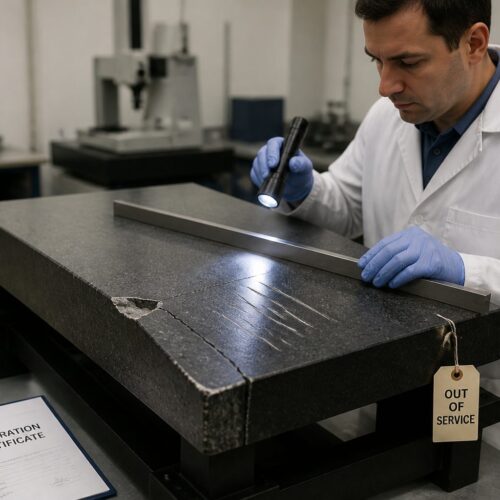
First, perform a comprehensive visual inspection of the entire plate surface, looking for any chips, scratches, or signs of etching that might have occurred during storage or transit. Pay close attention to the corners and edges, as these areas are most vulnerable. Even minor surface defects can impact readings.
Next, thoroughly clean the working surface once more, even if it appeared clean during unpacking. Dust or microscopic residues can settle during acclimation. Use a specialized surface plate cleaner and lint-free cloths to ensure an impeccably clean and dry surface.
Verify that the plate rests correctly on its stand and support points, with no rocking or uneven contact. Any instability in the support structure will directly translate to inaccuracies in measurement. Ensure all leveling adjustments are firm and secure.
For plates that have been in long term storage, a full recalibration by a certified metrology technician is absolutely mandatory. Even with the best storage practices, subtle environmental shifts or internal granite relaxation can affect flatness. Relying on an outdated calibration is a recipe for error.
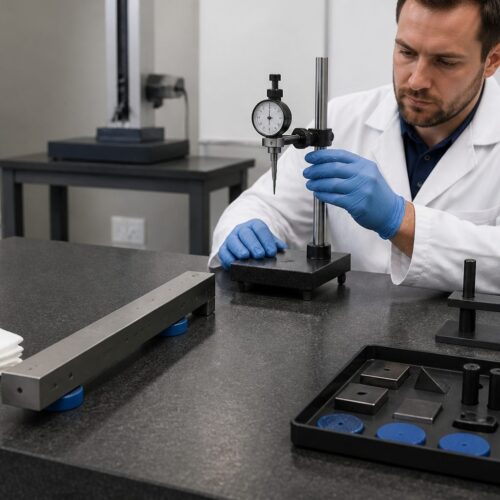
If a full recalibration is not immediately possible, perform a preliminary flatness check using a repeat-o-meter or electronic level. While not a substitute for formal calibration, this check provides a quick indication of any major deviations. It helps you decide if the plate is safe for less critical tasks.
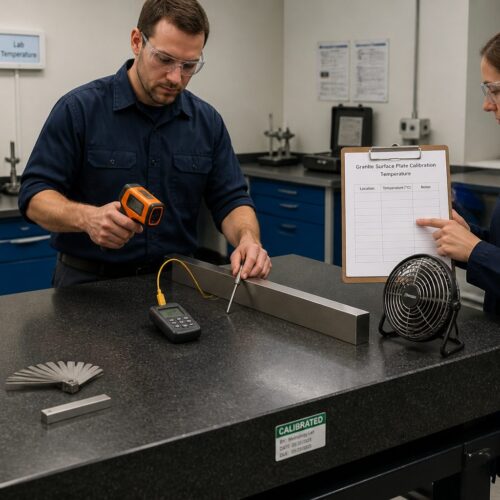
Check the surface temperature of the plate using a calibrated thermometer. Ensure it has fully stabilized to the ambient temperature of the metrology lab. Significant temperature differences can cause thermal expansion or contraction, affecting dimensional accuracy.
Inspect all accessories, such as clamps, straightedges, or angle plates, that were stored with or near the surface plate. Ensure they are clean, free of rust, and in good working condition. These tools are extensions of the surface plate’s accuracy.
Update the plate’s calibration record with the date of reintroduction to service and any new calibration data. Accurate documentation is vital for maintaining a robust quality system. These diligent post-storage checks are a final, crucial step in surface plate storage best practices.
Conclusion
Protecting your precision surface plates is not just about maintenance; it is about preserving the foundation of accurate measurement in your facility. Implementing robust surface plate storage best practices ensures these critical granite calibration standards retain their integrity and precision. Every step, from cleaning to proper support, contributes to their longevity.
Whether your plate is undergoing long term storage or simply being prepared for relocation, attention to detail is paramount. Safeguarding against dust, moisture, and impact prevents costly damage and maintains your investment. Remember, a well-stored plate is a reliably accurate plate.
By following these guidelines for protective packaging and careful handling, you ensure your granite calibration standards remain ready for high-precision work whenever they are needed. Your commitment to proper care truly makes a difference in the consistent quality of your metrology operations. Keep your precision tools precise.