
Deciding whether to recondition or replace a surface plate is a common dilemma for quality control managers and machinists. This choice directly impacts measurement accuracy, operational costs, and overall workflow efficiency in your shop. Understanding the factors involved helps you make an informed decision without relying on guesswork.
Surface plates are the foundation of precise measurement, providing a stable, flat reference plane. Over time, these granite calibration standards experience wear, affecting their flatness and reliability. Ignoring this wear leads to inaccurate measurements and potential product quality issues.
This article explores the specifics of surface plate reconditioning vs replacement, outlining what each option entails and when it makes the most sense. We will cover everything from wear patterns to hidden costs, helping you maintain metrology standards effectively.
What Reconditioning Actually Includes
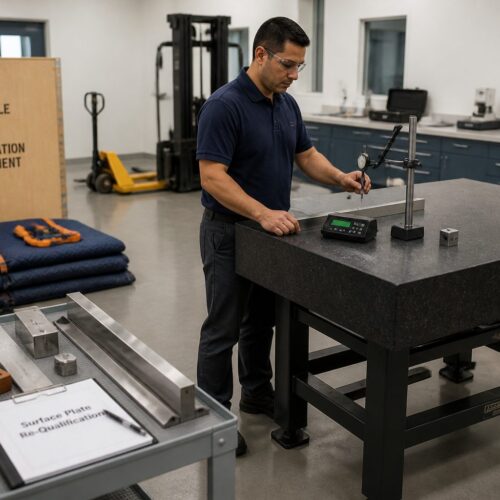
Surface plate reconditioning, also known as resurfacing or lapping granite, involves restoring the plate’s original flatness specification. This process carefully removes a thin layer of granite from the plate’s surface. Skilled technicians use specialized lapping equipment to achieve the required precision.
The goal is to bring the plate back within its specified grade tolerance, whether laboratory, inspection, or toolroom grade. This typically involves multiple stages of abrasive grinding and polishing. Each step progressively refines the surface until the desired flatness is achieved.
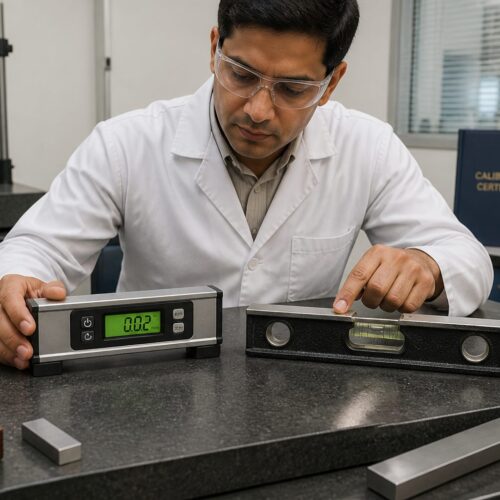
Technicians use a master straightedge and autocollimator or electronic levels to measure the plate’s deviations during the lapping process. They constantly check and adjust their technique to ensure uniform material removal across the entire surface. This meticulous approach is what makes reconditioning effective.
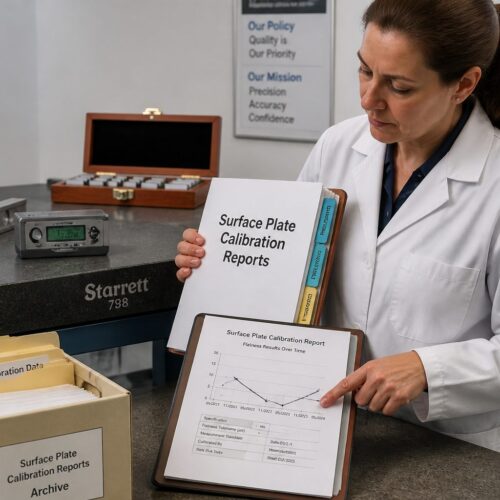
A crucial part of reconditioning is the final calibration and certification. Once the lapping is complete, the plate undergoes a thorough inspection to verify its flatness. The service provider issues a certificate of calibration, confirming the plate meets industry standards.
This process is more than just sanding down a surface; it is a highly skilled operation requiring specialized tools and expertise. Choosing a reputable service provider with experienced technicians is essential for successful reconditioning. They know how to properly lap granite to precise specifications.
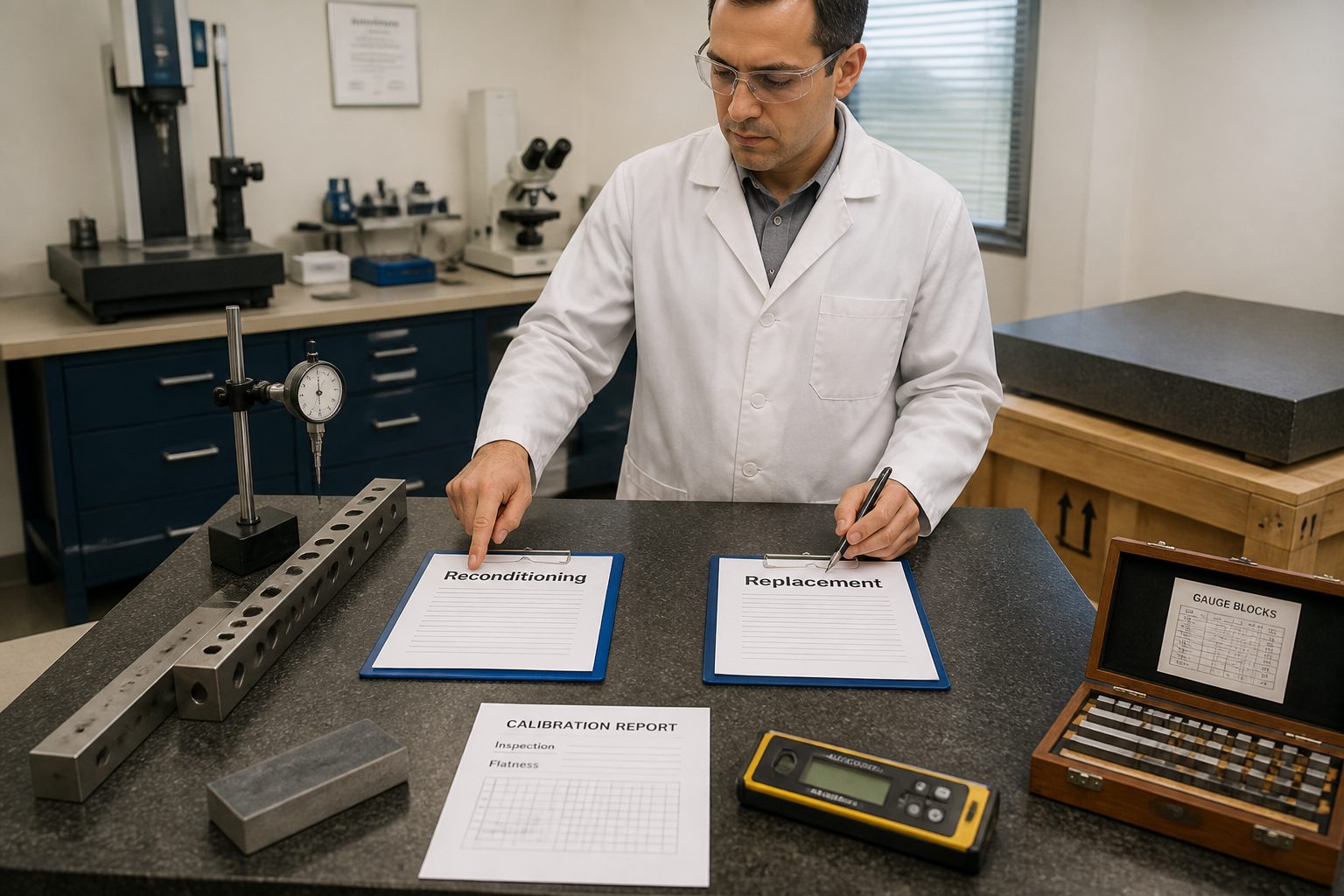
Reconditioning can significantly extend the lifespan of your existing surface plates. It offers a cost-effective alternative to purchasing new equipment, especially for larger or higher-grade plates. Many companies find this a smart investment for maintaining their metrology lab integrity.
How Wear Patterns Develop on Granite Plates
Granite surface plates, while incredibly durable, are not immune to wear from daily use. Constant sliding of parts, gauges, and measuring instruments across the surface gradually erodes the granite. This causes localized low spots and affects the overall flatness of the plate.
Common wear patterns often appear in specific areas, such as the center, edges, or frequently used zones for specific fixtures. These areas experience more friction and pressure, leading to greater material removal over time. Understanding these patterns helps predict when a plate might need service.
| Wear Type | Typical Location | Impact on Measurement |
|---|---|---|
| Central Depression | Middle of the plate | Leads to convex measurement errors, parts appear shorter |
| Edge Roll-off | Perimeter of the plate | Causes concave errors, parts appear longer near edges |
| Localized Pitting | Specific high-use spots | Creates inconsistent contact, affects gauge block stacking |
| Grooves/Scratches | Across the surface | Interferes with smooth gauge movement, introduces error |
| Overall Concavity | Entire surface | General underestimation of part height or length |
Measuring the Real Condition: What to Look For
Accurately assessing your surface plate’s condition is the first step in deciding its future. You cannot just eyeball flatness; precision metrology requires precise measurement of the plate itself. Regular calibration and inspection are non-negotiable for any quality control program.
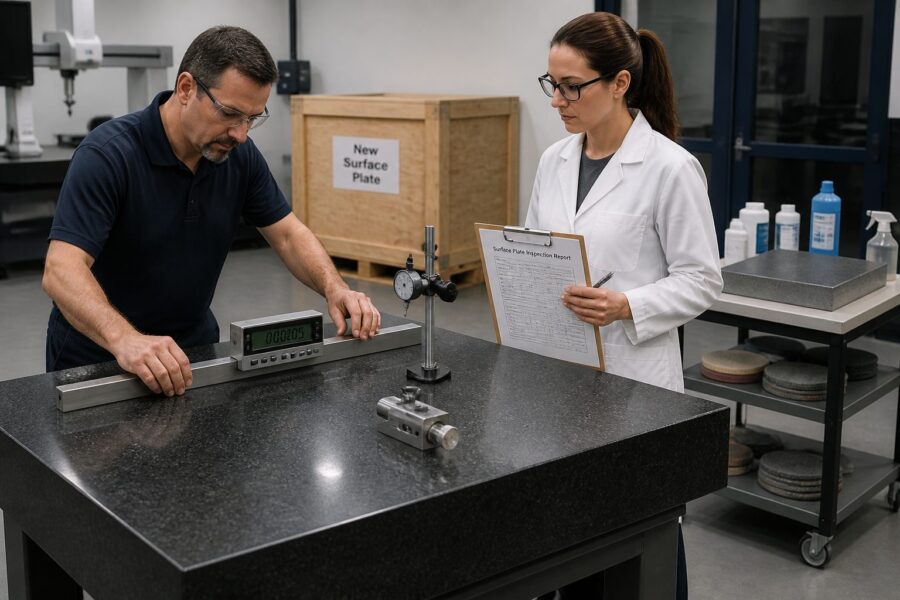
A professional calibration service uses electronic levels, autocollimators, or laser interferometers to map the entire surface. This mapping identifies high and low spots, providing a detailed flatness report. The report shows deviations from true flatness and compares them against the plate’s specified grade tolerance.
Beyond the flatness report, look for visible signs of wear. Deep scratches, chips, or areas with a noticeably duller finish can indicate significant surface degradation. These physical imperfections directly affect the contact points for your precision instruments.
Pay attention to areas where you frequently place heavy workpieces or slide gauge blocks. These zones are prone to accelerated wear and often show the first signs of deviation from flatness. Regular cleaning and careful handling can help minimize this wear, but it will still occur over time.
Consider the age of the plate and its last calibration date. Older plates, or those that have not been calibrated in several years, are more likely to be out of tolerance. A proactive calibration schedule helps catch wear before it severely impacts your measurements.
The plate’s current grade is also important. A laboratory grade plate has much tighter tolerances than a toolroom grade plate, meaning even small deviations can make it unusable for its intended purpose. Always verify the plate’s current performance against its original specifications.
When Reconditioning Is the Best Option
Reconditioning is often the most sensible choice when your surface plate shows signs of wear but still has sufficient granite thickness. A reputable service provider can assess the plate’s remaining thickness to determine if it can withstand the lapping process. They will tell you if the plate has enough material for resurfacing.
This option becomes particularly attractive for larger surface plates or those with a high original purchase price. The cost comparison between reconditioning and replacement heavily favors resurfacing for these substantial investments. You save money by extending the life of existing assets.
If your plate is only slightly out of tolerance, reconditioning is a straightforward solution. Minor deviations are easily corrected by removing a minimal amount of granite, restoring the plate to its required flatness. This prevents small inaccuracies from escalating into significant measurement problems.
Reconditioning also makes sense when you have a plate of a specific grade that is hard to find or has sentimental value. Some older, high-quality granite plates were made with exceptional material that is difficult to replicate today. Keeping these plates in service is a smart move.
When you have limited budget constraints but still need to maintain high metrology standards, reconditioning offers a practical solution. It allows you to achieve necessary precision without the capital expenditure of a new plate. This helps balance your quality needs with financial realities.
Furthermore, if your facility has specific rigging or installation challenges for a new, heavy plate, reconditioning avoids those logistical hurdles. The existing plate is already in place, simplifying the process of getting it back into service. This minimizes disruption to your operations.
When Replacement Makes More Sense
While reconditioning is often a good choice, there are times when a full replacement is the more prudent decision. This usually happens when the surface plate has suffered extensive damage or is nearing the end of its useful life due to significant plate thickness wear. You cannot lap granite indefinitely.
If the granite plate has deep cracks, large chips, or has been exposed to damaging chemicals, its structural integrity might be compromised. These types of damage are often irreparable and can affect the fundamental stability of the measurement surface. A new plate provides a fresh, reliable foundation.
- Severe granite thickness wear
- Extensive cracking or chipping
- Compromised structural integrity
- Outdated plate grade for current needs
- Frequent reconditioning required
- Cost of reconditioning approaches new plate cost
- Need for a different size or configuration
- Advancements in material technology
- Long-term reliability is paramount
- Compliance with new industry standards
Downtime Planning: Getting Work Done While the Plate Is Serviced
The decision to recondition or replace a surface plate always involves considering operational downtime. Your metrology lab or production floor relies on these critical reference surfaces, so planning for their absence is crucial. You cannot simply stop all measurement activities while the plate is away.
One common strategy is to schedule service during planned facility shutdowns or slower production periods. This minimizes the impact on your daily operations, allowing you to get the work done without significant disruption. Coordinate with your service provider well in advance to secure a suitable timeframe.
Another option is to use a temporary loaner plate from your service provider, if available. Some companies offer this service, allowing you to maintain a basic level of measurement capability while your primary plate is being worked on. This keeps critical tasks moving forward.
For facilities with multiple surface plates, you can redistribute workload to other available plates. This requires careful planning to ensure that all necessary measurements can still be performed accurately and efficiently. Always verify the calibration status of your backup plates.
Consider the lead time for both reconditioning and new plate delivery. Reconditioning typically has a shorter turnaround time than ordering a custom new plate, which can sometimes take weeks or months. Factor these timelines into your overall downtime planning.
Finally, communicate clearly with your team about the service schedule and any temporary changes to measurement procedures. Ensuring everyone understands the plan helps prevent errors and keeps your operations running as smoothly as possible. Good communication is key to managing expectations.
How Plate Size and Grade Affect the Decision
The physical dimensions and precision grade of your surface plate significantly influence the reconditioning vs replacement decision. Larger plates, for instance, are inherently more expensive to replace due to material costs and logistical challenges. Reconditioning a large plate often presents a better cost comparison.
A small 12×18 inch plate might be cheap enough to simply replace when it goes out of tolerance. However, a massive 48×72 inch or larger plate represents a substantial capital investment. The economics of lapping granite for a large plate are usually more favorable than buying new.
The grade of the surface plate also plays a critical role. Laboratory grade (Grade AA) plates have the tightest tolerances, meaning even minimal wear can push them out of specification. Reconditioning is often necessary to maintain these stringent accuracy requirements, as they are costly to replace.
Inspection grade (Grade A) and toolroom grade (Grade B) plates have progressively looser tolerances. While still important for precision, they might tolerate slightly more wear before requiring service. The decision for these grades often comes down to the extent of the wear and the cost comparison.
Higher grade plates demand more expertise and time during the lapping process, which affects reconditioning costs. However, the cost of a new, large, high-grade plate typically far outweighs the reconditioning expense. It is a simple math problem that usually points towards resurfacing.
Consider the long-term value of your investment. A high-quality, reconditioned plate can provide years of accurate service, justifying the initial resurfacing cost. Replacing a specialty size or grade plate can also involve longer lead times, impacting your operational schedule more severely.
Hidden Costs: Stands, Leveling, Rigging, and Training
When considering surface plate reconditioning vs replacement, many people focus only on the price tag of the service or the new plate. However, several hidden costs can significantly impact your total expenditure. These often overlooked expenses can quickly add up, especially for replacement.
If you opt for a new surface plate, you might need a new stand. Older stands might not be compatible with the dimensions or weight of a new plate, or they might simply be worn out. A proper stand is crucial for maintaining the plate’s inherent accuracy.
Rigging and installation are major cost factors for new plates, particularly large ones. Moving a heavy granite slab requires specialized equipment and trained personnel. This involves heavy machinery, permits, and careful coordination to ensure safe placement in your facility.
Accurate leveling is essential for any surface plate to perform correctly. A new plate requires meticulous leveling upon installation to ensure its inherent flatness is maintained. This process can be time-consuming and requires specialized tools, often performed by the service provider.
Even if you recondition an existing plate, it often needs re-leveling once it is back in place. While less intensive than leveling a completely new installation, it is still a necessary step. Always budget for this critical final adjustment.
Consider the training implications for your staff. A new plate might come with different features or require updated handling procedures. Ensuring your team is properly trained on the care and use of the new equipment helps prolong its life and maintain accuracy. This protects your investment.
What to Ask a Service Provider Before You Commit
Choosing the right service provider for surface plate reconditioning or replacement is paramount. Asking the right questions upfront helps you select a qualified professional and avoid unexpected issues. You want to ensure they meet your specific needs and quality expectations.
First, inquire about their accreditation and certifications. Are they ISO/IEC 17025 accredited? This accreditation demonstrates their competence to perform calibration and testing, providing assurance of their quality standards. You should never compromise on this point.
Ask for details about their reconditioning process. What methods do they use for lapping granite? Do they use electronic levels or autocollimators for measurement? A transparent explanation of their procedure indicates their expertise and commitment to precision.
Obtain a clear quote that breaks down all costs, including transportation, labor, and certification. Ensure there are no hidden fees, and clarify what is included in the quoted price. A detailed estimate helps you compare services accurately.
Inquire about their typical turnaround time for reconditioning services. Understanding the expected duration helps you plan for downtime and minimizes disruption to your operations. They should be able to provide a realistic timeframe.
Ask if they provide a calibration certificate traceable to national standards upon completion. This certificate is vital for audit purposes and confirms that your plate meets the required accuracy specifications. It is a non-negotiable document.
Finally, ask about their experience with plates of your specific size and grade. A provider accustomed to handling large, laboratory-grade plates will have the necessary equipment and expertise. Their experience directly translates to the quality of their work.
Decision Checklist You Can Use Today
Making a confident decision about your surface plate requires a systematic approach. This checklist helps you evaluate your specific situation, guiding you toward the best choice between reconditioning and replacement. You can use this to streamline your decision-making process.
Start by assessing the current condition of your plate. Have you recently received a calibration report? Does it indicate that the plate is out of tolerance, and by how much? This objective data is fundamental to your evaluation.
Next, consider the severity of any visible damage. Are there deep cracks, large chips, or significant localized wear? Minor surface imperfections are often repairable, but structural issues usually point towards replacement. Be honest about the plate’s overall integrity.
Evaluate the plate’s remaining granite thickness. A service provider can often tell you if there is enough material left for effective lapping. If the plate is too thin, reconditioning might not be a viable or safe option, as it could compromise stability.
Perform a comprehensive cost comparison. Get quotes for both reconditioning and a new replacement plate, including all hidden costs like rigging, transportation, and leveling. Sometimes, the cost of reconditioning vs replacement is surprisingly close, making the choice easier.
Think about your operational downtime tolerance. Can your facility manage without the plate for the reconditioning period, or do you need an immediate replacement? Factor in lead times for both options, as they vary considerably.
Finally, consider the long-term strategic value. Does your current plate meet future metrology needs, or is it time for an upgrade in size or grade? This forward-thinking perspective ensures your decision supports your company’s growth and precision requirements for years to come.
Conclusion
The decision between surface plate reconditioning vs replacement is a significant one for any precision manufacturing or metrology lab. It demands careful consideration of several factors, from the plate’s current condition to long-term operational goals. You cannot afford to get this wrong.
Reconditioning offers a cost-effective and environmentally friendly way to extend the life of your existing granite calibration standards. It restores accuracy and ensures your foundational measurements remain reliable. This is often the best path for plates with sufficient thickness and minor wear.
However, replacement becomes necessary when a plate suffers severe structural damage, has excessive plate thickness wear, or no longer meets evolving accuracy demands. Sometimes, the initial investment in a new plate truly makes more sense for the long haul. It provides a fresh start.
Always prioritize professional assessment and calibration reports to inform your choice. A qualified service provider can give you an objective evaluation of your plate’s condition and the feasibility of lapping granite back to specification. Their expertise is invaluable in this process.
By using the information and checklist provided, you can approach this decision with confidence and clarity. Ensuring the accuracy of your surface plates safeguards the quality of your products and the integrity of your entire measurement system. This proactive approach saves you money and headaches in the long run.
Ultimately, investing in the proper care or replacement of your surface plates is an investment in your company’s precision and reputation. Make the choice that best supports your operational excellence and commitment to quality. Your metrology lab depends on it.