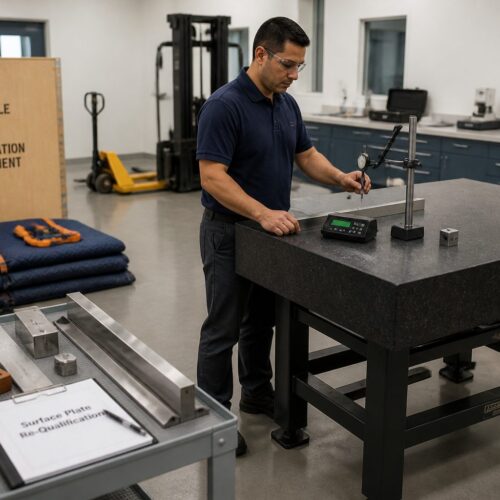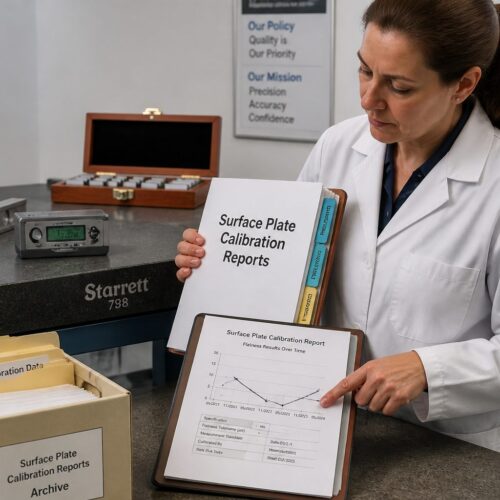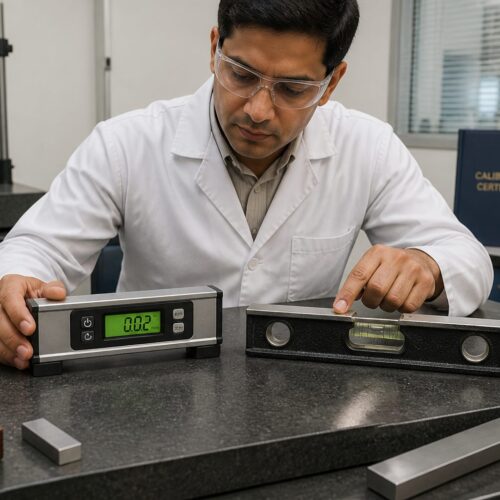


Precision measurement on a surface plate is not just about reading a dial or a digital display. It also involves understanding the inherent variability in your results. Every measurement you take carries a certain degree of uncertainty, meaning the reported value isn’t perfectly exact.
Ignoring this reality can lead to costly mistakes, from rejecting good parts to accepting bad ones. Grasping the surface plate measurement uncertainty basics allows you to make informed decisions about product quality and process control.
This article dives into how calibration data impacts your daily work, exploring the main error sources and practical ways to manage them. You will learn to apply calibration certificates effectively and build a robust uncertainty budget for your metrology tasks.
Knowing your measurement capabilities empowers you to set realistic tolerances and maintain a high confidence level in your manufacturing processes. Let’s get into the specifics of what truly affects your granite surface plate measurements.
What “Uncertainty” Means in Practical Terms
Measurement uncertainty is essentially a quantified doubt about the validity of a measurement result. It tells you the range within which the true value of the measured quantity most likely lies.
Think of it like this: if you measure a part as 10.000 inches, and the uncertainty is ±0.0005 inches, the true length is probably between 9.9995 and 10.0005 inches. This range gives you a realistic picture of your measurement’s reliability.
It’s not an error you can correct, but rather a characteristic of the measurement itself, reflecting all the potential error sources. Understanding this distinction prevents you from chasing a perfectly precise number that doesn’t exist.
A calibration certificate often provides an expanded uncertainty, usually at a 95% confidence level. This means there’s a 95% probability that the true value falls within the stated range.
This confidence level is critical for making acceptance or rejection decisions, especially when working close to tolerance limits. You absolutely need to know how reliable your measurement truly is before signing off on a part.
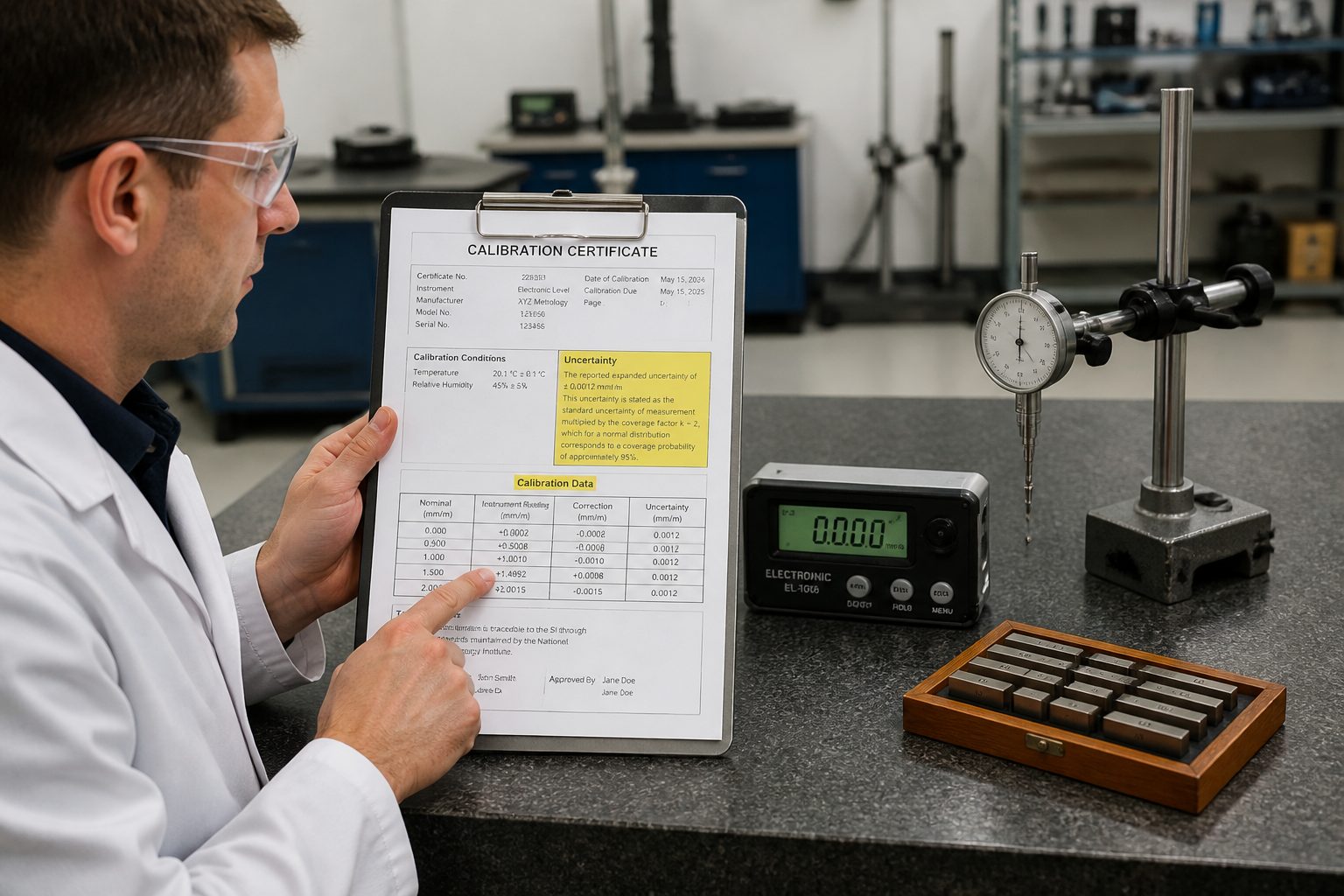
Many people confuse uncertainty with tolerance, but they are different concepts. Tolerance describes the allowable deviation of a part from its nominal dimension, while uncertainty describes the quality of your measurement of that part.
You can have a part within tolerance, but if your measurement uncertainty is too large, you might not be able to confidently prove it. This shows why a solid grasp of surface plate measurement uncertainty basics is non-negotiable.
The Main Sources of Uncertainty on a Surface Plate
Several factors conspire to introduce uncertainty into surface plate measurements, and ignoring any of them is a recipe for bad data. You need to consider everything from the environment to your operator’s technique.
One major contributor is the surface plate itself; its flatness deviation directly impacts the accuracy of any measurement taken upon it. Even a perfectly calibrated plate has some residual non-flatness, which must be accounted for.
The measuring equipment you use also plays a significant role in your overall uncertainty budget. Each gage, indicator, and height stand has its own resolution, repeatability, and bias.
Environmental conditions like temperature fluctuations and vibration can subtly but significantly distort results. Granite expands and contracts with temperature, and even small changes can affect precision measurements.
Operator skill and technique are also considerable error sources, as different operators might apply varying amounts of gaging force or position parts slightly differently. This human element is often overlooked but always present.
The part itself contributes to uncertainty through its surface finish, geometry, and material properties. A rough surface or a flexible part will always be harder to measure consistently than a smooth, rigid one.
Finally, the method you choose for measurement can also introduce bias. Using a comparator setup versus a direct measurement method will have different uncertainty profiles.
Plate Flatness vs Your Setup: Where Errors Add Up
Your surface plate’s flatness is a fundamental element, but it’s only one piece of the puzzle when it comes to overall measurement accuracy. The way you set up your measurement on the plate can introduce just as many, if not more, errors.
Even if your surface plate is Grade AA, poor fixturing or an unstable indicator stand can introduce significant deviations. This is where the rubber meets the road between theoretical plate accuracy and practical measurement reality.
| Uncertainty Source | Typical Impact | Mitigation Strategy |
|---|---|---|
| Surface Plate Flatness | Up to 30% of total uncertainty | Regular calibration, proper support |
| Gage Repeatability & Reproducibility (GR&R) | Often 20-50% of total uncertainty | Training, R&R studies, high-quality gages |
| Temperature Variation | Expansion/contraction of part & plate | Environment control, temperature soak |
| Operator Technique | Inconsistent gaging force, positioning | Standard operating procedures, training |
| Part Geometry/Condition | Surface finish, flexibility, burrs | Part cleaning, appropriate fixturing |
| Measurement Method Bias | Systematic deviations in technique | Method validation, master calibration |
How Temperature, Touch, and Time Affect Results
Environmental factors are often underestimated when it comes to surface plate metrology, but they can profoundly skew your measurements. Temperature is perhaps the most insidious of these, silently distorting your granite and parts.
Granite surface plates, like all materials, expand and contract with temperature changes. Even a few degrees of fluctuation can cause the plate to warp minutely, altering its flatness and affecting your reference plane.
Your workpiece and measuring instruments also react to temperature, expanding or contracting at different rates than the surface plate. This differential expansion can introduce significant errors, especially for larger parts or those made of dissimilar materials.
Human touch is another subtle but powerful factor; the heat from your hands can transfer to parts or gages, causing temporary thermal expansion. This effect is particularly noticeable with smaller, more thermally sensitive components.
Allowing parts to “soak” at the surface plate’s ambient temperature for several hours before measurement is a crucial step to minimize thermal gradients. This ensures everything is at a stable, uniform temperature.
Time also plays a role in the stability of your measurements, as subtle changes can accumulate over long periods. Surface plates can “settle” or experience wear, necessitating regular recalibration to maintain their specified accuracy.
Vibration from machinery, foot traffic, or even distant construction can also introduce momentary fluctuations in your indicator readings. While often transient, these vibrations contribute to the overall noise in your measurement signal.
Keeping your metrology lab in a controlled environment, with stable temperature and minimal vibration, is not a luxury; it’s a necessity for achieving reliable measurements. You simply cannot expect high precision in an uncontrolled space.
Understanding Resolution and Repeatability Limits
When you choose a measuring instrument, its resolution and repeatability are fundamental characteristics that directly impact your surface plate measurement uncertainty basics. These two concepts define the inherent limits of what your tool can reliably tell you.
Resolution refers to the smallest increment an instrument can display or detect, such as 0.00005 inches on a digital indicator. While it defines the precision of the readout, it doesn’t guarantee the accuracy of that reading.
- Always use a gage with sufficient resolution for your tolerance
- Perform repeatability studies on your specific setup
- Understand that higher resolution does not equal higher accuracy
- Account for gage resolution in your uncertainty budget
- Never rely solely on a digital readout’s last digit
Using Calibration Uncertainty Without Overcomplicating
Calibration certificates provide a wealth of information, but many people get lost in the numbers, especially the stated uncertainty. You don’t need a PhD in metrology to use this data effectively; just focus on a few key points.
The primary thing to look for is the “expanded uncertainty” value, typically expressed at a 95% confidence level. This number tells you the range within which the true value of the calibrated item is expected to lie.
When you receive a surface plate calibration, the certificate will show the flatness deviation and the uncertainty associated with that flatness measurement. You must incorporate this uncertainty into your own measurement uncertainty budget.
For example, if your plate is certified at 0.000050 inches flatness with an expanded uncertainty of ±0.000005 inches, then your reference plane isn’t just 0.000050 inches; it’s potentially anywhere from 0.000045 to 0.000055 inches. This range impacts everything else.
You should also check the “as found” and “as left” data on the certificate. This helps you understand if your equipment was within tolerance when it was received for calibration and if any adjustments were made.
Don’t ignore the environmental conditions listed on the certificate either; if your lab operates at a significantly different temperature, the calibration data might not be directly applicable. Adjustments may be necessary for accurate results.
The calibration interval is also important; adhering to recommended recalibration schedules ensures your instruments remain within their specified performance limits. Letting calibrations lapse is a common way to introduce uncontrolled uncertainty.
Choosing Tools That Fit the Uncertainty You Need
Selecting the right measuring tools for your surface plate work is more than just picking a brand; it’s about matching the tool’s capabilities to the required measurement uncertainty. Using an instrument that’s either too precise or not precise enough wastes resources and introduces risk.
First, always consider the tolerance of the feature you are measuring. A general rule of thumb is that your measurement system’s uncertainty should be no more than 10% of the feature’s tolerance, though some industries allow up to 20%.
If you need to measure a feature with a ±0.001 inch tolerance, your total measurement uncertainty should ideally be around ±0.0001 inches or less. This dictates the resolution and quality of the gages you’ll need.
Investing in a high-resolution digital indicator (e.g., 0.00001 inch increments) for a part with a ±0.010 inch tolerance might be overkill, adding unnecessary cost without improving the practical utility of the measurement. Conversely, using a 0.001 inch indicator for a ±0.0005 inch tolerance is a recipe for disaster.
Consider the stability and rigidity of your height stand and fixturing. A flimsy stand can introduce far more error than any minor inaccuracy in your indicator, effectively nullifying the benefits of a high-quality gage.
Factor in the contact points or styli of your probes. Different materials and tip geometries can influence how the measurement is taken, affecting repeatability and potential deformation of the part.
Always evaluate your entire measurement system, not just individual components. This holistic view helps you identify the weakest link and allocate resources wisely to improve your overall measurement confidence level.
Sometimes, the best tool isn’t the most expensive one, but the one that offers the optimal balance of resolution, repeatability, and robust design for your specific application. Making smart choices here is a core aspect of surface plate measurement uncertainty basics.
Recording Conditions So Your Results Stay Defensible
Good measurement practices extend beyond just taking a reading; they include meticulously documenting the conditions under which that reading was taken. Without proper records, your measurements lose their defensibility and become open to challenge.
Always record the ambient temperature of the metrology lab at the time of measurement. This is crucial because thermal expansion and contraction can significantly affect results, as discussed earlier.
Document the serial numbers and calibration dates of all gages, height stands, and masters used in the setup. This traceability proves that you used calibrated equipment within its validity period.
Note the part number, lot number, and any specific orientation or fixturing methods used. This helps ensure that if the measurement needs to be replicated or disputed, all variables are known.
The name or ID of the operator performing the measurement is also important for accountability and tracking potential variations in technique. Different operators might introduce different systematic biases.
If any unusual conditions were observed, such as nearby vibration, drafts, or equipment malfunctions, record those too. These anomalies can help explain unexpected measurement deviations.
Maintain a clear, standardized log or data sheet for all measurements. Consistency in documentation reduces errors and makes it easier to review data later, strengthening your confidence level in the results.
These detailed records are not just bureaucratic overhead; they are your first line of defense in quality control and a fundamental part of managing your measurement uncertainty budget. They provide the context necessary to interpret your data accurately.
Common Misunderstandings That Lead to Bad Decisions
Many common misconceptions about measurement uncertainty can lead to flawed quality decisions and wasted resources. Clearing up these misunderstandings is a critical step in mastering surface plate metrology.
One frequent mistake is equating high resolution with high accuracy. Just because a digital indicator reads to five decimal places doesn’t mean those last digits are reliable or even meaningful.
Another common error is assuming that a “perfectly flat” surface plate exists or that its calibration certificate removes all uncertainty from the plate itself. Every plate has some deviation, and the calibration quantifies that, along with its own uncertainty.
People often ignore the human element, believing that automated equipment eliminates operator error. While automation reduces variability, it doesn’t remove the need for skilled setup and interpretation, which still contribute to the uncertainty budget.
Failing to account for environmental factors like temperature is another significant oversight. Measurements taken in a hot shop are rarely comparable to those taken in a controlled lab without proper compensation.
Some technicians mistakenly believe that if a part measures within tolerance, it is automatically acceptable, without considering the measurement uncertainty. If your uncertainty range overlaps a tolerance limit, you might have an ambiguous result.
Ignoring the “guard banding” principle is also problematic. This involves tightening your acceptance limits slightly to account for measurement uncertainty, ensuring that parts accepted are truly within tolerance with a high confidence level.
Finally, many do not see measurement uncertainty as a dynamic property that changes with different setups, operators, and conditions. It’s not a fixed number; it’s a context-dependent assessment.
A Simple Workflow to Keep Uncertainty Under Control
Managing surface plate measurement uncertainty doesn’t have to be overwhelmingly complex. You can implement a straightforward workflow that significantly improves the reliability of your measurements and builds a stronger uncertainty budget.
First, always define your measurement objective and the required tolerance. Knowing your target precision helps you select appropriate equipment and methods from the start.
Next, gather all your calibrated equipment, ensuring each item’s calibration is current and its certificate is accessible. Verify that the resolution of your chosen gages is adequate for the measurement task.
Allow your parts and gages to thermally stabilize on the surface plate for an adequate period, typically several hours for critical measurements. This minimizes errors due to temperature gradients.
Perform a quick check of your surface plate’s cleanliness and ensure it’s properly supported. A dirty or improperly leveled plate can introduce immediate errors.
Use a consistent measurement technique, following standard operating procedures (SOPs) if available. This reduces operator-induced variability, one of the significant error sources.
Take multiple readings, especially for critical features, and calculate the average. Analyzing the spread of these readings gives you insight into the repeatability of your setup.
Document everything: part ID, operator, equipment serial numbers, environmental conditions, and the measurement results. This creates a traceable record that stands up to scrutiny.
Finally, review your results against the tolerance, considering your estimated total measurement uncertainty. Apply guard banding if necessary to make robust acceptance decisions and maintain a high confidence level.
Conclusion
Understanding surface plate measurement uncertainty basics is not just an academic exercise; it’s a practical necessity for anyone serious about precision manufacturing and quality control. Every measurement comes with inherent doubt, and acknowledging this is the first step toward better data.
By identifying and mitigating error sources, from plate flatness to environmental conditions and operator technique, you build a more reliable measurement system. This allows you to leverage calibration data effectively without overcomplicating your workflow.
Implementing a clear, documented process for measurements ensures your results are defensible and consistent, reducing costly mistakes. You gain a higher confidence level in your products and processes when you truly understand your measurement capabilities.
Don’t just chase numbers; understand the quality of those numbers. Mastering uncertainty empowers you to make smarter decisions, optimize your tooling, and ultimately deliver higher quality parts consistently. It’s about working smarter, not just harder, in the world of metrology.