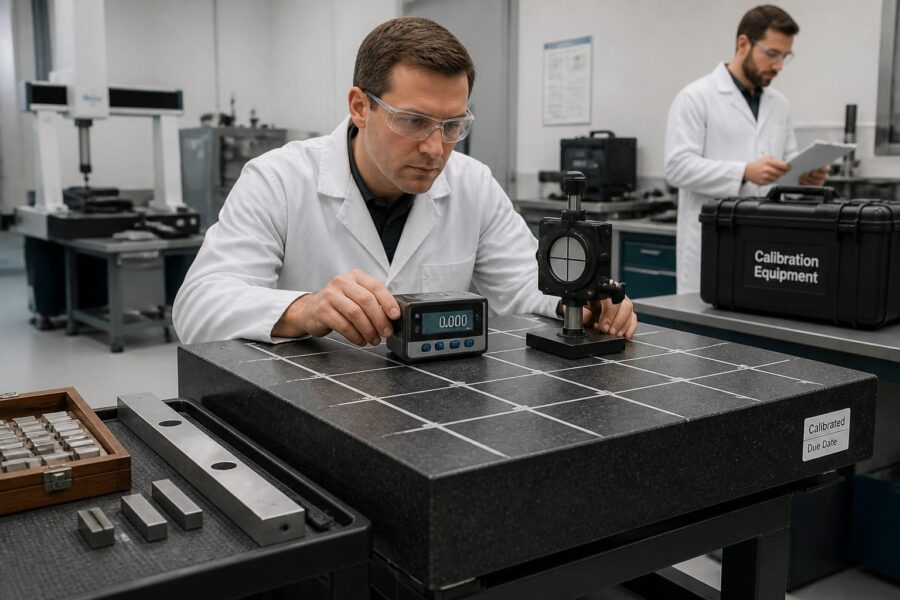
The goal is to provide a comprehensive picture of the surface plate’s condition, ensuring it can reliably support your most demanding metrology tasks. This detailed evaluation supports your quality assurance efforts and helps prevent costly measurement errors. Trusting your surface plate means trusting its calibration.
When You Should Schedule Calibration (Common Triggers)
Determining the right time for surface plate calibration depends on several factors, but annual calibration is a common industry standard. Many quality systems and accreditation bodies require yearly verification to maintain compliance. This regular schedule helps catch subtle wear before it impacts your work significantly.
Beyond routine scheduling, specific events should immediately trigger a calibration request. Any time the surface plate is moved, even a short distance within your facility, its flatness can be affected. The internal stresses of the granite can shift, altering the precision of its surface.
If you notice visible damage, such as a deep scratch, a chipped edge, or a significant impact mark, you need to schedule an immediate inspection. Even seemingly minor damage can compromise the integrity of the reference plane. This type of damage can introduce errors into your critical measurements.
Another strong indicator is if you start experiencing inconsistent measurement results or unexplained discrepancies in your quality control checks. Your surface plate might be the root cause of these issues, leading to frustration and potential product defects. Don’t let uncertainty linger in your metrology lab.
Heavily used surface plates, especially those supporting large or heavy workpieces, might require more frequent calibration than less active ones. The constant loading and unloading of parts can accelerate wear and tear on the granite. Consider a six-month interval for high-volume applications.
Furthermore, if your facility undergoes an external audit, the auditors will almost certainly review your calibration records. Having up-to-date and compliant calibration certificates is crucial for maintaining your certifications. Proactive scheduling avoids last-minute rushes and potential audit findings.
Changes in environmental conditions within your shop, such as new HVAC systems or significant temperature fluctuations, can also necessitate a calibration check. Granite is sensitive to thermal expansion and contraction, which can temporarily or permanently alter its flatness. Always consider your environment when thinking about calibration.
Finally, if you acquire a used surface plate, a professional calibration is absolutely essential before putting it into service. You cannot trust its previous calibration history without independent verification. This ensures you start with a known, accurate reference surface.

Pre-Calibration Prep You Can Do in Your Shop
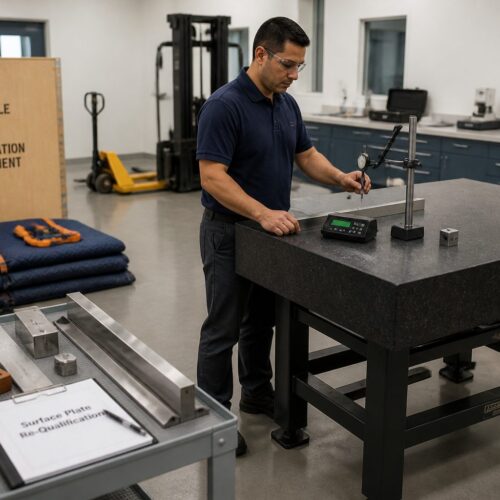
Preparing your surface plate before the technician arrives can significantly streamline the calibration process and ensure accurate results. A clean surface is paramount, as any dust, grime, or debris can interfere with precise measurements. Thoroughly clean the entire working surface with a specialized surface plate cleaner.
Beyond cleaning, ensure the plate has stabilized to the ambient room temperature for at least 24 hours prior to calibration. Granite expands and contracts with temperature changes, and an unstable temperature will lead to inaccurate flatness measurements. Consistency in environmental factors is key for precise work.
| Preparation Step | Why It Matters | Technician Impact |
|---|---|---|
| Thorough Cleaning | Removes debris that causes false readings and wear. | Faster setup, more accurate initial assessment. |
| Temperature Stabilization | Prevents thermal expansion/contraction errors. | Accurate readings reflecting true plate condition. |
| Clear Access Around Plate | Allows technician to move freely with equipment. | Efficient workflow, prevents accidental bumps. |
| Adequate Lighting | Helps technician spot damage and read instruments. | Improved visibility for detailed inspection. |
| Power Outlet Nearby | Needed for electronic levels and other equipment. | Uninterrupted calibration process. |
| Remove All Workpieces | Ensures plate is unloaded and ready for measurement. | Prevents false deflections or obstructions. |
Environmental Conditions That Affect Results
The accuracy of a surface plate calibration is highly dependent on the environmental conditions within your facility. Temperature is arguably the most critical factor, as granite, like all materials, expands when heated and contracts when cooled. Significant temperature swings can cause the plate to temporarily deform, leading to inaccurate readings.
Ideally, the surface plate and the calibration equipment should be at a stable temperature, typically 20°C (68°F), for at least 24 hours prior to and during the calibration. Even small temperature gradients across the plate can introduce errors into the flatness measurement. Maintaining a consistent temperature is a non-negotiable aspect of precision metrology.
Humidity also plays a role, though its effect is generally less pronounced than temperature for granite plates. High humidity can contribute to corrosion on metal calibration tools and can cause slight swelling in some materials. While granite itself is largely unaffected, the tools used for calibration can be.
Vibration is another insidious enemy of accurate measurement. Even subtle vibrations from nearby machinery, forklifts, or heavy foot traffic can cause the sensitive optical or electronic instruments to wobble, introducing noise into the readings. Calibrating in a quiet, isolated environment is always preferable.
Air currents and drafts can also affect readings, particularly when using optical instruments like autocollimators. Moving air can cause slight deflections in the laser path or create thermal gradients across the plate surface. This highlights the need for a stable and controlled environment during the surface plate calibration process.
Keeping doors and windows closed and minimizing personnel movement around the plate during calibration helps mitigate these issues. Think of the calibration area as a temporary cleanroom for the duration of the service. Controlling these variables ensures the technician captures the true state of your granite plate.
Direct sunlight or proximity to heat sources like radiators or uninsulated windows can create localized thermal gradients on the plate. These hotspots will skew the flatness measurements in those specific areas. Always ensure your surface plate is positioned away from such influences for optimal performance.
How the Technician Sets Up the Measurement Grid
The technician begins the granite plate calibration steps by carefully establishing a precise measurement grid across the surface plate. This grid is fundamental to capturing a comprehensive map of the plate’s flatness. A typical grid pattern involves a series of intersecting lines, forming a network of measurement points.
Standard patterns often include perimeter lines, diagonal lines, and a center line, with additional intermediate lines for larger plates. The specific layout of the grid depends on the size and grade of the surface plate, as well as the applicable calibration standard. This systematic approach ensures no significant area is overlooked during the flatness measurement.
- Clean the surface thoroughly
- Position the calibration stand or tripod
- Align the autocollimator or electronic levels
- Mark grid points with a non-abrasive marker
- Verify environmental stability
- Establish a reference point (usually a corner)
- Begin collecting initial elevation readings
- Recalibrate instruments as needed
- Document all setup parameters
- Ensure clear line of sight for all measurements
Tools Used to Measure Flatness and Repeatability
Professional surface plate calibration relies on highly precise instruments to accurately measure flatness and repeatability. The choice of tools often depends on the required precision, the size of the plate, and the specific calibration standard being followed. Understanding these tools helps demystify the granite plate calibration steps.
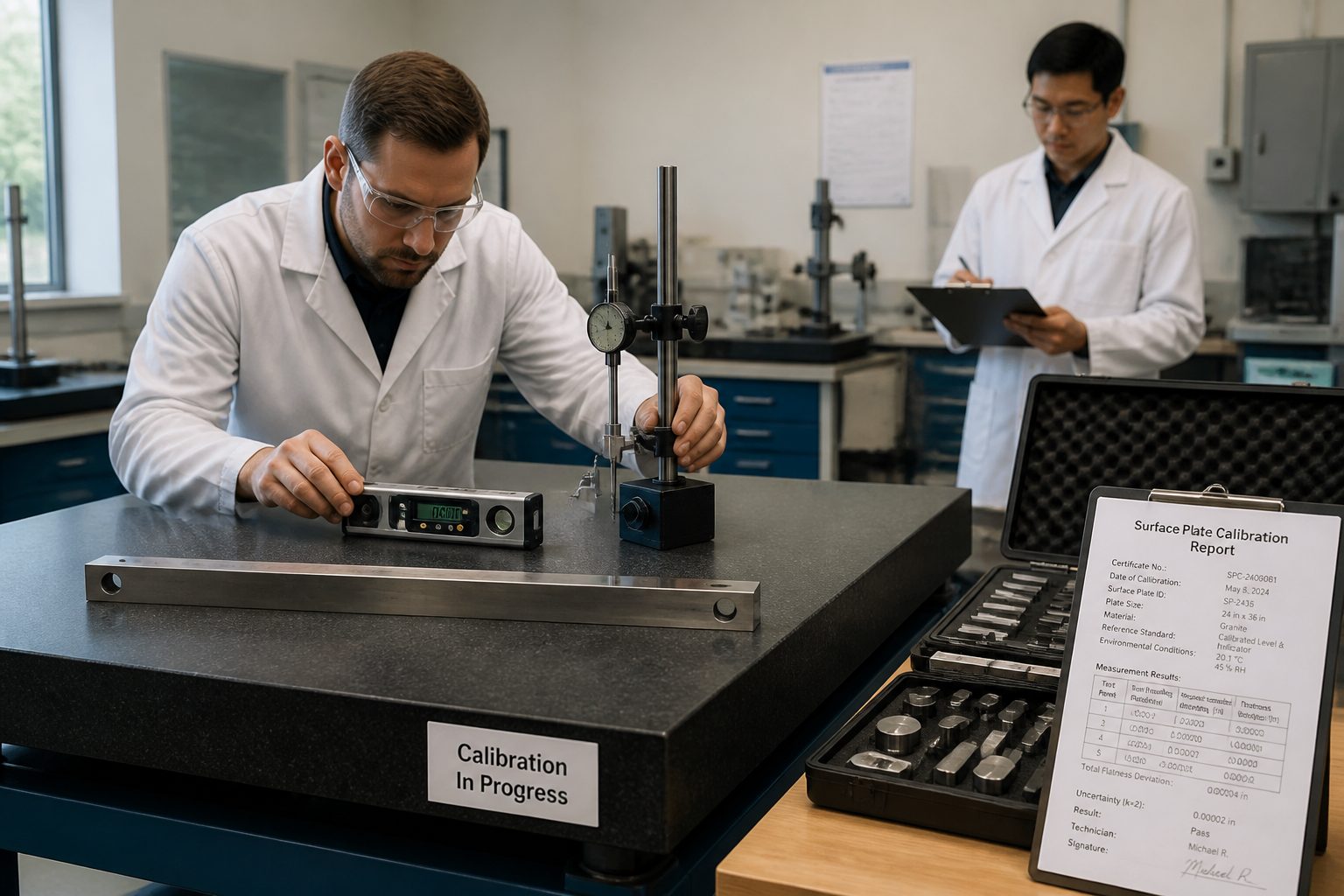
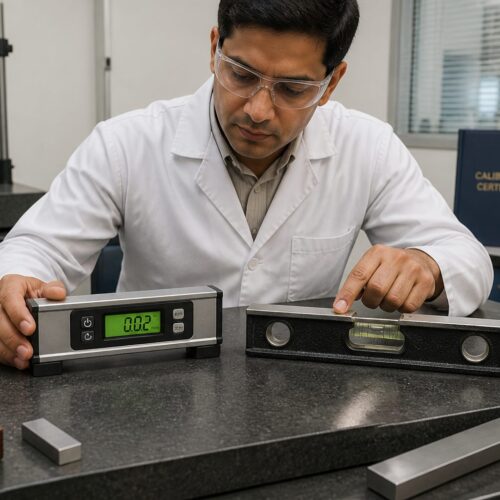
One of the most common and accurate tools is the electronic level, often used in conjunction with a precise calibration stand. These levels measure minute angular deviations across the surface, providing a digital readout of the plate’s topography. Multiple readings are taken at each grid point, then processed to calculate overall flatness.
Autocollimators are another staple in high-precision surface plate calibration. These optical instruments project a beam of light onto a mirror placed on the surface plate and measure the angular deviation of the reflected beam. They offer exceptional accuracy for measuring small angular changes over distance.
Interferometers, while less common for routine field calibration due to their complexity and environmental sensitivity, represent the pinnacle of flatness measurement technology. They use the interference patterns of light waves to create a highly detailed topographical map of the surface. These are usually reserved for master plates or research applications.
For measuring repeatability and local area variations, technicians might use a combination of electronic levels and a specialized repeat reading fixture. This fixture allows for consistent placement of a probe at specific points, ensuring that any variation detected is from the plate itself, not from measurement inconsistencies. This meticulous approach is key to reliable results.
All these instruments are themselves regularly calibrated and traceable to national standards, forming an unbroken chain of accuracy. This traceability is a cornerstone of metrology, ensuring that your surface plate’s calibration is reliable and globally recognized. You should always confirm the calibration status of the tools used on your plate.
Beyond the primary measurement devices, technicians also use temperature sensors to monitor the plate’s temperature throughout the process. This helps account for any thermal expansion or contraction that might occur during the calibration. Environmental monitoring is an integral part of ensuring accurate flatness measurement.
Finally, specialized software is used to collect, process, and analyze the vast amount of data generated during the calibration. This software applies complex algorithms to calculate flatness deviations and generate the comprehensive calibration report. The raw data is transformed into actionable insights about your granite plate’s condition.
How Flatness Error Is Calculated and Interpreted
After collecting hundreds, sometimes thousands, of data points across the surface plate, the technician’s work shifts to calculating and interpreting the flatness error. This crucial step determines whether your granite plate meets its specified tolerance. The raw elevation data from each grid point is entered into specialized software.
The software then establishes an “ideal” reference plane, often using a least-squares fit algorithm, which minimizes the sum of the squares of the distances from all measured points to the plane. This mathematical plane serves as the benchmark against which all actual surface points are compared. It provides an objective reference for flatness measurement.
Flatness error is then calculated as the total indicator reading (TIR) between the highest and lowest points on the surface relative to this ideal plane. If the highest point is +5 microns and the lowest is -3 microns, the total flatness error is 8 microns. This single value represents the overall deviation from a perfect plane.
Interpreting this value requires comparing it to the specified tolerance for your surface plate’s grade. For example, a Grade A inspection plate has a much tighter flatness tolerance than a Grade B workshop plate. Knowing your plate’s grade is essential for understanding the significance of the calculated error.
The calibration report will often include a topographical map or graphical representation of the surface plate. This visual aid helps quickly identify areas of concern, showing where the plate is high or low. These maps are incredibly useful for visualizing the overall flatness measurement.
Furthermore, local area flatness and repeat readings are also analyzed. Local area flatness checks ensure that no small sections of the plate exceed tolerance, even if the overall flatness is acceptable. Repeatability results confirm the plate’s stability and consistency under various conditions.
Understanding these calculations helps you grasp the true condition of your surface plate and its suitability for your precision applications. A well-interpreted flatness measurement allows you to make informed decisions about your metrology operations. This detailed analysis is a key part of the surface plate calibration process.
What Happens If the Plate Is Out of Tolerance
Discovering your surface plate is out of tolerance during the surface plate calibration process can be a setback, but it’s not necessarily the end of its useful life. The immediate next step involves assessing the severity and nature of the deviation. Minor deviations might still allow for continued use in less critical applications, but precision work will be compromised.
For plates that are only slightly out of tolerance, or have localized high spots, reconditioning is often a viable option. Reconditioning involves lapping and polishing the granite surface to bring it back within specified flatness limits. This process requires specialized equipment and highly skilled technicians.
During reconditioning, a series of abrasive compounds are used to carefully remove material from the high spots on the plate. This is a painstaking process that demands extreme precision and continuous measurement to ensure the plate achieves the desired flatness. It’s an art as much as a science, requiring immense patience and expertise.
After reconditioning, the surface plate must undergo a full calibration to verify that it now meets the required flatness standards. This post-reconditioning calibration is crucial for confirming the success of the repair. Never assume a reconditioned plate is accurate without proper verification.
If the plate is severely out of tolerance, or has significant structural damage like deep cracks, reconditioning might not be cost-effective or even possible. In such cases, the plate may need to be downgraded for less demanding tasks or, unfortunately, replaced entirely. Sometimes, a new granite plate is the only reliable solution.
The decision to recondition, downgrade, or replace often comes down to a cost-benefit analysis. Consider the cost of reconditioning versus a new plate, factoring in downtime and the critical nature of the measurements you perform. A professional calibration service can advise on the best course of action based on their findings.
Even if a plate is downgraded for less critical work, it is still important to clearly mark its new grade and update all relevant documentation. This prevents accidental use in applications requiring higher precision. Transparency about the plate’s condition is vital for preventing errors.
What a Good Calibration Certificate Includes
A comprehensive calibration report is more than just a piece of paper stating “pass” or “fail”; it’s a critical document that provides detailed evidence of your surface plate’s metrological integrity. This report is essential for quality audits and for maintaining traceability within your measurement system. You should expect thorough documentation of the surface plate calibration process.
At a minimum, a good calibration certificate will clearly identify the calibrated item, including its serial number, size, and grade. This ensures there’s no ambiguity about which specific surface plate was evaluated. Clear identification is the first step in maintaining accurate records.
It must also state the date of calibration and the date of the next recommended calibration. This helps you maintain your calibration schedule and ensures continuous compliance. Knowing these dates is crucial for proactive maintenance of your metrology equipment.
The certificate will specify the standard or procedure used for the calibration, such as Federal Specification GGG-P-463c or ISO 8512-2. This confirms that the calibration was performed according to recognized industry best practices. Adherence to standards is a key indicator of quality.
Crucially, it will present the “as found” and “as left” data, documenting the plate’s condition before and after any adjustments or reconditioning. This data includes the overall flatness deviation, often broken down into specific areas or points. This detailed information gives a complete picture of the flatness measurement.
The report should list the environmental conditions, primarily temperature, during the calibration process. This confirms that the calibration was performed under stable and controlled circumstances. Environmental data adds another layer of confidence to the results.
Information about the calibration equipment used, including its make, model, and last calibration date, is also vital. This establishes the traceability of the measurements back to national or international standards. Traceability is a non-negotiable aspect of any credible calibration report.
Finally, the certificate must include the name and signature of the calibrating technician and the authorizing manager, along with the accreditation body’s logo (e.g., A2LA, ISO 17025) if applicable. This verifies the competence and authority of the individuals and organization performing the service. An accredited calibration report offers the highest level of assurance.
Some advanced calibration reports will also include graphical representations, such as contour maps, illustrating the surface topography. These visual aids make it easier to understand the flatness measurement and identify any localized deviations. A good report provides both numerical data and clear visual context.
How to Store and Use the Report for Audits and Traceability
Once you receive your surface plate calibration report, proper storage and utilization are just as important as the calibration itself. This document is a critical asset for your quality management system and must be handled with care. It serves as concrete evidence of your commitment to precision.
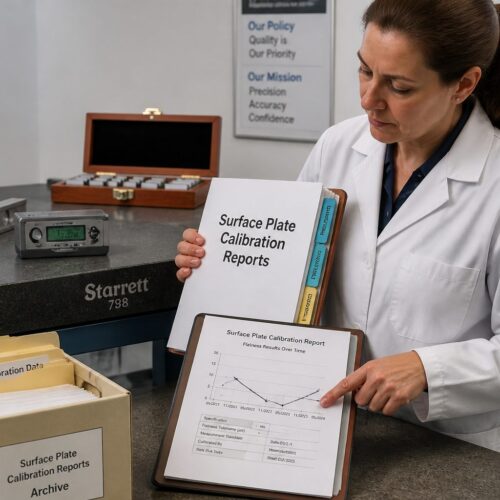
Store the original calibration certificate in a secure, designated location, preferably in a binder or digital archive that is easily accessible but protected from damage. Creating a digital backup is always a smart practice to ensure long-term preservation. This safeguards your vital records against loss.
For audits, the calibration report provides essential proof of compliance with industry standards and internal quality procedures. Auditors will expect to see current certificates for all critical measuring equipment, including your surface plates. Having these readily available demonstrates a well-managed metrology program.
The report also establishes an unbroken chain of traceability for your measurements. This means that any measurement taken on your surface plate can be linked back to national and international standards through the calibration laboratory’s equipment. Traceability is fundamental to the credibility of your results.
Use the “next calibration due” date on the report to proactively schedule your next service. Set up reminders in your calendar or quality management software to avoid missing deadlines. Consistent scheduling ensures your surface plate always remains within its certified accuracy.
Beyond audits, the report is a valuable reference for internal quality control. Reviewing the flatness measurement data over time can help identify trends in wear and tear, allowing for predictive maintenance. This data-driven approach helps extend the life of your granite plate.
If your surface plate is moved or suffers damage, refer to the report’s “as found” data before any re-calibration. This provides a baseline for comparison and helps assess the impact of the event. The report becomes a historical record of your granite plate’s performance.
When training new personnel, the calibration report can serve as an educational tool, explaining the importance of proper surface plate care and the principles of flatness measurement. It reinforces the critical role of metrology in your operations. Make sure everyone understands the value of this document.
Conclusion
Understanding the surface plate calibration process is absolutely critical for anyone operating in a precision environment. It is not just a formality but a fundamental practice that underpins the accuracy of your entire measurement system. Regular and thorough calibration ensures your granite plate remains a reliable foundation for quality.
From the initial preparation of your shop to the intricate flatness measurement techniques employed by technicians, each step plays a vital role. Knowing what goes into the granite plate calibration steps helps you appreciate the investment and the detailed work involved. This knowledge empowers you to maintain higher standards.
A comprehensive calibration report is your proof of compliance and a valuable record of your surface plate’s condition. This document is indispensable for audits, traceability, and making informed decisions about your equipment’s lifespan. Always keep your calibration report safe and accessible.
Investing in professional surface plate calibration is an investment in the accuracy of your products, the efficiency of your operations, and the reputation of your business. It minimizes rework, reduces errors, and provides unwavering confidence in your measurements. Don’t compromise on the integrity of your metrology foundation.
By following recommended calibration schedules and understanding the nuances of the process, you ensure your surface plates consistently deliver the precision you demand. This proactive approach prevents costly surprises and maintains your competitive edge. Trust in a well-calibrated surface plate for all your critical tasks.
Regular calibration is a cornerstone of quality assurance, reflecting a commitment to excellence in every measurement. It safeguards against inaccuracies that can propagate throughout your manufacturing processes. Make surface plate calibration a non-negotiable part of your quality control regimen.
The detailed insights provided by a professional calibration service offer more than just a pass/fail result; they offer a deeper understanding of your equipment. This insight allows for better maintenance planning and resource allocation. Embrace the full value of the surface plate calibration process.
Maintaining the accuracy of your measurement tools is paramount in any precision manufacturing or quality control environment. A surface plate, often the foundation for many critical measurements, requires consistent verification to ensure its integrity. Understanding the surface plate calibration process is essential for anyone relying on these critical tools.
This comprehensive guide walks you through each step, from initial preparation to interpreting the final calibration report. Knowing what to expect helps you prepare your shop and understand the value delivered by professional metrology services. We will explore the intricacies of ensuring your granite plate meets the stringent flatness requirements necessary for accurate work.
Regular calibration is not just a regulatory requirement; it is a fundamental practice that upholds product quality and operational efficiency. A well-calibrated surface plate provides a reliable reference plane, minimizing measurement errors and avoiding costly rework. Let’s explore the surface plate calibration process in detail.
What Surface Plate Calibration Really Checks
Surface plate calibration goes far beyond a simple visual inspection; it rigorously evaluates the plate’s geometric accuracy. The primary focus is on measuring flatness, which refers to how closely the plate’s working surface conforms to a true plane. This measurement determines if the plate provides a stable and accurate reference for your precision instruments and parts.
Beyond overall flatness, technicians also assess local area variations and repeatability. Local area variations identify any dips or humps in specific regions of the plate that could affect smaller components. Repeatability checks ensure that measurements taken at the same point yield consistent results, confirming the plate’s stability under load.
These checks are performed in accordance with strict industry standards, most commonly ISO 8512-2 or Federal Specification GGG-P-463c. Adherence to these standards guarantees that the calibration is universally recognized and traceable to national measurement institutes. This provides confidence in the accuracy of your entire measurement system.
The technician will meticulously map the entire surface, identifying any deviations from the ideal plane. These deviations are then compared against the specified tolerance for your surface plate’s grade. Understanding these checks helps appreciate the scientific rigor involved in maintaining metrological integrity.
A secondary but equally important aspect is the inspection for any physical damage, such as scratches, nicks, or wear spots. While not directly a flatness measurement, these imperfections can compromise the plate’s utility and must be noted. Significant damage might necessitate repairs or even replacement of the surface plate.
The goal is to provide a comprehensive picture of the surface plate’s condition, ensuring it can reliably support your most demanding metrology tasks. This detailed evaluation supports your quality assurance efforts and helps prevent costly measurement errors. Trusting your surface plate means trusting its calibration.
When You Should Schedule Calibration (Common Triggers)
Determining the right time for surface plate calibration depends on several factors, but annual calibration is a common industry standard. Many quality systems and accreditation bodies require yearly verification to maintain compliance. This regular schedule helps catch subtle wear before it impacts your work significantly.
Beyond routine scheduling, specific events should immediately trigger a calibration request. Any time the surface plate is moved, even a short distance within your facility, its flatness can be affected. The internal stresses of the granite can shift, altering the precision of its surface.
If you notice visible damage, such as a deep scratch, a chipped edge, or a significant impact mark, you need to schedule an immediate inspection. Even seemingly minor damage can compromise the integrity of the reference plane. This type of damage can introduce errors into your critical measurements.
Another strong indicator is if you start experiencing inconsistent measurement results or unexplained discrepancies in your quality control checks. Your surface plate might be the root cause of these issues, leading to frustration and potential product defects. Don’t let uncertainty linger in your metrology lab.
Heavily used surface plates, especially those supporting large or heavy workpieces, might require more frequent calibration than less active ones. The constant loading and unloading of parts can accelerate wear and tear on the granite. Consider a six-month interval for high-volume applications.
Furthermore, if your facility undergoes an external audit, the auditors will almost certainly review your calibration records. Having up-to-date and compliant calibration certificates is crucial for maintaining your certifications. Proactive scheduling avoids last-minute rushes and potential audit findings.
Changes in environmental conditions within your shop, such as new HVAC systems or significant temperature fluctuations, can also necessitate a calibration check. Granite is sensitive to thermal expansion and contraction, which can temporarily or permanently alter its flatness. Always consider your environment when thinking about calibration.
Finally, if you acquire a used surface plate, a professional calibration is absolutely essential before putting it into service. You cannot trust its previous calibration history without independent verification. This ensures you start with a known, accurate reference surface.
Pre-Calibration Prep You Can Do in Your Shop
Preparing your surface plate before the technician arrives can significantly streamline the calibration process and ensure accurate results. A clean surface is paramount, as any dust, grime, or debris can interfere with precise measurements. Thoroughly clean the entire working surface with a specialized surface plate cleaner.
Beyond cleaning, ensure the plate has stabilized to the ambient room temperature for at least 24 hours prior to calibration. Granite expands and contracts with temperature changes, and an unstable temperature will lead to inaccurate flatness measurements. Consistency in environmental factors is key for precise work.
| Preparation Step | Why It Matters | Technician Impact |
|---|---|---|
| Thorough Cleaning | Removes debris that causes false readings and wear. | Faster setup, more accurate initial assessment. |
| Temperature Stabilization | Prevents thermal expansion/contraction errors. | Accurate readings reflecting true plate condition. |
| Clear Access Around Plate | Allows technician to move freely with equipment. | Efficient workflow, prevents accidental bumps. |
| Adequate Lighting | Helps technician spot damage and read instruments. | Improved visibility for detailed inspection. |
| Power Outlet Nearby | Needed for electronic levels and other equipment. | Uninterrupted calibration process. |
| Remove All Workpieces | Ensures plate is unloaded and ready for measurement. | Prevents false deflections or obstructions. |
Environmental Conditions That Affect Results
The accuracy of a surface plate calibration is highly dependent on the environmental conditions within your facility. Temperature is arguably the most critical factor, as granite, like all materials, expands when heated and contracts when cooled. Significant temperature swings can cause the plate to temporarily deform, leading to inaccurate readings.
Ideally, the surface plate and the calibration equipment should be at a stable temperature, typically 20°C (68°F), for at least 24 hours prior to and during the calibration. Even small temperature gradients across the plate can introduce errors into the flatness measurement. Maintaining a consistent temperature is a non-negotiable aspect of precision metrology.
Humidity also plays a role, though its effect is generally less pronounced than temperature for granite plates. High humidity can contribute to corrosion on metal calibration tools and can cause slight swelling in some materials. While granite itself is largely unaffected, the tools used for calibration can be.
Vibration is another insidious enemy of accurate measurement. Even subtle vibrations from nearby machinery, forklifts, or heavy foot traffic can cause the sensitive optical or electronic instruments to wobble, introducing noise into the readings. Calibrating in a quiet, isolated environment is always preferable.
Air currents and drafts can also affect readings, particularly when using optical instruments like autocollimators. Moving air can cause slight deflections in the laser path or create thermal gradients across the plate surface. This highlights the need for a stable and controlled environment during the surface plate calibration process.
Keeping doors and windows closed and minimizing personnel movement around the plate during calibration helps mitigate these issues. Think of the calibration area as a temporary cleanroom for the duration of the service. Controlling these variables ensures the technician captures the true state of your granite plate.
Direct sunlight or proximity to heat sources like radiators or uninsulated windows can create localized thermal gradients on the plate. These hotspots will skew the flatness measurements in those specific areas. Always ensure your surface plate is positioned away from such influences for optimal performance.
How the Technician Sets Up the Measurement Grid
The technician begins the granite plate calibration steps by carefully establishing a precise measurement grid across the surface plate. This grid is fundamental to capturing a comprehensive map of the plate’s flatness. A typical grid pattern involves a series of intersecting lines, forming a network of measurement points.
Standard patterns often include perimeter lines, diagonal lines, and a center line, with additional intermediate lines for larger plates. The specific layout of the grid depends on the size and grade of the surface plate, as well as the applicable calibration standard. This systematic approach ensures no significant area is overlooked during the flatness measurement.
- Clean the surface thoroughly
- Position the calibration stand or tripod
- Align the autocollimator or electronic levels
- Mark grid points with a non-abrasive marker
- Verify environmental stability
- Establish a reference point (usually a corner)
- Begin collecting initial elevation readings
- Recalibrate instruments as needed
- Document all setup parameters
- Ensure clear line of sight for all measurements
Tools Used to Measure Flatness and Repeatability
Professional surface plate calibration relies on highly precise instruments to accurately measure flatness and repeatability. The choice of tools often depends on the required precision, the size of the plate, and the specific calibration standard being followed. Understanding these tools helps demystify the granite plate calibration steps.
One of the most common and accurate tools is the electronic level, often used in conjunction with a precise calibration stand. These levels measure minute angular deviations across the surface, providing a digital readout of the plate’s topography. Multiple readings are taken at each grid point, then processed to calculate overall flatness.
Autocollimators are another staple in high-precision surface plate calibration. These optical instruments project a beam of light onto a mirror placed on the surface plate and measure the angular deviation of the reflected beam. They offer exceptional accuracy for measuring small angular changes over distance.
Interferometers, while less common for routine field calibration due to their complexity and environmental sensitivity, represent the pinnacle of flatness measurement technology. They use the interference patterns of light waves to create a highly detailed topographical map of the surface. These are usually reserved for master plates or research applications.
For measuring repeatability and local area variations, technicians might use a combination of electronic levels and a specialized repeat reading fixture. This fixture allows for consistent placement of a probe at specific points, ensuring that any variation detected is from the plate itself, not from measurement inconsistencies. This meticulous approach is key to reliable results.
All these instruments are themselves regularly calibrated and traceable to national standards, forming an unbroken chain of accuracy. This traceability is a cornerstone of metrology, ensuring that your surface plate’s calibration is reliable and globally recognized. You should always confirm the calibration status of the tools used on your plate.
Beyond the primary measurement devices, technicians also use temperature sensors to monitor the plate’s temperature throughout the process. This helps account for any thermal expansion or contraction that might occur during the calibration. Environmental monitoring is an integral part of ensuring accurate flatness measurement.
Finally, specialized software is used to collect, process, and analyze the vast amount of data generated during the calibration. This software applies complex algorithms to calculate flatness deviations and generate the comprehensive calibration report. The raw data is transformed into actionable insights about your granite plate’s condition.
How Flatness Error Is Calculated and Interpreted
After collecting hundreds, sometimes thousands, of data points across the surface plate, the technician’s work shifts to calculating and interpreting the flatness error. This crucial step determines whether your granite plate meets its specified tolerance. The raw elevation data from each grid point is entered into specialized software.
The software then establishes an “ideal” reference plane, often using a least-squares fit algorithm, which minimizes the sum of the squares of the distances from all measured points to the plane. This mathematical plane serves as the benchmark against which all actual surface points are compared. It provides an objective reference for flatness measurement.
Flatness error is then calculated as the total indicator reading (TIR) between the highest and lowest points on the surface relative to this ideal plane. If the highest point is +5 microns and the lowest is -3 microns, the total flatness error is 8 microns. This single value represents the overall deviation from a perfect plane.
Interpreting this value requires comparing it to the specified tolerance for your surface plate’s grade. For example, a Grade A inspection plate has a much tighter flatness tolerance than a Grade B workshop plate. Knowing your plate’s grade is essential for understanding the significance of the calculated error.
The calibration report will often include a topographical map or graphical representation of the surface plate. This visual aid helps quickly identify areas of concern, showing where the plate is high or low. These maps are incredibly useful for visualizing the overall flatness measurement.
Furthermore, local area flatness and repeat readings are also analyzed. Local area flatness checks ensure that no small sections of the plate exceed tolerance, even if the overall flatness is acceptable. Repeatability results confirm the plate’s stability and consistency under various conditions.
Understanding these calculations helps you grasp the true condition of your surface plate and its suitability for your precision applications. A well-interpreted flatness measurement allows you to make informed decisions about your metrology operations. This detailed analysis is a key part of the surface plate calibration process.
What Happens If the Plate Is Out of Tolerance
Discovering your surface plate is out of tolerance during the surface plate calibration process can be a setback, but it’s not necessarily the end of its useful life. The immediate next step involves assessing the severity and nature of the deviation. Minor deviations might still allow for continued use in less critical applications, but precision work will be compromised.
For plates that are only slightly out of tolerance, or have localized high spots, reconditioning is often a viable option. Reconditioning involves lapping and polishing the granite surface to bring it back within specified flatness limits. This process requires specialized equipment and highly skilled technicians.
During reconditioning, a series of abrasive compounds are used to carefully remove material from the high spots on the plate. This is a painstaking process that demands extreme precision and continuous measurement to ensure the plate achieves the desired flatness. It’s an art as much as a science, requiring immense patience and expertise.
After reconditioning, the surface plate must undergo a full calibration to verify that it now meets the required flatness standards. This post-reconditioning calibration is crucial for confirming the success of the repair. Never assume a reconditioned plate is accurate without proper verification.
If the plate is severely out of tolerance, or has significant structural damage like deep cracks, reconditioning might not be cost-effective or even possible. In such cases, the plate may need to be downgraded for less demanding tasks or, unfortunately, replaced entirely. Sometimes, a new granite plate is the only reliable solution.
The decision to recondition, downgrade, or replace often comes down to a cost-benefit analysis. Consider the cost of reconditioning versus a new plate, factoring in downtime and the critical nature of the measurements you perform. A professional calibration service can advise on the best course of action based on their findings.
Even if a plate is downgraded for less critical work, it is still important to clearly mark its new grade and update all relevant documentation. This prevents accidental use in applications requiring higher precision. Transparency about the plate’s condition is vital for preventing errors.
What a Good Calibration Certificate Includes
A comprehensive calibration report is more than just a piece of paper stating “pass” or “fail”; it’s a critical document that provides detailed evidence of your surface plate’s metrological integrity. This report is essential for quality audits and for maintaining traceability within your measurement system. You should expect thorough documentation of the surface plate calibration process.
At a minimum, a good calibration certificate will clearly identify the calibrated item, including its serial number, size, and grade. This ensures there’s no ambiguity about which specific surface plate was evaluated. Clear identification is the first step in maintaining accurate records.
It must also state the date of calibration and the date of the next recommended calibration. This helps you maintain your calibration schedule and ensures continuous compliance. Knowing these dates is crucial for proactive maintenance of your metrology equipment.
The certificate will specify the standard or procedure used for the calibration, such as Federal Specification GGG-P-463c or ISO 8512-2. This confirms that the calibration was performed according to recognized industry best practices. Adherence to standards is a key indicator of quality.
Crucially, it will present the “as found” and “as left” data, documenting the plate’s condition before and after any adjustments or reconditioning. This data includes the overall flatness deviation, often broken down into specific areas or points. This detailed information gives a complete picture of the flatness measurement.
The report should list the environmental conditions, primarily temperature, during the calibration process. This confirms that the calibration was performed under stable and controlled circumstances. Environmental data adds another layer of confidence to the results.
Information about the calibration equipment used, including its make, model, and last calibration date, is also vital. This establishes the traceability of the measurements back to national or international standards. Traceability is a non-negotiable aspect of any credible calibration report.
Finally, the certificate must include the name and signature of the calibrating technician and the authorizing manager, along with the accreditation body’s logo (e.g., A2LA, ISO 17025) if applicable. This verifies the competence and authority of the individuals and organization performing the service. An accredited calibration report offers the highest level of assurance.
Some advanced calibration reports will also include graphical representations, such as contour maps, illustrating the surface topography. These visual aids make it easier to understand the flatness measurement and identify any localized deviations. A good report provides both numerical data and clear visual context.
How to Store and Use the Report for Audits and Traceability
Once you receive your surface plate calibration report, proper storage and utilization are just as important as the calibration itself. This document is a critical asset for your quality management system and must be handled with care. It serves as concrete evidence of your commitment to precision.
Store the original calibration certificate in a secure, designated location, preferably in a binder or digital archive that is easily accessible but protected from damage. Creating a digital backup is always a smart practice to ensure long-term preservation. This safeguards your vital records against loss.
For audits, the calibration report provides essential proof of compliance with industry standards and internal quality procedures. Auditors will expect to see current certificates for all critical measuring equipment, including your surface plates. Having these readily available demonstrates a well-managed metrology program.
The report also establishes an unbroken chain of traceability for your measurements. This means that any measurement taken on your surface plate can be linked back to national and international standards through the calibration laboratory’s equipment. Traceability is fundamental to the credibility of your results.
Use the “next calibration due” date on the report to proactively schedule your next service. Set up reminders in your calendar or quality management software to avoid missing deadlines. Consistent scheduling ensures your surface plate always remains within its certified accuracy.
Beyond audits, the report is a valuable reference for internal quality control. Reviewing the flatness measurement data over time can help identify trends in wear and tear, allowing for predictive maintenance. This data-driven approach helps extend the life of your granite plate.
If your surface plate is moved or suffers damage, refer to the report’s “as found” data before any re-calibration. This provides a baseline for comparison and helps assess the impact of the event. The report becomes a historical record of your granite plate’s performance.
When training new personnel, the calibration report can serve as an educational tool, explaining the importance of proper surface plate care and the principles of flatness measurement. It reinforces the critical role of metrology in your operations. Make sure everyone understands the value of this document.
Conclusion
Understanding the surface plate calibration process is absolutely critical for anyone operating in a precision environment. It is not just a formality but a fundamental practice that underpins the accuracy of your entire measurement system. Regular and thorough calibration ensures your granite plate remains a reliable foundation for quality.
From the initial preparation of your shop to the intricate flatness measurement techniques employed by technicians, each step plays a vital role. Knowing what goes into the granite plate calibration steps helps you appreciate the investment and the detailed work involved. This knowledge empowers you to maintain higher standards.
A comprehensive calibration report is your proof of compliance and a valuable record of your surface plate’s condition. This document is indispensable for audits, traceability, and making informed decisions about your equipment’s lifespan. Always keep your calibration report safe and accessible.
Investing in professional surface plate calibration is an investment in the accuracy of your products, the efficiency of your operations, and the reputation of your business. It minimizes rework, reduces errors, and provides unwavering confidence in your measurements. Don’t compromise on the integrity of your metrology foundation.
By following recommended calibration schedules and understanding the nuances of the process, you ensure your surface plates consistently deliver the precision you demand. This proactive approach prevents costly surprises and maintains your competitive edge. Trust in a well-calibrated surface plate for all your critical tasks.
Regular calibration is a cornerstone of quality assurance, reflecting a commitment to excellence in every measurement. It safeguards against inaccuracies that can propagate throughout your manufacturing processes. Make surface plate calibration a non-negotiable part of your quality control regimen.
The detailed insights provided by a professional calibration service offer more than just a pass/fail result; they offer a deeper understanding of your equipment. This insight allows for better maintenance planning and resource allocation. Embrace the full value of the surface plate calibration process.