
Maintaining the integrity of your precision metrology equipment is a constant battle against environmental variables. Among these, humidity often flies under the radar, yet it poses a significant threat to the accuracy and longevity of your valuable granite surface plate. Proper granite surface plate humidity control is not just a recommendation; it is an absolute necessity for anyone serious about maintaining measurement precision.
Ignoring the subtle effects of surface plate moisture can lead to a cascade of problems, from rusting tools to compromised calibration. Understanding how atmospheric water vapor interacts with both the granite itself and the instruments used upon it is the first step. This article will guide you through the critical aspects of managing your granite metrology environment.
We will explore the dangers of both high and low humidity, define ideal conditions, and provide practical strategies for monitoring and controlling moisture levels. Protecting your investment and ensuring consistent measurement accuracy requires proactive measures against this pervasive environmental challenge. Let’s ensure your precision equipment remains in peak condition.
Why Humidity is a Hidden Threat to Your Surface Plate
Humidity, simply put, is the amount of water vapor in the air. While invisible, its presence or absence can profoundly impact the stability and performance of your precision equipment. Many workshops overlook this factor, focusing instead on temperature, which is a common mistake.
The very nature of granite, though incredibly stable, makes it susceptible to certain humidity-related issues over time. Even subtle changes in surface plate moisture can introduce minute distortions, which are unacceptable in high-precision metrology. These distortions, though tiny, can accumulate and throw off critical measurements.
Beyond the granite itself, the tools and gauges resting on the surface plate are directly threatened by uncontrolled humidity. Steel and cast iron components are particularly vulnerable to corrosion when exposed to damp air. This means your expensive gauge blocks, micrometers, and indicators could develop rust, rendering them useless.
Rust formation is a primary concern, as it not only degrades the tool’s surface but also introduces particulate contamination to the granite plate. This contamination can scratch the plate or interfere with the smooth movement of instruments, further compromising measurement accuracy. Preventing rust on granite-adjacent tools is a key aspect of proper environmental control.
Long-term exposure to unfavorable humidity levels can also affect the protective coatings and calibration of your instruments. Seals can dry out or become brittle, and internal mechanisms can seize due to corrosion. This hidden enemy silently degrades your entire metrology setup, making consistent granite surface plate humidity control essential.
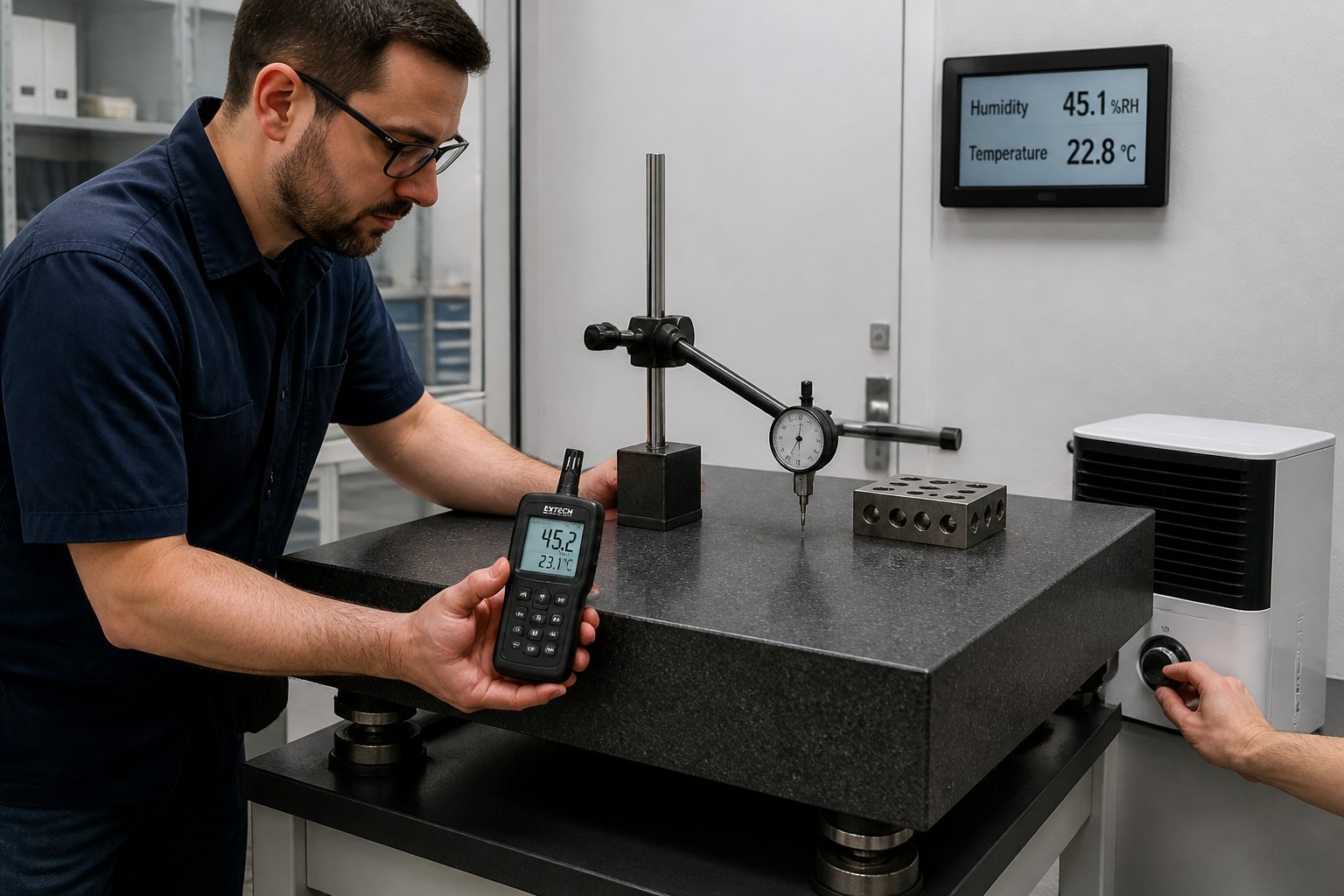
Many metrology labs operate under tight tolerances where even micro-inches matter. Fluctuations in humidity can cause materials to expand or contract, albeit slightly, leading to measurement errors that are hard to trace. A stable granite metrology environment is therefore critical for reliable, repeatable results.
Consider the cumulative effect of these small degradations over months or years. What seems like a minor oversight today can become a costly repair or replacement tomorrow. Proactive humidity management protects your investment and ensures your quality control processes remain robust.
Understanding the Effects of High Humidity on Granite and Tools
High levels of humidity introduce a host of problems that directly impact the accuracy and longevity of your metrology equipment. The most immediate and visible threat is the formation of rust on any ferrous metal tools and accessories. This surface plate moisture accelerates oxidation, turning precision steel into pitted, unusable scrap.
While granite itself does not rust, it is not entirely immune to high humidity’s effects. The microscopic pores within the granite can absorb and release moisture, potentially causing minute dimensional changes over time. This hygroscopic behavior, though minimal, can affect the long-term stability of the surface plate’s flatness.
| Component Affected | High Humidity Effect | Consequence for Metrology |
|---|---|---|
| Steel Tools & Gauges | Accelerated oxidation, rust formation | Loss of dimensional accuracy, surface pitting, tool damage |
| Cast Iron Stands/Supports | Corrosion, flaking paint | Structural degradation, particulate contamination, cosmetic damage |
| Granite Surface Plate | Microscopic moisture absorption | Potential for minute dimensional changes, surface film |
| Electronic Measuring Devices | Internal condensation, short circuits | Malfunctions, reduced lifespan, calibration drift |
| Calibration Standards | Surface degradation, dimensional instability | Inaccurate reference points, compromised traceability |
The Dangers of Low Humidity for Surface Plate Stability
While high humidity often grabs attention due to visible rust, excessively low humidity also presents significant, albeit different, challenges to your metrology setup. A dry environment can be just as detrimental to precision measurement as a damp one. This opposite extreme can affect both the granite and the operational environment.
In extremely dry conditions, the granite surface plate itself can experience a subtle, long-term drying out process. Although granite is remarkably stable, prolonged exposure to arid air might lead to internal stresses or micro-cracking over decades, especially in lower quality plates. This effect is less common but still a consideration for long-term stability.
A more immediate concern with low humidity involves static electricity. Dry air readily promotes the buildup of static charges, which can attract dust and other airborne contaminants to the surface plate. These particles, no matter how small, interfere with the precise contact required for accurate measurements and can scratch delicate surfaces.
Additionally, static electricity can interfere with sensitive electronic measuring devices, causing erratic readings or even permanent damage. Imagine trying to get a stable reading on a digital indicator when static discharge is constantly affecting its sensor. This introduces an unpredictable variable into your measurement process.
Low humidity can also dry out the protective oils and lubricants on precision tools and gauges. This leads to increased friction, premature wear, and potential seizing of moving parts. Ensuring proper granite surface plate humidity control means avoiding both extremes to protect all components of your granite metrology environment.
Certain specialized tools, such as optical flats or laser interferometers, rely on stable atmospheric conditions for accurate operation. Dry air can cause minor refractive index changes or create conditions where optical surfaces become more prone to dust accumulation. These subtle impacts can compromise highly sensitive measurements.
Maintaining a balanced humidity level is about creating a harmonious environment where all elements can perform optimally. Without this balance, you’re constantly fighting against environmental factors that degrade accuracy and shorten equipment life. This balance is key to preventing rust on granite-adjacent tools while avoiding other issues.
Ideal Humidity Levels for Surface Plate Environments
Defining the perfect humidity range is crucial for optimal granite surface plate humidity control. Metrology standards and industry best practices generally recommend a relative humidity (RH) level between 40% and 60%. This range provides a sweet spot, mitigating the risks of both excessive moisture and overly dry conditions.
Operating within this 40-60% RH window helps to prevent surface plate moisture from causing rust on your precision tools and gauges. It also minimizes the risk of static electricity buildup, which can attract dust and interfere with electronic instruments. Achieving this balance is a cornerstone of a reliable granite metrology environment.
Many manufacturers of high-precision equipment, including granite surface plates and calibration standards, specify this humidity range in their operational guidelines. Deviating significantly from these recommendations can void warranties or, more critically, lead to unreliable measurement results. Consistency is far more important than any single measurement.
Temperature also plays a role, as relative humidity is temperature-dependent. Maintaining a stable temperature, typically 68°F (20°C), in conjunction with the ideal humidity, creates the most stable metrology environment possible. Fluctuations in either parameter can introduce errors that are difficult to isolate and correct.
Some extremely sensitive applications might even require tighter humidity control, perhaps a narrower 45-55% range. However, for most general metrology applications, the 40-60% RH guideline serves as an excellent target. Always consult the specific requirements for your most sensitive instruments.
Striving for consistency within this range is more important than hitting an exact number at all times. Rapid and frequent swings in humidity can be just as damaging as consistently high or low levels. Your goal should be to create a controlled, stable atmosphere that minimizes environmental stressors on your equipment.
By consciously managing your workshop’s humidity, you are not just preventing rust on granite-adjacent tools; you are actively preserving the accuracy and lifespan of your entire precision measurement system. This proactive approach saves money and ensures the integrity of your quality control. Remember, precision demands a precise environment.
Simple Tools for Monitoring Workshop Humidity
You cannot control what you do not measure. Monitoring the relative humidity in your workshop is the essential first step towards effective granite surface plate humidity control. Fortunately, there are several straightforward and affordable tools available to help you keep tabs on your granite metrology environment.
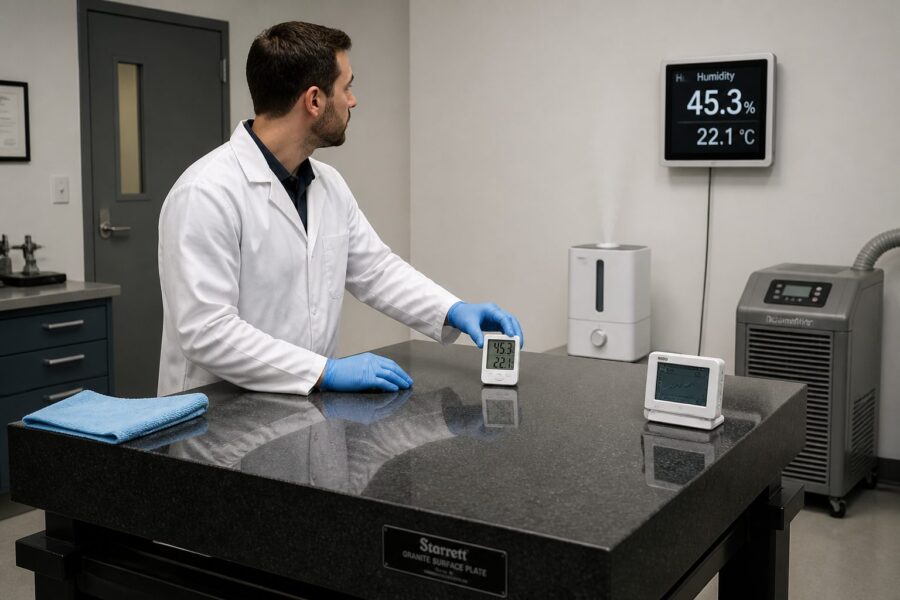
The most common and accessible device is a hygrometer, which specifically measures humidity levels. Many modern thermometers also include a hygrometer function, making them convenient dual-purpose instruments. Placing these near your surface plate provides immediate, localized readings.
Digital hygrometers are generally preferred for their accuracy and ease of reading. Look for models that offer a clear digital display and perhaps even trend indicators, showing how humidity has changed over time. Some advanced versions can even log data, giving you a historical record of your conditions.
For more critical applications or larger spaces, consider a wireless hygrometer system. These allow you to place multiple sensors throughout your workshop and monitor them from a central display or even a smartphone app. This provides a more comprehensive picture of your surface plate moisture distribution.
Remember that the placement of your hygrometer matters significantly. Position it close to your granite surface plate, but not directly in the path of air vents or heat sources, which could skew readings. You want an accurate representation of the air immediately surrounding your precision equipment.
Regularly checking your hygrometer readings should become a part of your daily routine. This vigilance allows you to detect unfavorable trends early, before surface plate moisture or dryness causes damage. Early detection means you can implement corrective actions promptly, preventing rust on granite-adjacent tools and other issues.
Even if you have an advanced HVAC system, local monitoring with a simple hygrometer is still a wise practice. Microclimates can exist within a larger room, especially near windows, doors, or equipment that generates heat or cold. These localized readings give you the true picture of your granite surface plate’s immediate surroundings.
Active Humidity Control Solutions for Your Workspace
Once you understand your workshop’s humidity patterns, implementing active control measures becomes necessary for a stable granite metrology environment. These solutions directly add or remove moisture from the air, maintaining your desired relative humidity range. Investing in these systems protects your precision equipment from surface plate moisture.
The choice of active solution depends on your local climate, workshop size, and the severity of your humidity challenges. Sometimes a combination of approaches provides the most effective and robust control. Each solution offers distinct advantages in managing your environment.
- Industrial-grade dehumidifiers
- Whole-building HVAC systems with humidity control
- Stand-alone humidifiers for dry climates
- Desiccant dry cabinets for sensitive tools
- Localized climate control units
- Air conditioning systems (often dehumidify as a byproduct)
Passive Strategies to Stabilize Room Humidity
While active systems directly manipulate air moisture, passive strategies offer supplementary benefits for granite surface plate humidity control. These methods focus on minimizing external influences and creating a more stable internal environment. They work in conjunction with active controls to fortify your granite metrology environment.
One fundamental passive strategy involves ensuring proper insulation and sealing of your workshop space. Gaps around windows, doors, and utility penetrations allow external air, with its fluctuating humidity, to enter. Sealing these entry points reduces the burden on your active control systems and stabilizes internal conditions.
Consider the use of vapor barriers in your walls and ceiling, especially in climates prone to extreme humidity. A well-installed vapor barrier prevents moisture from migrating through building materials, helping to maintain consistent internal humidity levels. This is a crucial element in preventing surface plate moisture issues.
Strategic ventilation can also play a role, though it requires careful management. Exhaust fans in areas generating significant moisture, like wash stations or machining areas, can remove localized humidity before it spreads. However, this must be balanced to avoid drawing in too much uncontrolled outside air.
Maintaining a consistent internal temperature also indirectly aids humidity control. As mentioned earlier, relative humidity is temperature-dependent; stable temperatures mean more predictable RH. Avoid large temperature swings, which can cause condensation or excessive drying.
Even the arrangement of your workspace can impact humidity. Avoid placing heat-generating equipment too close to your surface plate, as localized temperature increases can affect RH readings and create microclimates. Thoughtful layout contributes to a more uniform granite metrology environment.
Simple measures like keeping exterior doors closed can have a surprisingly large impact on maintaining stable internal conditions. Every time a door opens, it introduces a slug of uncontrolled air, potentially negating the efforts of your active systems. These small habits collectively contribute to better granite surface plate humidity control.
Protecting Accessories and Tools from Humidity Damage
Your granite surface plate is only as good as the tools used on it. Therefore, protecting your precision accessories, gauges, and instruments from surface plate moisture is just as important as caring for the plate itself. Rust is the archenemy of precision steel, and preventing rust on granite-adjacent tools demands specific attention.
After each use, thoroughly clean and dry all metal tools and gauges. Even microscopic fingerprints contain moisture and oils that can initiate corrosion. A quick wipe-down with a clean, lint-free cloth is a simple yet effective daily habit to adopt.
Apply a thin, uniform layer of rust-preventative oil or corrosion inhibitor to all exposed metal surfaces before storage. Specialized instrument oils are designed to provide a protective barrier without interfering with future measurements. This sacrificial layer keeps damaging moisture away from the tool’s surface.
Store precision tools in dedicated, enclosed cabinets or drawers. These provide a physical barrier against airborne moisture and dust. For even greater protection, consider using desiccants like silica gel packets within these storage containers to absorb residual humidity.
For highly sensitive or expensive instruments, a desiccant dry cabinet offers the ultimate protection. These sealed cabinets actively maintain a low relative humidity, often below 20% RH, safeguarding against any surface plate moisture concerns. This is an excellent investment for critical gauge blocks or optical components.
Avoid storing tools directly on the granite surface plate for extended periods, especially overnight. Even in a controlled environment, direct contact can sometimes trap minute amounts of moisture, leading to localized corrosion. Always return tools to their designated, protected storage.
Regularly inspect all your metal accessories for any signs of surface rust or degradation. Catching issues early allows for cleaning and re-oiling before permanent damage occurs. This vigilance is a key part of maintaining a pristine granite metrology environment.
Daily Habits for Mitigating Humidity’s Impact
Effective granite surface plate humidity control is not just about installing expensive equipment; it is about cultivating consistent daily habits. Small, routine actions can make a significant difference in preserving your precision equipment. These habits form the backbone of a robust defense against surface plate moisture.
Always clean your granite surface plate thoroughly before and after each use. Use a specialized granite cleaner or a mild soap and water solution, followed by a complete wipe-down with a dry, lint-free cloth. This removes contaminants and any residual moisture that could attract rust.
When not actively in use, cover your granite surface plate with a protective cover. This cover acts as a barrier against dust, airborne particles, and direct exposure to fluctuating room humidity. A simple, breathable fabric cover can provide substantial protection.
Regularly check your hygrometer readings throughout the day, especially if your active control systems are not fully automated. This allows you to identify and address any deviations from your ideal 40-60% RH range promptly. Consistent monitoring is a non-negotiable part of maintaining a stable granite metrology environment.
Keep your workshop tidy and free of clutter, especially around the surface plate. Clutter can trap moisture, impede air circulation, and make it harder to spot potential issues. A clean workspace is inherently easier to control environmentally.
Ensure that any water-based operations, such as cooling systems for machining, are properly contained and vented away from your metrology area. Uncontrolled water vapor from these processes can quickly spike room humidity. Segregating these activities is often a smart move.
If you live in a climate with seasonal humidity swings, adjust your control strategies accordingly. You might need to increase dehumidifier usage in summer and consider a humidifier in winter. Adapting to seasonal changes ensures continuous granite surface plate humidity control.
Educate everyone who uses the surface plate about the importance of these daily habits. A single careless user can inadvertently compromise the entire setup. Team awareness and adherence to protocols are vital for preventing rust on granite-adjacent tools and maintaining overall precision.
Recognizing Signs of Humidity-Related Issues
Even with the best intentions for granite surface plate humidity control, problems can sometimes arise. Knowing how to recognize the early warning signs of humidity-related issues can save your equipment from irreversible damage. Vigilance is your first line of defense against surface plate moisture.
The most obvious sign of high humidity is the appearance of rust on your steel tools, gauges, or cast iron stands. Look for reddish-brown spots, pitting, or a generally dull, oxidized appearance on metal surfaces. Even a thin film of rust indicates an environment that is too damp.
A sticky or greasy feel on the surface plate itself can sometimes indicate high humidity combined with airborne contaminants. While granite doesn’t rust, moisture can combine with dust to create a film that interferes with smooth tool movement. This film needs immediate attention.
If you notice electronic measuring devices behaving erratically, such as fluctuating readings or intermittent power, low humidity and static electricity could be the culprit. Conversely, internal condensation within displays or lenses points directly to high humidity. These are clear indicators of environmental stress.
Tools that feel stiff, gritty, or difficult to move, even after proper cleaning and lubrication, might be experiencing early stages of corrosion or drying out. Increased friction is a red flag that humidity levels are impacting the mechanical performance of your precision instruments. This affects your granite metrology environment negatively.
Unusual amounts of dust accumulation on the surface plate, especially shortly after cleaning, can signal overly dry conditions and increased static electricity. Static charges act like magnets for airborne particles, compromising the cleanliness required for accurate measurements. This is a subtle but important indicator.
Any visible condensation on cold surfaces within your workshop, like metal pipes or windows, is a definitive sign of high relative humidity. This visible moisture indicates that the air is saturated and poses an immediate threat to your precision equipment. Addressing this quickly is vital for preventing rust on granite-adjacent tools.
If your hygrometer readings consistently fall outside the 40-60% RH ideal range, it’s a clear signal that your current humidity control methods are insufficient. Trust your instruments, and investigate the cause of the deviation. Addressing these signs proactively protects your investment and maintains measurement integrity.
Conclusion
Effective granite surface plate humidity control is not a luxury; it is a fundamental requirement for any precision metrology operation. The subtle yet pervasive threats of surface plate moisture, whether too high or too low, can silently degrade your equipment and compromise your measurement accuracy. Ignoring this environmental factor is a costly oversight.
By understanding the impact of humidity, establishing ideal conditions, and implementing both active and passive control strategies, you create a robust granite metrology environment. Monitoring with simple tools and adopting diligent daily habits are equally important steps. This comprehensive approach safeguards your investment and ensures reliable, repeatable results.
Remember, precision demands a precise environment. Protecting your tools from rust and maintaining the dimensional stability of your granite surface plate directly impacts the quality of your work. Make humidity control a priority in your metrology lab, and reap the benefits of consistent, accurate measurements for years to come. Your equipment, and your reputation, depend on it.
Investing time and resources into managing your workshop’s humidity is a smart business decision. It minimizes costly repairs, extends the lifespan of your valuable instruments, and ensures compliance with critical quality standards. Don’t let an invisible threat undermine your commitment to accuracy.
We encourage you to review your current workshop conditions and implement the strategies discussed here. Start by simply monitoring your humidity levels, and then gradually introduce control measures as needed. Every step you take towards better humidity management is a step towards greater metrology confidence.