
Working on a granite surface plate demands absolute precision, where even the slightest visual obstruction can lead to measurement errors. The highly polished surface of a granite calibration standard is excellent for metrology, but it also creates unique challenges for lighting. Understanding how light interacts with this dense, reflective material is key to maintaining accuracy in your measurements.
Poor lighting can introduce glare, cast unwanted shadows, and cause significant eye strain, all of which compromise the integrity of your work. Achieving optimal visibility without adding heat or causing discomfort is a critical aspect of any precision workstation setup. This guide explores practical strategies for illuminating your granite surface plate effectively, ensuring clear sightlines and reliable results every time.
We will discuss specific light types, positioning techniques, and simple accessories that make a real difference in your daily metrology tasks. Proper illumination is not just a convenience; it is a fundamental requirement for accurate layout and inspection work on any granite surface plate, directly impacting the quality and consistency of your output.
Why Lighting Matters for Layout and Inspection Work
Accurate metrology hinges on the ability to clearly see the smallest details and measurement lines on your granite surface plate. Insufficient or improperly directed light can easily obscure these critical features, leading to misinterpretations and costly errors. Every skilled technician knows that precision begins with a clear view of the workpiece.
When you are performing intricate layout tasks or conducting detailed inspections, your eyes need every advantage they can get. Good inspection lighting ensures that scale marks, scribed lines, and indicator readings are crisp and unambiguous. This directly translates to higher confidence in your measurements and fewer reworks.
The reflective nature of a granite surface plate means that light sources can either be your best friend or your worst enemy. Strategic illumination helps to define edges and surfaces, making it easier to position gauges, height masters, and other precision tools correctly. It significantly enhances the visual contrast required for high-accuracy work.
Moreover, consistent and uniform lighting across the entire granite surface plate prevents areas of varying brightness that can trick the eye. This uniformity is especially important when moving a workpiece or an instrument across a large surface. You want the same visual conditions regardless of where you are working.
Effective lighting reduces the likelihood of parallax errors when reading analog scales or micrometer thimbles. When light falls evenly, you can more reliably align your eye with the measurement point, minimizing human error. This often overlooked aspect of workstation setup plays a substantial role in overall measurement quality.
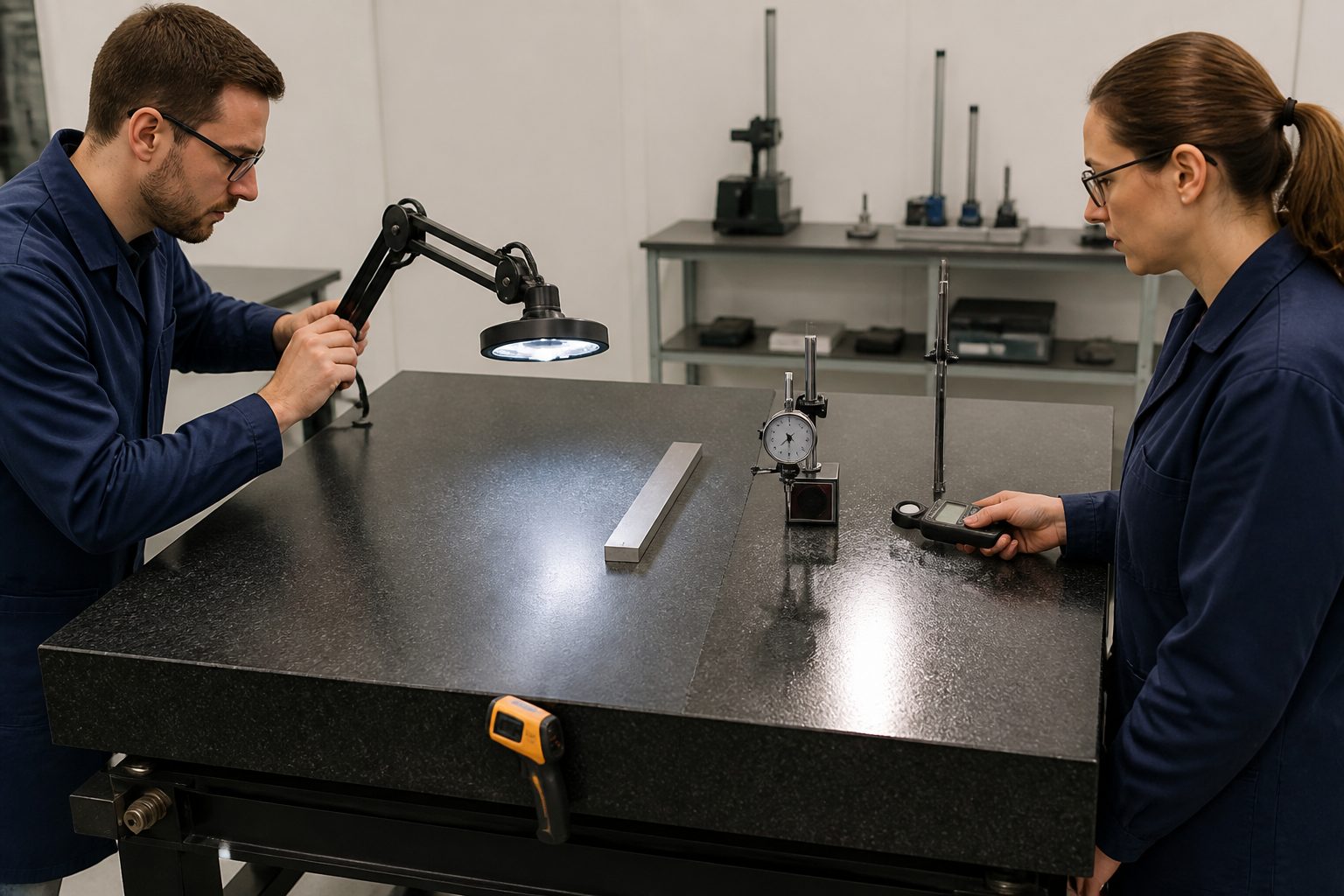
Ultimately, investing in proper granite surface plate lighting and glare reduction techniques is an investment in accuracy and efficiency. It minimizes the need for repeated measurements and ensures that every piece of data collected is as reliable as possible. Your precision work deserves the best possible visual environment.
Common Lighting Problems: glare, shadows, and eye strain
The polished surface of a granite surface plate, while ideal for metrology, can become a major source of glare if lighting is not managed correctly. This intense reflection can wash out details, making it incredibly difficult to discern fine lines or small features on the workpiece. Glare reduction is perhaps the most immediate lighting challenge to address.
Shadows present another significant hurdle, often obscuring critical areas or creating false readings. An overhead light positioned directly above your workstation can cast harsh shadows from your hands, tools, or the workpiece itself. These moving shadows interrupt your workflow and force constant adjustments to your posture.
Prolonged exposure to poor lighting conditions, particularly those involving glare and high contrast shadows, inevitably leads to eye strain. Symptoms like headaches, blurred vision, and general fatigue can severely impact a technician’s concentration and productivity. This kind of discomfort reduces both accuracy and job satisfaction over time.
Uneven illumination creates hot spots, areas of excessive brightness that stand in stark contrast to darker regions on the granite surface plate. Your eyes constantly try to adapt to these varying light levels, a process that accelerates fatigue and reduces visual acuity. A uniform light field is always preferable for precision tasks.
Reflections from windows or other bright surfaces in the room can also interfere with visibility on the granite. These environmental reflections are often dynamic, changing with the time of day or external weather conditions. Managing these external light sources is just as important as controlling your primary inspection lighting.
Ultimately, ignoring these common lighting problems compromises the very purpose of a granite surface plate: providing an unyielding, precise reference plane. Addressing glare, shadows, and eye strain directly improves both the quality of your measurements and the comfort of your working environment. A well-lit workstation setup ensures consistent, reliable performance.
Choosing Light Types: LED options and color temperature basics
When selecting lighting for a granite surface plate, LED options stand out as the superior choice due to their efficiency, longevity, and versatility. LEDs produce very little heat, which is a crucial factor for maintaining the thermal stability of your precision measurement environment. This low heat output helps prevent unwanted thermal expansion of the granite itself.
Beyond their practical benefits, LEDs offer a wide range of color temperatures, allowing you to fine-tune the visual characteristics of your workstation. Color temperature, measured in Kelvin (K), describes the warmth or coolness of the light emitted. Understanding this concept helps optimize your inspection lighting for specific tasks.
| Color Temperature (K) | Description | Best Use for Metrology |
|---|---|---|
| 2700K – 3000K | Warm White (Yellowish) | Comfortable for general office work, less ideal for critical inspection. |
| 3500K – 4000K | Neutral White | Good all-around light, suitable for many metrology tasks without being too harsh. |
| 5000K – 5500K | Daylight White | Excellent for detailed inspection, offers high contrast and true color rendering. |
| 6000K – 6500K | Cool White/Blueish | Very crisp and bright, ideal for identifying minute imperfections, can cause eye strain over long periods. |
Positioning Lights to Reduce Glare on Polished Granite
Strategic light positioning is the single most effective method for glare reduction on a granite surface plate. Instead of placing lights directly above your work area, which creates harsh reflections, consider indirect or angled illumination. This approach scatters the light more effectively, minimizing direct specular glare.
One proven technique involves positioning task lighting at a low angle, almost parallel to the granite surface. This grazing light helps to highlight surface irregularities and fine features by casting subtle shadows, making them more visible. It also directs the primary reflection away from your eyes, greatly reducing discomfort.
Using multiple light sources from different directions can also help to even out illumination and reduce concentrated glare. Imagine setting up two adjustable lamps, one on each side of your workstation, angled towards the center. This cross-illumination technique fills in shadows and diffuses reflections across the granite surface plate.
For larger granite calibration standards, overhead lighting should ideally be diffuse and spread out across the ceiling. If you have direct overhead fixtures, try to position your workstation so that the brightest part of the fixture is not directly reflected into your eyes. Sometimes a slight shift in plate orientation makes a big difference.
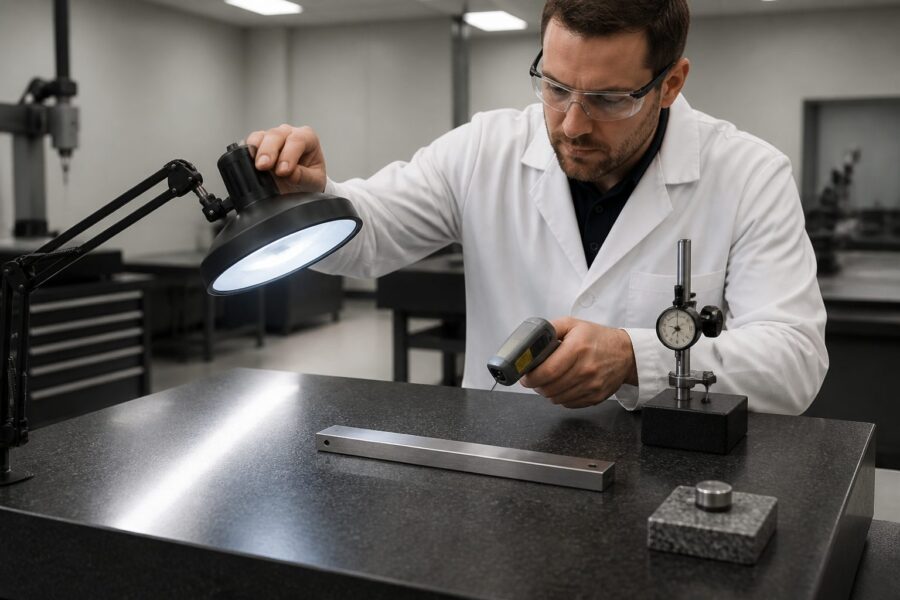
Adjustable arm lamps are invaluable for this purpose, allowing you to experiment with various angles until you find the sweet spot for your current task. The ability to quickly pivot and tilt a light source means you can adapt to different workpieces and measurement setups. This flexibility is a cornerstone of effective inspection lighting.
Remember that the goal is to illuminate the workpiece and the measurement area, not to create a bright reflection of the light source itself. By carefully positioning your lights, you gain superior visibility and significantly improve your ability to perform precise metrology tasks on a granite surface plate. This thoughtful workstation setup prevents many common visual frustrations.
Avoiding Heat and Hot Spots From Lighting
Maintaining a stable thermal environment is paramount for accurate metrology on a granite surface plate, and lighting choices play a direct role. Traditional incandescent or halogen lamps generate significant heat, which can cause the granite to expand or contract, compromising its flatness and measurement integrity. This thermal instability introduces errors that are hard to detect.
The best way to avoid unwanted heat is by exclusively using LED lighting for your workstation setup. Modern LEDs are incredibly efficient, converting most of their energy into light rather than heat, making them ideal for precision environments. They allow you to achieve bright, effective inspection lighting without the thermal side effects.
Even with LEDs, avoid positioning a very powerful light source too close to a specific measurement area for extended periods. While LEDs produce less heat, a concentrated beam can still cause localized temperature changes if left in one spot for hours. Distribute your light sources to prevent concentrated thermal loads.
Hot spots, areas of intense illumination, are not only visually fatiguing but can also indicate a concentrated heat source. These areas can lead to uneven thermal expansion across the granite surface plate, subtly distorting its geometry. Diffusing light helps spread both the illumination and any residual heat more evenly.
Consider the ambient temperature of your metrology lab and how your lighting contributes to it. If the room itself tends to run warm, even low-heat lights can exacerbate the issue. A balanced approach to lighting and room temperature control is essential for the highest accuracy on your granite calibration standards.
By prioritizing low-heat LED technology and thoughtful light distribution, you can effectively prevent thermal distortions from your lighting setup. This attention to detail ensures that your granite surface plate remains thermally stable, providing a consistent and reliable reference for all your critical measurements. It is a simple step with profound impact on precision.
Task Lighting for Indicators and Small Features
While general workstation lighting is important, specific task lighting becomes indispensable for reading precise indicators and examining tiny features on workpieces. These focused light sources allow you to pinpoint illumination exactly where it is needed, enhancing visibility for critical, up-close tasks. This level of detail is often where measurement errors occur.
A well-placed task light can make the difference between a clear reading and a frustrating squint, especially when working with dial indicators, digital readouts, or optical comparators. It helps to eliminate micro-shadows that might otherwise obscure the fine graduations or subtle surface textures. Effective glare reduction is paramount in these close-up scenarios.
- Adjustable gooseneck lamps with LED heads
- Fiber optic illuminators for precise spot lighting
- Ring lights for shadow-free magnification
- Magnifying lamps with integrated LED lighting
- Portable inspection lights for tricky angles
Managing Reflections From Windows and Overhead Fixtures
External light sources, such as windows and large overhead room fixtures, can introduce dynamic and often uncontrollable reflections onto your granite surface plate. These reflections contribute significantly to glare and visual distraction, making consistent measurements challenging. Addressing these ambient light issues is crucial for an optimal workstation setup.
If possible, position your granite surface plate away from direct window light or areas with strong, uncontrolled ambient illumination. Sometimes a simple reorientation of the surface plate can redirect reflections away from your line of sight. This initial placement decision can save a lot of trouble later on.
Window treatments, such as blinds, curtains, or even simple opaque film, offer an effective way to control incoming natural light. These solutions allow you to diffuse or block harsh sunlight that might otherwise create intense glare on the polished granite. You want soft, ambient light, not direct beams.
For overhead room lighting, consider fixtures with diffusers or parabolic louvers that spread light more evenly across the room. If your existing fixtures produce harsh, direct light, you might explore adding diffusion panels beneath them. This softens the light before it reaches your granite surface plate, reducing the intensity of reflections.
Another strategy involves creating a localized “light bubble” around your granite surface plate using your primary inspection lighting. By carefully directing your task lights, you can overpower or minimize the impact of external reflections on your immediate work area. This creates a controlled micro-environment for precision tasks.
Ultimately, managing reflections from environmental sources requires a combination of strategic workstation placement and intelligent light control. Effective glare reduction from windows and overhead fixtures ensures that your granite surface plate lighting and glare are optimally managed, contributing to more reliable and comfortable inspection work.
Simple Add-Ons: diffusers, shades, and movable arms
Even with carefully chosen and positioned light sources, simple add-ons can significantly enhance your granite surface plate lighting and glare reduction efforts. These accessories often provide the final touch, transforming good lighting into truly exceptional illumination for metrology. They offer fine-tuning capabilities that improve comfort and accuracy.
Diffusers are perhaps the most essential add-on, softening the light output from any direct source. Attaching a diffuser panel to your task lamp or overhead fixture spreads the light more evenly, reducing harsh shadows and eliminating concentrated glare spots on the granite surface plate. This creates a much more pleasant visual environment.
Light shades or baffles can be used to direct light precisely where you want it and block it from areas where it causes glare. These accessories are particularly useful for preventing light spill onto other reflective surfaces or directly into your eyes. They allow for very focused control over the light beam.
Movable arm lamps, especially those with multiple articulation points, offer unparalleled flexibility for adjusting your inspection lighting. The ability to quickly change the angle, height, and distance of a light source is invaluable for different workpieces and measurement setups. This adaptability is key to optimal glare reduction.
Consider using polarizing filters on your light sources or even as an attachment to your viewing optics. Polarizers can dramatically reduce glare by filtering out horizontally polarized light, which is often the component causing intense reflections from polished surfaces. This can reveal details otherwise obscured by shine.
These simple, often inexpensive, add-ons provide powerful ways to refine your workstation setup and optimize your visual environment. By incorporating diffusers, shades, and flexible mounting options, you can achieve superior control over your granite surface plate lighting and significantly reduce eye strain during precision work.
Keeping Fixtures Clean to Maintain consistent brightness
The performance of your granite surface plate lighting and glare reduction efforts depends heavily on the cleanliness of your light fixtures. Dust, grime, and fingerprints on lamps or diffusers can significantly diminish light output and alter its quality. A clean fixture maintains the consistent brightness and color temperature you rely on.
Over time, a layer of dust can accumulate on bulbs, lenses, and reflective surfaces within a light fixture, acting as an unintended filter. This reduces the effective illumination reaching your granite surface plate, forcing your eyes to work harder. Regular cleaning prevents this gradual degradation of your inspection lighting.
Dirty diffusers, in particular, can become less effective at spreading light evenly, leading to uneven illumination and reintroducing glare. Streaks or smudges on a diffuser can create distracting patterns on your work surface. A clean diffuser ensures uniform light distribution across your entire workstation setup.
Make it a routine to gently wipe down your light fixtures, including bulbs and covers, with a soft, lint-free cloth. For stubborn grime, a mild, non-abrasive cleaner safe for electronics or plastics can be used sparingly. Always ensure fixtures are unplugged and cool before cleaning them.
Maintaining clean fixtures is a simple, yet often overlooked, aspect of optimal metrology workstation management. It ensures that the investment you made in quality lighting continues to pay off with consistent, high-performance illumination. This small habit contributes significantly to long-term visual comfort and measurement accuracy.
A clean lighting setup not only maximizes brightness but also preserves the intended color temperature, preventing subtle shifts that could affect your perception of features. Consistent light quality is just as important as consistent light quantity for precision work. This practice extends the lifespan of your equipment as well.
A quick lighting check you can do before critical work
Before embarking on any critical layout or inspection work on your granite surface plate, a quick lighting check can prevent many common visual frustrations. This simple routine ensures that your workstation setup is optimally prepared for precision, minimizing the risk of errors due to poor visibility. It only takes a moment but offers significant benefits.
First, position your body as you normally would for the task and observe the granite surface plate for any obvious glare spots. Move your head slightly to see if reflections shift directly into your eyes. If you spot significant glare, adjust your primary inspection lighting angles or reposition the workpiece slightly until it dissipates.
Next, place a small, reflective object, like a polished gauge block or a ruler, onto the granite surface plate. Look for any harsh shadows cast by your hands, tools, or the object itself. If shadows are too prominent, introduce a secondary light source from an opposing angle to fill them in, or adjust your main light’s position.
Check the overall uniformity of illumination across your granite surface plate. Are there noticeably brighter or darker areas that could affect your visual judgment? If so, consider adding diffusers or repositioning ambient room lights to achieve a more consistent light field. Even lighting is vital for consistent results.
Take a moment to look away from your work and then back at it; if your eyes struggle to readjust or if you immediately feel strain, your lighting might be too intense or too dim. Adjust the brightness of your task lighting to a comfortable level that provides clear visibility without causing discomfort. Your eyes will thank you for it.
Finally, confirm that your task lighting effectively illuminates the specific features or indicators you will be working with. Ensure that the focused beam enhances contrast and makes fine details pop, without creating new glare on the granite surface plate. This quick check is a small investment that yields significant returns in accuracy and comfort.
Conclusion
Optimizing lighting for your granite surface plate is not merely about brightness; it is about creating an ideal visual environment for precision metrology. By strategically addressing factors like glare, shadows, and heat, you can significantly enhance the accuracy and reliability of your measurements. This attention to detail elevates the quality of all your inspection lighting tasks.
Investing in quality LED options and understanding color temperature allows you to tailor your workstation setup for maximum clarity and minimal eye strain. These choices ensure that your granite surface plate remains thermally stable, preventing minute distortions that could compromise your work. Thoughtful selection makes a real difference.
Strategic positioning of light sources, coupled with simple add-ons like diffusers and movable arms, provides unparalleled control over illumination. These techniques are crucial for effective glare reduction, turning a potentially reflective surface into a clearly visible workspace. Your ability to see fine details directly impacts measurement integrity.
Managing ambient reflections from windows and overhead fixtures further refines your working conditions, ensuring consistent lighting regardless of external factors. A holistic approach that considers both direct and indirect light sources contributes to a more stable and comfortable environment. Every element plays a role in precision.
Ultimately, a well-lit granite surface plate workstation reduces fatigue, improves concentration, and minimizes the potential for human error. It is a fundamental component of any high-accuracy metrology operation, ensuring that every measurement taken is as precise as possible. Prioritize your visual environment for superior results.
By implementing these practical strategies, you transform your granite surface plate from a challenging surface into an optimally illuminated foundation for all your critical work. This commitment to superior granite surface plate lighting and glare management will undoubtedly lead to higher quality outputs and greater confidence in your precision measurements. It is a worthwhile endeavor for any professional.