
Precision measurement relies on a granite surface plate, an incredibly flat and stable work surface essential for accurate metrology. While robust, even these plates are susceptible to environmental factors.
Environmental factors like temperature and humidity subtly yet significantly impact measurement accuracy. Understanding granite surface plate humidity and temperature effects is crucial for maintaining measurement integrity, as ignoring them can lead to costly errors and inconsistent results.
Mastering metrology requires understanding how atmospheric elements interact with your calibration standards. Paying close attention to these details ensures trustworthy measurements.
What Granite Does (and Doesn’t) Do With Temperature Changes
Granite is ideal for surface plates due to its very low coefficient of thermal expansion. It expands and contracts far less than steel or cast iron, making it a trusted material for high-precision work.
However, ‘low’ isn’t ‘zero.’ In precision work, even minor changes matter. A plate might expand or contract by millionths of an inch per degree Celsius, a minuscule yet impactful change requiring careful consideration.
The real challenge isn’t uniform expansion, which is predictable. It’s temperature gradients—where parts of the plate are warmer or cooler—that cause warping or distortion, compromising flatness.
Imagine a warm spot directly under a workpiece or near a heat source, or a cool draft hitting one edge. These localized temperature differences create stress within the granite. This stress then manifests as subtle deviations from the ideal flat plane, directly affecting measurement accuracy.
Proper thermal stabilization means more than just a set room temperature. It requires the plate and everything on it to reach a uniform temperature. This equilibrium allows granite to perform optimally.
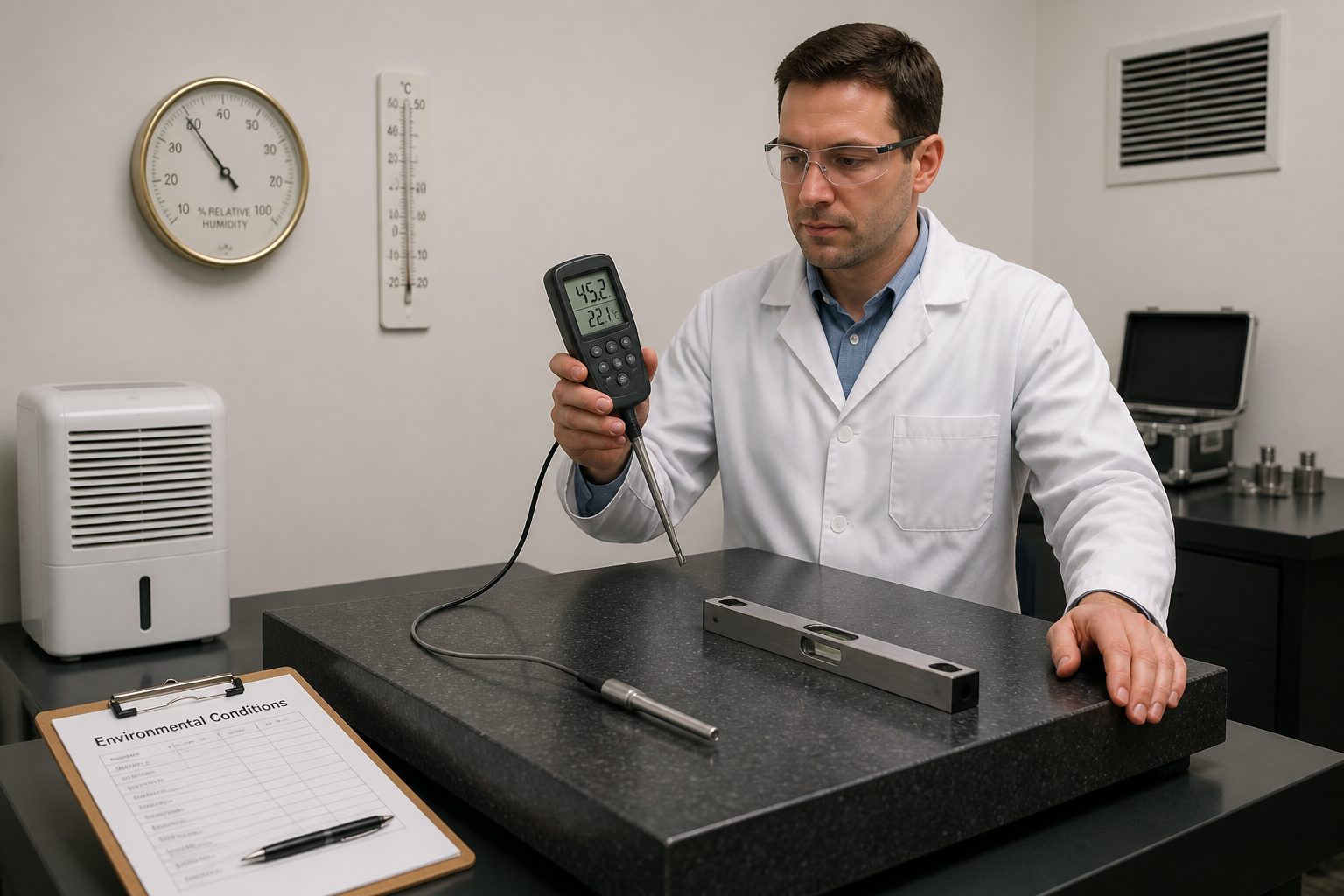
Ignoring these gradients means measuring on a surface that isn’t perfectly flat, even if calibrated. Understanding and managing temperature distribution is crucial for reliable metrology, as precision begins with recognizing these subtle environmental influences.
Many shops mistakenly believe granite is impervious to temperature changes. While more stable than other materials, it’s still affected by environmental shifts. Even minor temperature differences across the plate can introduce unacceptable errors in high-tolerance work.
Why Your Plate Needs Time to Stabilize
Granite has significant thermal inertia, meaning it takes a long time for its temperature to change and become uniform. This resistance to rapid fluctuations also means it holds new temperatures for extended periods, demanding patience and planning for precision work.
Introducing a workpiece with a different temperature immediately creates a differential. Both the plate and workpiece need time to acclimate to each other and ambient room temperature before reliable measurements. Thermal stabilization is non-negotiable for accuracy.
| Factor | Impact on Stabilization Time | Mitigation Strategy |
|---|---|---|
| Plate Size & Mass | Larger, heavier plates take much longer to stabilize. | Allow extended acclimation periods, especially for master plates. |
| Temperature Difference (ΔT) | Greater temperature difference requires more time. | Minimize temperature swings in the metrology lab. |
| Material Properties | Granite’s high thermal inertia prolongs stabilization. | Maintain stable room temperature and avoid direct heat/cold sources. |
| Airflow & Ventilation | Poor airflow can create hot/cold spots, delaying uniformity. | Ensure gentle, consistent ambient airflow around the plate. |
| Workpiece Size | Large workpieces increase overall thermal mass on the plate. | Pre-condition workpieces near the plate for several hours. |
| Environmental Controls | Fluctuating HVAC settings disrupt stable conditions. | Program HVAC for consistent temperature, avoid drastic changes. |
The Real Problem With Humidity: Condensation and Residue
Many mistakenly believe granite surface plates absorb moisture. High-quality granite is virtually non-porous. The real concern with high humidity is condensation forming on the plate’s surface.
Condensation occurs when the plate’s surface temperature drops below the air’s dew point. This happens when a cooler plate meets warm, humid air, or when humid air cools rapidly around it, forming a thin film of water.
This thin film of water is problematic. It interferes with instrument glide, introduces an unpredictable layer, and leads to inaccurate readings. Even microscopic liquid disrupts the precision contact essential for metrology.
The bigger issue arises after condensation evaporates. Water, especially tap water, contains dissolved minerals and contaminants. When it evaporates, these residues are left behind on the plate’s polished surface.
Over time, these mineral deposits build up, creating an uneven, gritty surface that compromises flatness and wears down instruments. This residue impacts long-term accuracy and lifespan, making condensation control essential. Preventing buildup is always better than just cleaning.
These minuscule deposits act like tiny speed bumps, causing subtle rocking or sticking for gauges and height stands. This leads to inconsistent measurement pressure and unreliable data, quietly degrading metrology capabilities over time.
Imagine measuring on a perfectly clean, dry surface versus one with invisible, sticky film. Even unseen, residue affects friction and the true reference plane. Strict humidity standards are as vital as temperature control for precision equipment.
The keyword ‘granite surface plate humidity and temperature effects’ highlights this dual threat. Addressing both factors simultaneously achieves stable, reliable measurement conditions, ensuring the longevity and accuracy of your metrology assets.
Recognizing Condensation Risk in Daily Shop Conditions
Recognizing condensation risk means being attuned to your shop’s environmental dynamics. The danger is often invisible until too late. Understanding subtle cues helps proactively prevent damage and maintain accuracy.
AC cycling is a common culprit. When the AC rapidly cools humid air, surfaces like your granite plate can quickly drop below the dew point, causing condensation. This sudden temperature drop is a prime risk.
Opening bay doors on humid days or bringing in cold parts from unconditioned areas also causes condensation. Rapidly introducing warm, moist air to a cooler environment creates ideal conditions for moisture. These actions have significant consequences.
Visually, condensation appears as a subtle sheen, haziness, or tiny droplets. If visible, immediate action is needed. Often, however, condensation is microscopic, forming a barely perceptible film that impacts measurements without being obvious.
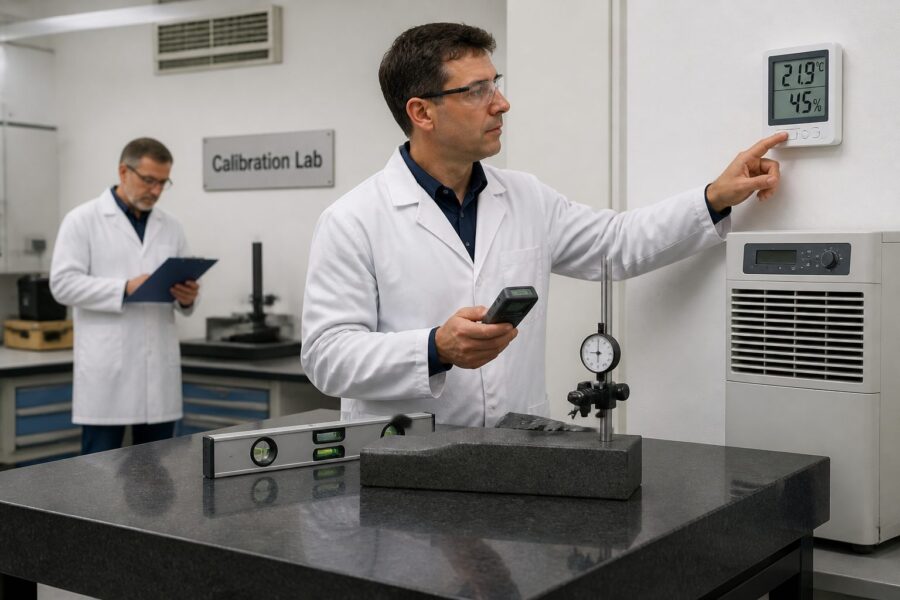
Invisible moisture is insidious, degrading the plate’s surface over time without clear warning. Regular environmental monitoring with thermometers and hygrometers is your first defense. Knowing your dew point is a powerful tool.
Significant temperature swings between day/night or shifts increase condensation risk. These cycles cause the plate’s surface temperature to lag behind air temperature. Consistent conditions are always preferable.
Operators leaning over the plate can contribute to localized humidity. Human breath releases moisture, increasing the dew point above the measurement surface in still air. Such small details matter in precision environments.
Cultivate awareness of these environmental factors daily. It’s not just about calibrating the plate, but maintaining its environment for continued accuracy. Proactive vigilance prevents reactive cleaning and measurement errors.
Simple Monitoring: Where to Place Thermometers and Hygrometers
Effective environmental monitoring doesn’t require complex systems; a few strategically placed instruments suffice. The goal is to understand actual conditions directly affecting your granite surface plate, not just general room temperature or humidity. Localized data provides actionable insights.
Know the plate’s temperature, the ambient air around it, and humidity levels in that zone. Correct sensor placement provides a true picture of your metrology microclimate, key to proactive condensation control and thermal stabilization.
- Directly on the plate surface (non-contact IR thermometer or small probe)
- Ambient air, 6-12 inches above the plate
- Near incoming HVAC vents or open doorways
- Adjacent to any heat-generating equipment
- At workpiece staging areas for acclimation checks
- Near operator workstations to gauge human influence
- At different heights if plate is exceptionally large
Practical Steps to Reduce Temperature Gradients
Reducing temperature gradients is a continuous effort yielding significant measurement accuracy returns. Small, consistent actions prevent subtle warpage and distortion, creating a stable micro-environment for your critical reference plane.
Shield the plate from direct heat sources like sunlight, heat lamps, or radiant machinery heat. Use curtains, blinds, or physical barriers to block these thermal assaults.
Protect the plate from cold air drafts from AC vents or open doors. Localized cold spots create significant temperature differentials, causing uneven contraction. Redirecting airflow or baffling vents minimizes this impact.
Use an insulating cover for your granite surface plate when not in use. This buffers the plate from ambient temperature swings and contaminants, maintaining a more stable temperature. A cover acts like a thermal blanket, reducing temperature change.
Pre-conditioning workpieces and instruments mitigates gradients. Never place parts significantly colder or warmer than the plate directly on it. Allow all items to acclimate to room and plate temperature for several hours, or overnight, before critical work.
Consistent ambient room temperature is fundamental. While perfectly controlled environments are ideal, a reasonably stable temperature (e.g., ±2°F) is better than wild fluctuations. Your HVAC system is crucial for metrology support.
Position your granite surface plate away from exterior walls, which have greater temperature swings. Interior locations offer a more thermally stable environment, reducing external influences on your precision setup.
Your body heat can create localized gradients if you lean over the plate. Take breaks, step back, and allow the air to re-equilibrate. Even subtle human presence influences sensitive measurements.
These steps cultivate a metrology mindset, not just prevent errors. Every action to reduce temperature gradients contributes to reliable data and greater confidence, investing in your quality control process integrity.
Airflow and Vents: When “Comfort Air” Hurts Consistency
Comfort air systems can harm metrology precision. HVAC vents, fans, and open windows create localized airflow patterns that disrupt granite surface plate thermal stability. What feels like ‘comfort air’ can introduce significant measurement errors.
Direct air blasts (warm or cold) create immediate temperature gradients. A cold draft on one corner will cause contraction, subtly distorting flatness. Uneven cooling or heating is a silent killer of accuracy.
The solution isn’t turning off HVAC or sealing the room. Instead, manage airflow around the plate by redirecting vents with diffusers, installing baffles, or strategically placing screens to break up direct air currents.
Aim for gentle, consistent, indirect air movement around the plate to promote uniform temperature without localized hot/cold spots. Create a buffered zone where air temperature changes slowly and evenly, supporting thermal stabilization without sacrificing comfort.
Even ambient room fans, if pointed directly at the plate, create problems. They introduce uncontrolled airflow and temperature differences. Repositioning or using oscillating fans that don’t focus air on the plate can help.
Consider plate placement relative to high-traffic areas or doorways. Opening a door creates a rush of air significantly different in temperature and humidity. Minimizing these external influences is key to effective environmental monitoring.
Prioritizing human comfort often overlooks subtle impacts on precision equipment. Slight adjustments to vent direction or adding a barrier can profoundly improve measurement consistency. It’s about balancing a productive and precise environment.
Airflow management is critical for ‘granite surface plate humidity and temperature effects.’ Controlling air movement mitigates temperature gradients and reduces condensation risk by preventing localized cooling. It’s a multi-faceted approach to maintaining metrology integrity.
Cleaning After Moisture Events Without Spreading Minerals
Despite control efforts, moisture events can occur. When condensation appears, immediate and correct cleaning is crucial to prevent mineral residue spread and maintain surface integrity. Haphazard cleaning can do more harm, leaving abrasive contaminants.
Never use tap water or household cleaners on your plate. Tap water contains dissolved minerals that leave microscopic deposits upon evaporation. These residues degrade flatness over time and must be avoided.
Use a specialized granite surface plate cleaner or denatured alcohol, formulated to evaporate cleanly without residue. These solutions effectively remove moisture and contaminants without introducing new ones. Always verify suitability for metrology-grade granite.
When wiping, use clean, lint-free, non-abrasive cloths or specialized wipes. Ensure microfiber cloths are clean and grit-free. Dirty or abrasive cloths can scratch the polished surface, permanently damaging accuracy.
Spray cleaner onto a clean cloth, not directly on the plate. Wipe in a single, overlapping direction to push contaminants off the edge. Change cloths frequently to avoid re-depositing residue.
After cleaning, allow the plate to air dry completely, or gently wipe with a separate, absolutely dry, lint-free cloth. Do not rush drying; ensure no moisture remains, especially in grooves or around inserts, to prevent new residue.
Regular, preventative cleaning removes airborne dust and microscopic particles. Incorporate a quick wipe-down with an approved cleaner into daily or weekly routines. This proactive maintenance extends your granite surface plate’s life and accuracy.
Meticulous cleaning is critical for managing ‘granite surface plate humidity and temperature effects.’ Properly addressing moisture events protects your investment and ensures reliable calibration standards. Precision requires attention to every detail.
Scheduling Work: Timing Sensitive Layouts for Stable Conditions
Timing sensitive measurement and layout tasks dramatically impacts accuracy, especially with ‘granite surface plate humidity and temperature effects.’ Intelligent scheduling optimizes metrology results by leveraging periods of maximum environmental stability.
Identify stable environmental periods (e.g., off-peak hours, after consistent HVAC operation). Avoid scheduling critical measurements during high environmental flux, like after door openings, shift changes, or AC startup. These are periods of maximum instability.
Allow ample time for workpieces and instruments to achieve thermal stabilization on the plate before critical work. This isn’t quick; large parts may need hours or overnight acclimation. Rushing introduces thermal errors.
Consider the entire measurement setup as a single thermal system: plate, workpiece, gauges, indicators, and operator proximity. All components need thermal equilibrium for reliable results. This holistic view is essential for high-precision tasks.
Integrate environmental monitoring data into scheduling. If sensors show significant temperature or humidity swings, postpone sensitive work until conditions stabilize. Real-time data helps make informed decisions about metrology readiness.
For tight tolerances, implement ‘soak’ periods where the room, plate, and parts are undisturbed. This allows everything to settle into uniform temperature, minimizing internal stresses or gradients—a commitment to precision that pays off.
Educate your team on scheduling importance. Understanding why tasks are timed fosters precision and best practices, ensuring everyone appreciates environmental stability’s impact on their work.
Consciously timing sensitive layouts and inspections actively mitigates environmental challenges. This proactive metrology schedule management directly invests in product quality and consistency—an easy win for precision.
Setting Reasonable Environmental Targets for Your Space
Ideal metrology labs have tight temperature and humidity control, but this is often unrealistic for manufacturing. Setting reasonable, achievable environmental targets for your space is more practical than chasing perfection. The goal is consistent improvement, not flawless control.
ISO 1 specifies 20°C (68°F) as the reference temperature for industrial length measurements—the gold standard. Efforts to approach and maintain this stability are beneficial, providing a clear objective for thermal stabilization.
For temperature, target ±1°C (±2°F) from 20°C, consistently. For humidity, aim for 40-60% relative humidity. This range is comfortable and reduces condensation/corrosion risk, balancing precision and practicality.
Consistency is crucial, not hitting an exact number. A room consistently at 22°C (71.6°F) with 55% humidity is better than one fluctuating wildly, even if its average is 20°C. Stability is paramount for reliable measurements.
Understand current environmental conditions through diligent monitoring. Use data to identify patterns, problems, and achievable improvements. This data-driven approach informs decisions on where to invest efforts for maximum impact.
Small consistency improvements yield significant gains in reliability and reduced scrap. Simple measures like better insulation, sealing drafts, or optimizing HVAC schedules can yield good results without massive capital expenditure. Every step towards stability is a step towards quality.
Regularly review monitoring data and adjust targets/strategies as needed. Shop conditions change seasonally or with new equipment, requiring adaptation. This continuous improvement mindset optimizes your metrology environment for precision over time.
Setting realistic goals for managing ‘granite surface plate humidity and temperature effects’ empowers your team to own measurement accuracy. It transforms environmental control into an actionable part of quality assurance. This focus on practical targets elevates metrology practices.
Conclusion
Maintaining precision measurements on a granite surface plate requires more than cleanliness. It demands awareness and proactive management of environmental factors. Understanding ‘granite surface plate humidity and temperature effects’ is fundamental for reliable metrology.
While granite is thermally stable, temperature gradients cause subtle distortion, impacting flatness and accuracy. Humidity, through condensation and mineral residue, threatens the plate’s long-term precision. Both demand vigilant attention and practical solutions.
From thermal stabilization and condensation control to airflow management and strategic scheduling, every step contributes to a stable measurement environment. Simple, correctly used monitoring tools provide critical data for informed decisions. These efforts create a robust system for precision.
Setting and pursuing reasonable environmental targets transforms your metrology space into a controlled one. This commitment to consistency translates into higher quality products, reduced scrap, and greater confidence. Precision investment starts with your foundation.
Don’t let unseen environmental forces compromise precision. Take control of your metrology environment with these strategies. Your granite surface plate is a critical asset; protect its accuracy to ensure it remains a reliable benchmark.
Proactive environmental management is integral to high-precision operations. Embrace these principles to elevate measurement quality and consistency. This dedication distinguishes professional shops.
For assistance with environmental monitoring, thermal stabilization, or granite surface plate calibration, reach out to our experts. We can assess your conditions and implement tailored solutions to meet your metrology needs, supporting your pursuit of ultimate precision.