
Reading a surface plate calibration certificate can feel like deciphering a secret code, full of numbers and technical jargon. However, this document is incredibly important for anyone relying on a surface plate for precise measurements. Understanding its contents ensures your quality control processes are sound and your measurements are trustworthy.
This certificate is your assurance that the granite surface plate meets specific accuracy standards, which is non-negotiable in metrology. We will walk through each critical section, explaining what the data means and how you can use it to maintain confidence in your equipment.
You have to know how to interpret this document to ensure your inspection tools are up to par. A complete and accurate surface plate calibration certificate is a cornerstone of reliable metrology.
What a Calibration Certificate Is Meant to Prove
A calibration certificate serves as official proof that your surface plate has been tested against recognized standards. It confirms the plate’s current condition regarding its flatness and overall accuracy. Without this document, you cannot definitively say your measurements are reliable.
This report establishes a clear chain of comparison back to national or international measurement standards. This concept, known as traceability, is fundamental to metrology and quality systems. Traceability ensures that every measurement you take can be linked back to a universally accepted unit of measure.
The certificate validates that a qualified technician performed the calibration using certified equipment. This means the process followed established procedures, minimizing potential errors. It gives you assurance that the results are not just arbitrary numbers.
It also provides a snapshot of your surface plate’s condition at a specific moment in time. This historical data helps you track wear and tear over time, informing future maintenance or replacement decisions. Regular calibration is not just a formality; it is a critical part of maintaining measurement integrity.
Ultimately, the surface plate calibration certificate protects your work from disputes about measurement accuracy. It stands as a verifiable record for audits, customer requirements, or internal quality checks. You can confidently claim your measurements are correct when backed by a solid certificate.
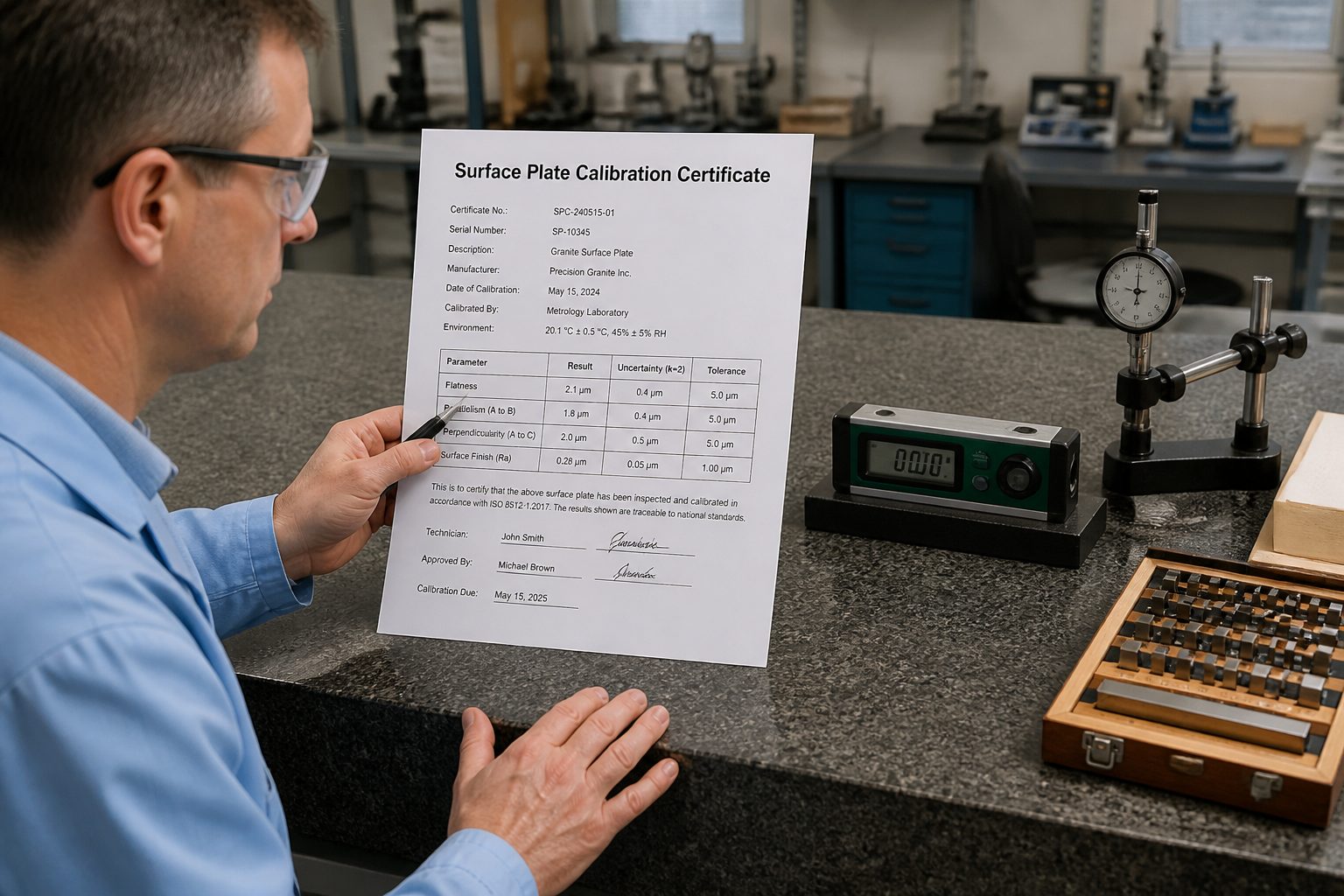
Key Identification Details You Should Verify
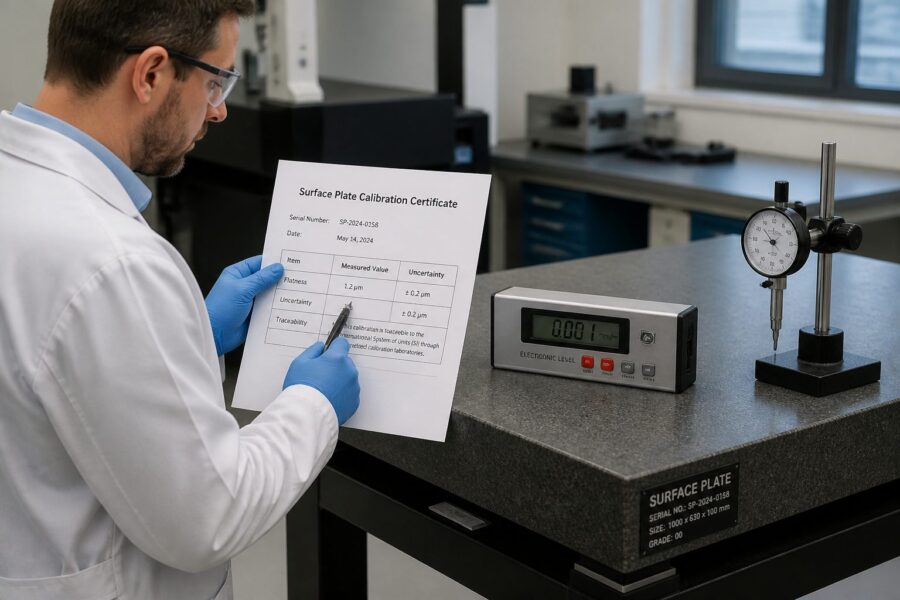
Every surface plate calibration certificate should clearly identify the specific piece of equipment being calibrated. Look for the manufacturer, model number, and a unique serial number or asset ID. These details confirm the report belongs to your particular surface plate.
You should also verify the calibration date and the recommended recalibration due date. This helps you track compliance and schedule future services. It is your responsibility to ensure these dates are current and align with your internal quality schedule.
| Detail | Why it matters | What to check |
|---|---|---|
| Manufacturer | Confirms plate origin | Matches plate’s nameplate |
| Model Number | Identifies specific type | Matches plate’s specifications |
| Serial Number/Asset ID | Unique identification | Matches plate’s engraved number or tag |
| Size/Dimensions | Verifies plate physical size | Matches actual plate measurements |
| Calibration Date | When test was performed | Must be recent and valid |
| Next Due Date | When next test is needed | Aligns with your quality policy |
| Certificate Number | Unique report identifier | For filing and easy reference |
Understanding “As Found” and “As Left” Results
The terms “as found” and “as left” are critical on any surface plate calibration certificate. “As found” results reflect the condition of your surface plate exactly as the technician received it, before any adjustments or cleaning. This data tells you how accurate your plate was during your last period of use.
If the “as found” results are outside acceptable tolerances, it means any measurements you took since the last calibration might be compromised. This is why understanding this section is so important for quality assurance. You need to assess the impact of these deviations on past work.
“As left” results, on the other hand, show the condition of the surface plate after the technician has performed all necessary cleaning, lapping, and adjustments. This represents the plate’s accuracy when it is returned to service. These are the numbers you will use going forward.
Ideally, the “as left” results should fall well within your specified tolerance limits. If they do not, it indicates that the plate could not be brought back into specification, or that the calibration service was incomplete. Always compare both sets of data to understand the changes.
The difference between the “as found” and “as left” values can also indicate how much wear and tear your plate experiences between calibrations. A significant difference might suggest you need more frequent calibration intervals. This helps you manage your metrology assets more effectively.
Flatness Results: How to Interpret the Numbers
The flatness results are the heart of your surface plate calibration certificate. These numbers quantify how flat the working surface truly is, usually expressed in microinches or micrometers. You need to understand these values to ensure your plate meets your required grade.
Surface plates are graded based on their flatness tolerance, such as Grade AA (laboratory master), Grade A (inspection), or Grade B (toolroom). Your certificate should state the achieved flatness and the corresponding grade. Make sure this matches your application’s needs.
The report often includes a graphical representation, like a contour map, showing the high and low spots across the plate surface. This visual aid helps you identify any localized areas of concern. It is much easier to see problem zones with a map than with just raw numbers.
The overall flatness deviation is typically reported as the maximum variation between any two points on the surface. This single number is often the most important for quick assessment. You must confirm this value is within your specified tolerance for the plate’s grade.
Some certificates also detail repeat reading (or local) accuracy, which measures the flatness within smaller, specific areas. This is important for precise gaging where instruments might only contact a small portion of the plate. Both overall and local flatness contribute to the plate’s utility.
Uncertainty: What It Means for Your Measurements
The uncertainty statement on a surface plate calibration certificate quantifies the doubt associated with the reported calibration results. No measurement is perfectly exact; there is always some degree of uncertainty. This section tells you how much you can trust the numbers provided.
Understanding the uncertainty statement is critical because it directly impacts the reliability of your own measurements. If the calibration uncertainty is too high, it might obscure small deviations in your parts. This could lead to incorrect acceptance or rejection decisions.
- Identifies potential error sources in calibration
- Quantifies the range of possible true values
- Helps evaluate the overall measurement process
- Ensures compliance with metrological standards
- Informs decisions on measurement capability
Environmental Conditions Listed on the Report
The environmental conditions section details the temperature, humidity, and atmospheric pressure in the calibration laboratory during the test. These factors significantly influence measurement accuracy, especially for highly precise instruments like surface plates. Granite expands and contracts with temperature changes.
Standard calibration often occurs at 20°C (68°F), known as the reference temperature. If your surface plate is calibrated at a different temperature, the report should note this and ideally include any compensation applied. You should operate your plate as close to this reference temperature as possible for consistent results.
Humidity also plays a role, particularly for optical measurements or when using certain types of gaging equipment. Extreme humidity can affect instrument stability and even the surface condition of the plate over time. The reported humidity ensures conditions were stable during testing.
Atmospheric pressure is less critical for surface plate flatness but can affect other related metrology equipment, such as air bearings or pneumatic gaging. Listing all three environmental factors confirms that the calibration was performed under controlled, documented conditions. This builds confidence in the results.
Always compare the reported environmental conditions to your own facility’s operating environment. Significant differences might introduce measurement errors when you use the plate. You want your working conditions to match the calibration conditions as closely as possible to minimize uncertainty.
Standards and Methods: What to Look For
A reputable surface plate calibration certificate will clearly list the standards and methods used during the calibration process. This section tells you which national or international documents guided the technician’s work. It is essential for ensuring the validity and traceability of the calibration.
Look for references to recognized standards bodies like ISO, ANSI/ASME, or NIST. For surface plates, common standards include ASME B89.3.7 for methods of measurement and ISO 8512-2 for flatness measurement. These standards define the procedures and acceptance criteria.
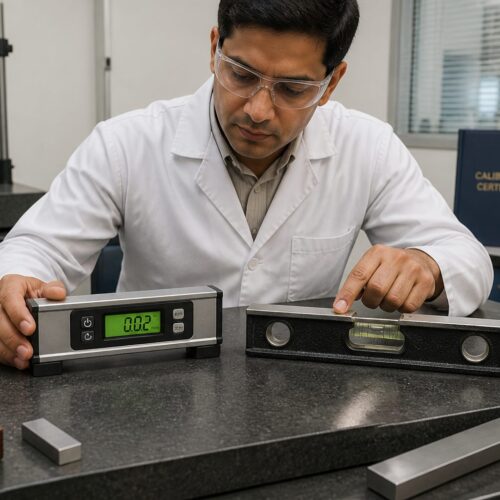
The certificate should also detail the specific instruments used for calibration, such as autocollimators, electronic levels, or laser interferometers. Each instrument should have its own calibration certificate, establishing a clear chain of traceability back to primary standards. You want to see that the tools used were themselves accurate.
The method section might describe the specific measurement pattern, like a “star” or “grid” method, along with the number of points measured. More measurement points generally lead to a more comprehensive assessment of flatness. This level of detail confirms a thorough job was done.
Verifying these details ensures that the calibration was performed correctly and consistently according to industry best practices. If this section is vague or missing, it is a significant red flag. A proper surface plate calibration certificate is transparent about its methodology.
Pass/Fail Statements and What They Actually Cover
Many surface plate calibration certificates include a pass/fail statement, which at first glance seems straightforward. However, it is important to understand what this statement truly means and what criteria it is based upon. A simple “pass” might not always align with your specific needs.
The pass/fail determination is usually made against a predefined tolerance specified by the customer or a default industry standard. You should confirm that the tolerance used for the pass/fail judgment matches your required grade for the surface plate. For example, a plate passing Grade B might fail if you need Grade A.
Sometimes, the certificate will explicitly state the tolerance limits used for the pass/fail decision. Always compare these limits to the actual “as left” flatness results. This allows you to independently verify the technician’s conclusion against the raw data.
A pass/fail statement typically applies to the overall flatness and possibly repeat reading accuracy. It usually does not cover other aspects like surface finish or physical damage, which you would need to inspect separately. The statement is focused on metrological performance.
If the plate fails, the certificate should indicate which specific parameters were out of tolerance. This information is important for deciding whether the plate can be reconditioned, repaired, or needs replacement. A clear surface plate calibration certificate helps you make informed decisions about your equipment’s future.
Red Flags That Suggest a Weak or Incomplete Report
Not all surface plate calibration certificates are created equal, and some might lack the necessary detail or credibility. You need to be able to spot red flags that indicate a weak or incomplete report. Ignoring these could compromise your quality system.
One major red flag is the absence of an “as found” reading, especially if the plate was found out of tolerance. Without this data, you cannot assess the impact of past inaccurate measurements. A complete surface plate calibration certificate always includes both “as found” and “as left” results.
Another concern is a missing or vague uncertainty statement. As discussed, measurement uncertainty is fundamental to metrology. If the report does not quantify this, you cannot fully trust the reported flatness values. This omission reduces the certificate’s value significantly.
Watch out for certificates that do not clearly list the specific standards and methods used for calibration. Generic statements like “calibrated to industry standards” are insufficient. You need to see specific reference documents to ensure proper procedures were followed.
Finally, a certificate without the calibrating technician’s signature, the lab’s accreditation body logo, or a unique certificate number is suspect. These elements provide crucial authentication and traceability. A legitimate surface plate calibration certificate will always include these identifying marks.
How to File and Reference Certificates for Traceability
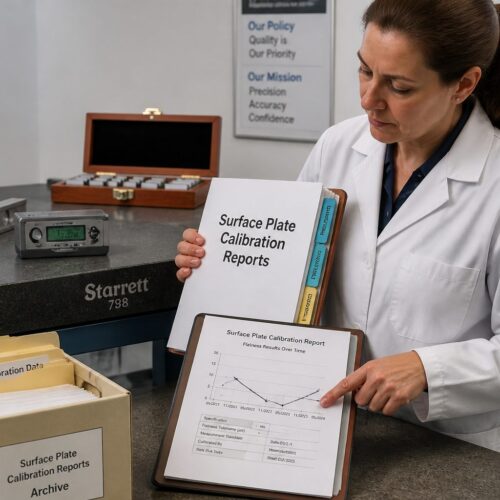
Properly filing and referencing your surface plate calibration certificates is essential for maintaining a robust quality system and ensuring traceability. These documents are not just pieces of paper; they are vital records that support your measurement claims. Organize them carefully for easy retrieval.
Establish a consistent filing system, whether physical or digital, that allows quick access to any certificate. Many organizations assign a unique asset ID to each surface plate and file its corresponding certificates under that ID. This ensures you can always link the document to the specific equipment.
When you use your surface plate for critical measurements, especially for customer-facing reports or quality audits, you should reference the current surface plate calibration certificate. Include the certificate number, calibration date, and next due date in your documentation. This provides clear traceability for your measurements.
Regularly audit your calibration records to ensure all equipment is current and within its calibration cycle. Expired certificates mean your equipment is no longer verified, which can lead to non-conformances in quality systems. Staying on top of these dates is a simple but important task.
Maintaining a well-organized system for your surface plate calibration certificate records also helps with historical analysis. You can track the performance of your plates over time, identify trends, and optimize your recalibration intervals. This proactive approach saves time and money in the long run.
Conclusion
Navigating a surface plate calibration certificate might seem daunting at first, but with a clear understanding, it becomes a powerful tool for quality assurance. Each section holds valuable information that directly impacts the reliability of your metrology operations. You are now equipped to interpret these reports with confidence.
Remember to always verify key identification details, pay close attention to “as found” and “as left” results, and carefully interpret the flatness figures. The uncertainty statement is not just a formality; it tells you how much trust to place in the numbers. Environmental conditions, standards, and methods provide context and credibility.
A pass/fail statement is helpful, but you must understand the underlying criteria. Be vigilant for red flags that suggest an incomplete or unreliable report, as these can undermine your entire measurement process. Your due diligence here protects your work and your reputation.
Finally, maintaining meticulous records of your surface plate calibration certificate documents ensures complete traceability for all your measurements. This organized approach is essential for audits, internal quality control, and demonstrating compliance with industry standards. It truly matters for precision work.
Embrace the details within each certificate, as they empower you to make informed decisions about your precision equipment. A well-understood surface plate calibration certificate is not just paperwork; it is a foundational element of accurate and reliable metrology. Your confidence in your measurements depends on it.